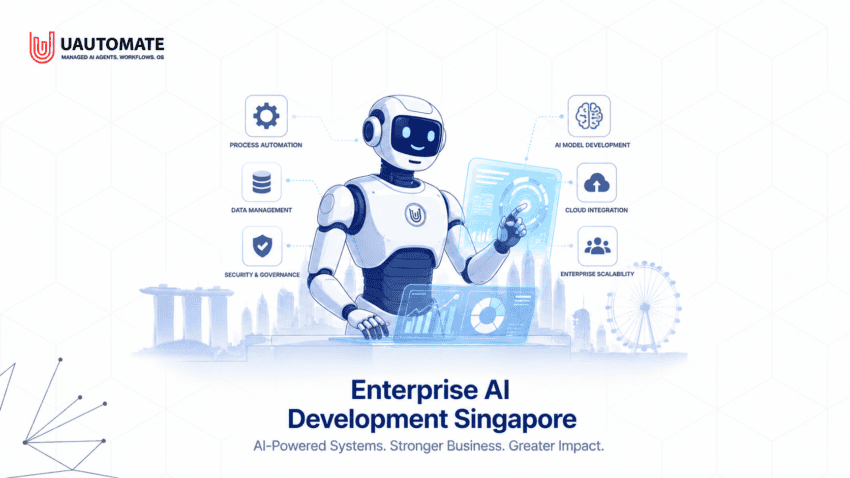
Enterprise AI Development Singapore is no longer just a technology trend – it has become a strategic business initiative for organizations looking to improve efficiency, enhance customer experiences, and make faster, data-driven decisions. As digital transformation accelerates across industries, enterprises are adopting Artificial Intelligence (AI) to automate complex workflows, analyze vast amounts of business data, and unlock new opportunities for innovation.
From financial institutions and healthcare providers to manufacturing companies and retail businesses, organizations in Singapore are embracing AI to stay competitive in an increasingly dynamic market. Unlike traditional software solutions that follow predefined rules, enterprise AI systems learn from data, adapt to changing business environments, and continuously improve their performance over time. This enables businesses to move beyond basic automation and build intelligent ecosystems that support long-term growth.
The increasing demand for Enterprise AI Solutions Singapore reflects this shift. Businesses are no longer looking for standalone AI tools; they want scalable solutions that integrate with their existing systems, solve real operational challenges, and deliver measurable returns on investment. Whether it’s optimizing customer support with AI-powered assistants, streamlining internal operations through intelligent automation, or enabling executives to make smarter strategic decisions, enterprise AI is reshaping the way modern organizations operate.
In this comprehensive guide, we’ll explore what enterprise AI really means, why it’s becoming essential for businesses in Singapore, the technologies driving its adoption, and how organizations can successfully implement AI to achieve sustainable digital transformation.
Why Has Enterprise AI Become a Business Priority?
Every organization today generates an enormous amount of data. Customer interactions, sales transactions, financial records, operational metrics, employee activities, and digital communications all contribute to an ever-growing stream of information. While this data holds valuable business insights, extracting meaningful intelligence from it has become increasingly challenging.
At the same time, businesses face several operational pressures:
- Rising customer expectations for faster and personalized services
- Increasing operational costs
- Complex regulatory requirements
- Global competition
- Talent shortages in specialized roles
- The need to make business decisions in real time
Traditional software systems are excellent at processing predefined tasks, but they cannot learn from historical data, predict future outcomes, or adapt to changing conditions. This limitation has led many enterprises to invest in AI-powered solutions that combine automation with intelligence.
Rather than replacing existing systems, enterprise AI enhances them. It connects data from multiple business applications, identifies patterns that humans may overlook, and recommends actions that improve efficiency and business performance.
For many organizations, Enterprise AI is no longer viewed as an optional innovation project – it is becoming an essential component of long-term business strategy.
Understanding Enterprise AI Development
Enterprise AI Development involves designing, building, integrating, and deploying artificial intelligence solutions that solve large-scale business challenges. Unlike consumer-facing AI applications, enterprise AI is created to support complex organizational processes while integrating seamlessly with systems such as ERP platforms, CRM software, HR management systems, financial applications, and cloud infrastructure.
The objective is not simply to automate repetitive tasks but to enable businesses to become more intelligent in how they operate.
For example, instead of manually reviewing thousands of invoices, AI can automatically extract information, validate records, identify anomalies, and route approvals to the appropriate stakeholders. Similarly, customer support teams can use AI to categorize enquiries, suggest responses, and provide instant assistance through intelligent virtual agents.
Enterprise AI also enables executives to access real-time dashboards that analyze business performance, forecast future trends, and support strategic planning using predictive insights.
This shift from manual decision-making to AI-assisted intelligence allows organizations to improve operational efficiency while reducing costs and minimizing human error.
Enterprise AI vs Traditional Business Automation
Many organizations assume that business automation and enterprise AI are the same. While both aim to improve efficiency, they operate very differently.
Traditional automation focuses on executing repetitive tasks based on predefined rules. Enterprise AI, on the other hand, combines automation with machine learning, predictive analytics, and intelligent decision-making.
| Traditional Automation | Enterprise AI Development |
| Executes predefined tasks | Learns and improves using business data |
| Follows fixed workflows | Adapts to changing conditions |
| Requires manual rule updates | Continuously optimizes performance |
| Limited decision-making | Supports predictive and intelligent decisions |
| Handles repetitive work | Solves complex business problems |
This evolution allows businesses to transition from simply automating work to building intelligent systems that actively contribute to business growth.
Core Technologies Powering Enterprise AI
Enterprise AI is not a single technology. It is a combination of multiple AI capabilities working together to create intelligent business solutions.
Machine Learning
Machine Learning enables systems to learn from historical data and improve their predictions over time without being explicitly programmed for every scenario.
Businesses commonly use machine learning for:
- Sales forecasting
- Fraud detection
- Customer segmentation
- Predictive maintenance
- Inventory optimization
- Risk analysis
As more data becomes available, machine learning models continuously improve their accuracy, making them valuable for organizations that rely on data-driven decision-making.
Natural Language Processing (NLP)
Natural Language Processing allows computers to understand and process human language. It forms the foundation of intelligent chatbots, document processing systems, voice assistants, and multilingual customer support platforms.
Within enterprises, NLP is commonly used to:
- Automate document classification
- Analyze customer feedback
- Extract insights from contracts and reports
- Enable intelligent enterprise search
- Improve customer communication
By reducing the need for manual text analysis, NLP significantly improves productivity across departments.
Predictive Analytics
Predictive analytics combines statistical models with AI algorithms to forecast future events based on historical and real-time data.
Organizations use predictive analytics to:
- Forecast product demand
- Predict customer churn
- Estimate financial performance
- Identify operational risks
- Optimize workforce planning
Rather than reacting to problems after they occur, businesses can anticipate future outcomes and prepare accordingly.
Intelligent Workflow Automation
One of the fastest-growing areas of AI Automation Singapore is intelligent workflow automation.
Unlike conventional workflow software that simply follows predefined rules, AI-powered automation analyzes business processes, identifies inefficiencies, prioritizes tasks, and continuously improves workflow execution.
For example, an AI-driven procurement workflow can automatically evaluate supplier performance, identify purchasing trends, recommend vendors, and streamline approval processes without constant human intervention.
This results in faster operations, reduced administrative workload, and improved overall efficiency.
Generative AI
The rapid adoption of Generative AI Development Singapore is enabling organizations to automate knowledge-intensive tasks that previously required significant manual effort.
Generative AI can assist businesses by:
- Drafting reports and proposals
- Summarizing lengthy documents
- Creating technical documentation
- Generating software code
- Assisting customer service teams with response suggestions
- Supporting internal knowledge management
Rather than replacing employees, generative AI acts as an intelligent assistant that enhances productivity and accelerates daily business operations.
How Enterprise AI Creates Value Across Business Functions?
One of the greatest advantages of enterprise AI is that its benefits extend beyond a single department. Instead of solving isolated problems, AI creates an interconnected business ecosystem where data, processes, and people work together more efficiently.
For leadership teams, AI provides real-time visibility into business performance through predictive dashboards and advanced analytics, enabling faster and more confident decision-making. Sales and marketing teams use AI to identify high-value prospects, personalize customer interactions, forecast revenue, and optimize campaign performance.
Finance departments benefit from automated invoice processing, fraud detection, financial forecasting, and compliance monitoring, reducing manual effort while improving reporting accuracy. Human Resources teams leverage AI to streamline recruitment, automate resume screening, enhance employee onboarding, and analyze workforce trends.
Customer support has also evolved significantly through AI Agents Development Singapore. Modern AI agents go beyond answering simple questions – they understand context, retrieve relevant business information, guide users through complex processes, and escalate conversations when human expertise is required. This results in faster response times, consistent service quality, and improved customer satisfaction.
As organizations continue expanding their digital capabilities, working with an experienced AI Company Singapore becomes increasingly important. A trusted partner can design customized enterprise AI solutions that align with business objectives, integrate with existing infrastructure, and scale alongside organizational growth. Companies like UAutomate help enterprises move beyond experimentation by developing AI solutions tailored to their operational needs, ensuring measurable business outcomes and long-term value.
Enterprise AI Across Key Industries
While every organization has unique business goals, the impact of Enterprise AI is visible across almost every industry. The ability to analyze massive datasets, automate repetitive processes, and generate actionable insights allows businesses to improve efficiency while delivering better customer experiences.
Let’s explore how different sectors are benefiting from Enterprise AI.
Financial Services
Banks, insurance companies, and financial institutions process millions of transactions every day. Monitoring these transactions manually is not only time-consuming but also increases the risk of fraud and compliance issues.
Enterprise AI helps financial organizations by:
- Detecting fraudulent transactions in real time
- Automating loan eligibility assessments
- Improving credit risk analysis
- Providing AI-powered financial recommendations
- Streamlining regulatory compliance reporting
Instead of relying solely on historical reports, AI enables financial institutions to proactively identify risks and improve operational efficiency.
Healthcare
Healthcare organizations generate enormous volumes of patient records, diagnostic reports, appointment schedules, and clinical documentation.
Enterprise AI supports healthcare providers by:
- Assisting with medical image analysis
- Automating appointment scheduling
- Predicting patient admission rates
- Supporting doctors through clinical decision systems
- Managing healthcare documentation more efficiently
Rather than replacing healthcare professionals, AI helps them spend more time delivering quality patient care.
Retail and E-commerce
Retail businesses operate in an environment where customer expectations constantly evolve.
Enterprise AI helps retailers by:
- Personalizing shopping experiences
- Forecasting product demand
- Optimizing inventory management
- Improving recommendation engines
- Automating customer support
For example, AI can analyze customer purchase history, browsing behaviour, and seasonal demand to recommend products that customers are most likely to buy.
Manufacturing
Manufacturers use Enterprise AI to improve productivity while minimizing downtime.
Some common applications include:
- Predictive equipment maintenance
- Production quality monitoring
- Supply chain optimization
- Demand forecasting
- Factory process automation
Instead of reacting to machine failures after production stops, AI predicts equipment maintenance requirements before breakdowns occur.
Logistics and Supply Chain
Modern supply chains involve multiple vendors, warehouses, transportation networks, and distribution centres.
Enterprise AI enables logistics companies to:
- Optimize delivery routes
- Predict shipment delays
- Improve warehouse operations
- Forecast inventory demand
- Reduce transportation costs
This creates a more resilient and efficient supply chain capable of adapting to market fluctuations.
Building a Successful Enterprise AI Strategy
Implementing AI successfully requires much more than selecting the latest technology. Organizations that achieve the highest return on investment begin with a clearly defined business strategy.
A successful Enterprise AI initiative should focus on solving measurable business problems rather than deploying AI for the sake of innovation.
Before implementation, organizations should evaluate:
- Which business processes consume the most time?
- Where are operational bottlenecks occurring?
- Which departments generate the largest volumes of repetitive work?
- What business outcomes should AI improve?
- How will success be measured?
By answering these questions early, businesses can prioritize high-impact AI projects instead of attempting enterprise-wide transformation all at once.
Enterprise AI Implementation Roadmap
Enterprise AI adoption is typically an ongoing journey rather than a one-time technology deployment.
A structured implementation roadmap helps organizations reduce risks while maximizing long-term value.
Step 1 – Identify Business Opportunities
Begin by identifying repetitive processes, operational inefficiencies, and decision-making challenges that AI can improve.
Examples include:
- Customer support automation
- Invoice processing
- Sales forecasting
- Knowledge management
- HR recruitment
Prioritizing use cases based on business impact creates a stronger foundation for AI adoption.
Step 2 – Assess Data Readiness
AI performs only as well as the data it receives.
Organizations should evaluate:
- Data quality
- Data accessibility
- Security policies
- Integration between existing systems
- Compliance requirements
Clean and well-structured data significantly improves AI accuracy.
Step 3 – Design the Right AI Solution
Not every business requires the same AI capabilities.
Depending on organizational goals, solutions may include:
- Machine Learning models
- Predictive Analytics
- Intelligent Document Processing
- AI Agents
- Computer Vision
- Generative AI applications
Selecting technologies that align with business objectives ensures better long-term outcomes.
Step 4 – Integrate AI with Existing Systems
One of the biggest advantages of enterprise AI is its ability to work alongside existing business applications.
Successful implementation often involves integration with:
- ERP systems
- CRM platforms
- HR software
- Accounting applications
- Cloud infrastructure
- Internal databases
Seamless integration minimizes disruption while accelerating adoption.
Step 5 – Monitor and Improve
AI systems continuously learn from business data.
Organizations should regularly evaluate:
- Model accuracy
- User adoption
- Workflow efficiency
- Business performance
- Customer satisfaction
Continuous improvement ensures AI evolves alongside changing business requirements.
Common Challenges During Enterprise AI Adoption
Although Enterprise AI offers significant benefits, implementation is not without challenges.
Understanding these obstacles helps organizations prepare more effectively.
Poor Data Quality
Incomplete, inconsistent, or outdated information reduces AI accuracy.
Businesses should establish strong data governance practices before deploying AI solutions.
Legacy Systems
Many enterprises continue using older software that wasn’t designed for AI integration.
Modern Enterprise AI platforms often require API integration or cloud modernization to connect with legacy infrastructure.
Employee Resistance
Employees sometimes fear AI will replace their roles.
Successful organizations position AI as a productivity tool that supports employees rather than replacing them.
Providing training and involving teams throughout implementation improves adoption.
Security and Compliance
Enterprise AI often processes sensitive customer and business information.
Organizations should implement:
- Strong encryption
- Access controls
- Compliance monitoring
- Responsible AI governance
- Regular security assessments
Protecting enterprise data remains a critical part of every AI initiative.
Business Goals and AI Solutions
The following table illustrates how Enterprise AI aligns with common organizational objectives.
| Business Goal | AI Solution | Business Impact |
| Reduce operational costs | Intelligent workflow automation | Faster processes with fewer manual tasks |
| Improve customer service | AI-powered customer assistants | 24/7 support and faster response times |
| Increase productivity | Enterprise AI Solutions | Better resource utilization and higher efficiency |
| Improve decision-making | Predictive Analytics | Real-time business intelligence |
| Accelerate innovation | Generative AI | Faster content creation and knowledge sharing |
| Scale business operations | AI-driven automation | Sustainable growth with lower operational overhead |
Rather than implementing isolated AI tools, successful organizations build integrated ecosystems where multiple AI technologies work together to achieve strategic business objectives.
Enterprise AI is not simply about adopting new software – it’s about creating a smarter organization capable of learning, adapting, and continuously improving in an increasingly competitive digital economy.
The Future of Enterprise AI in Singapore
As AI technologies continue to evolve, enterprises are moving beyond isolated automation projects and embracing AI as a core business capability. Organizations are no longer asking, “Should we invest in AI?” Instead, they’re asking, “How can AI create lasting business value across every department?”
Singapore’s strong digital infrastructure, government-led innovation initiatives, and growing technology ecosystem make it one of the leading hubs for enterprise AI adoption in Asia. Businesses that invest in AI today are positioning themselves to become more agile, resilient, and competitive in the years ahead.
Some of the emerging trends shaping the future of Enterprise AI include:
Autonomous AI Agents
Modern AI agents are becoming increasingly capable of handling multi-step business processes with minimal human intervention. Instead of simply responding to queries, these intelligent systems can retrieve enterprise knowledge, analyze business data, coordinate workflows, and execute tasks across multiple applications.
As AI Agents Development Singapore continues to evolve, businesses will increasingly rely on AI agents to improve operational efficiency while enhancing employee productivity.
Hyperautomation
Hyperautomation combines artificial intelligence, robotic process automation (RPA), analytics, and workflow orchestration to automate end-to-end business operations.
Rather than automating individual tasks, organizations can automate complete business processes—from receiving customer requests to generating reports and processing approvals.
AI-Powered Decision Intelligence
Future enterprise platforms will increasingly provide business leaders with predictive recommendations instead of historical reports.
Rather than asking “What happened?”, executives will receive insights such as:
- Which customers are most likely to churn?
- Which products will experience higher demand next month?
- Which operational risks require immediate attention?
- Which investment opportunities offer the highest potential returns?
This shift enables organizations to become proactive instead of reactive.
Responsible AI and Governance
As AI adoption grows, businesses must ensure their systems remain transparent, secure, and compliant.
Future Enterprise AI strategies will place greater emphasis on:
- Ethical AI development
- Data privacy
- Model transparency
- Bias monitoring
- Regulatory compliance
- Human oversight
Organizations that prioritize responsible AI will build stronger customer trust while reducing long-term business risks.
Choosing the Right AI Partner for Enterprise Transformation
Selecting the right technology partner is one of the most important decisions in any AI transformation journey.
Rather than focusing solely on technical capabilities, businesses should evaluate whether an AI partner understands their industry, business processes, and long-term objectives.
When evaluating an AI Company Singapore, consider the following questions:
- Do they develop custom AI solutions instead of offering one-size-fits-all products?
- Can they integrate AI with ERP, CRM, cloud platforms, and existing enterprise systems?
- Do they have experience working with enterprise-scale organizations?
- Can their solutions scale as your business grows?
- Do they provide post-deployment optimization and support?
- Do they follow responsible AI and data security best practices?
A reliable AI partner should work as a long-term technology advisor rather than simply delivering software.
At UAutomate, we believe Enterprise AI should solve real business problems—not create additional complexity. Our approach focuses on understanding your business objectives, identifying high-impact AI opportunities, and developing customized solutions that integrate seamlessly into your existing workflows. From intelligent automation and predictive analytics to enterprise-grade AI applications, UAutomate helps organizations accelerate digital transformation with scalable, future-ready AI solutions.
Conclusion
Enterprise AI is transforming the way modern organizations operate by combining intelligent automation, advanced analytics, and data-driven decision-making into a unified business strategy. Instead of viewing AI as a standalone technology initiative, successful enterprises are integrating AI across departments to improve operational efficiency, enhance customer experiences, reduce costs, and support long-term innovation.
Whether it’s automating repetitive workflows, improving financial forecasting, optimizing supply chains, or enabling intelligent customer support, Enterprise AI has become a catalyst for sustainable business growth. As technologies such as Generative AI Development Singapore, predictive analytics, and autonomous AI agents continue to mature, organizations that embrace AI today will be better equipped to respond to future challenges and opportunities.
The key to success lies in developing a clear AI strategy, building a strong data foundation, and implementing solutions that align with measurable business objectives. With the right approach and the right technology partner, Enterprise AI can become a powerful driver of innovation and competitive advantage.
Ready to Transform Your Business with Enterprise AI?
Artificial Intelligence is no longer limited to large technology companies. Businesses of every size can leverage Enterprise AI to streamline operations, enhance customer engagement, improve decision-making, and accelerate digital transformation.
Whether you’re exploring intelligent automation, AI-powered business applications, or enterprise-wide AI implementation, UAutomate delivers customized AI solutions designed around your business goals. Our team works closely with organizations to build scalable, secure, and future-ready AI systems that create measurable business value.
Frequently Asked Questions (FAQs)
1. What is Enterprise AI Development?
Enterprise AI Development is the process of designing, building, and implementing AI-powered solutions for large organizations. These solutions help automate workflows, analyze business data, improve decision-making, and increase operational efficiency across multiple departments.
2. How is Enterprise AI different from traditional automation?
Traditional automation follows predefined rules to perform repetitive tasks, while Enterprise AI can learn from data, recognize patterns, make predictions, and continuously improve its performance. This makes AI more adaptable and capable of solving complex business challenges.
3. Which industries benefit the most from Enterprise AI?
Enterprise AI is widely used across finance, healthcare, retail, manufacturing, logistics, telecommunications, education, and professional services. Any organization managing large volumes of data or repetitive business processes can benefit from AI implementation.
4. What are Enterprise AI Solutions?
Enterprise AI Solutions are customized AI applications that integrate with existing business systems to improve productivity, automate operations, enhance customer experiences, and provide data-driven insights for better decision-making.
5. How does AI Automation improve business operations?
AI automation reduces manual effort by automating repetitive workflows such as document processing, customer support, approvals, reporting, and inventory management. This allows employees to focus on higher-value activities while improving overall efficiency.
Connect with UAutomate today to discover how Enterprise AI can help your organization innovate, optimize, and grow with confidence.