Artificial intelligence is changing the way people use mobile and web applications. Apps are no longer limited to fixed menus, forms, and predefined actions. With the right AI capabilities, an application can understand natural-language questions, find information from business data, make recommendations, automate repetitive tasks, and support users in real time.
For a business looking for an AI App Development Company Indonesia, however, choosing a development partner is about more than finding someone who can connect an AI model to an application. The partner also needs to understand the business problem, user experience, data, integrations, security, and what the product will need after launch.
Indonesia is also paying increasing attention to AI capabilities and their use across different sectors. In July 2026, Indonesia’s Ministry of Communication and Digital discussed strengthening national AI capabilities and highlighted potential applications across areas including education, healthcare, financial services, and government.
So, if you are thinking about building an AI-powered application, where should you start?
This guide looks at the practical side of AI app development, including use cases, development stages, cost factors, technology considerations, and what to look for when selecting a development partner.
What Makes an AI App Different From a Conventional App?
A traditional application generally works around predefined rules. A user performs an action, the application processes it according to its programmed logic, and the system returns a result.
An AI-powered application can add another layer to that interaction. It can interpret natural language, identify patterns, retrieve relevant information, generate responses, or assist with decisions.
Here is a simple comparison:
| Area | Conventional Application | AI-Powered Application |
| User interaction | Mostly predefined flows | Can support natural-language interaction |
| Data handling | Structured queries and rules | Can work with structured and unstructured information |
| Recommendations | Usually rule-based | Can use AI-driven personalization |
| Customer support | FAQs and ticket systems | Context-aware AI assistance |
| Documents | Mostly manual processing | AI-assisted extraction and summarization |
| Search | Keyword-based | Semantic or conversational search |
| Automation | Fixed workflows | AI-assisted workflows and decisions |
| Knowledge access | Users search manually | AI can retrieve relevant information |
That does not mean every application needs AI.
In fact, adding AI just because it is currently popular can make a product more complicated and expensive without providing much value. The better approach is to identify a real problem first and then determine whether AI can solve it more effectively.
When Does an AI App Actually Make Sense?
Before contacting a development company, take a step back and look at the problem your business is trying to solve.
Ask yourself:
- Which tasks are repetitive?
- What questions do customers or employees ask again and again?
- Where are employees spending too much time searching for information?
- Which parts of the customer journey could be made easier?
- Does your business already have useful data that an AI system could work with?
- What result would make the project worthwhile?
A useful way to think about the decision is:
| Question | If the answer is “Yes” |
| Is there a repetitive or information-heavy task? | Investigate whether AI can improve it |
| Is useful business data available? | Assess how that data could support the AI |
| Can the process be improved measurably? | Define the expected business outcome |
| Is the use case technically feasible? | Start planning the solution |
| Is the business case still unclear? | Validate the problem before development |
This prevents a common mistake: starting with the technology instead of the business need.
For example, saying “We want to use an LLM in our app” is not a complete product requirement.
Saying “Our support team spends several hours every day answering the same product questions, and we want an AI assistant to handle routine queries” gives a development team something concrete to work with.
AI App Use Cases for Indonesian Businesses
There is no single type of AI application that works for every business. The right use case depends on the industry, customers, internal processes, available data, and desired outcome.
1. AI Customer Support Applications
Customer support is one of the more obvious areas where AI can make a practical difference.
An AI-powered support application can help customers find answers, classify requests, provide relevant information, and hand more complicated issues over to human staff.
For example, instead of forcing a customer to browse through several FAQ pages, an AI assistant could understand the question and provide an answer based on approved company information.
UAutomate AI’s chatbot solution describes capabilities including private knowledge bases, CRM integration, customer support automation, appointment scheduling, internal knowledge assistance, and business workflow connections.
2. AI Knowledge Applications
Businesses often have useful information spread across different places:
- PDFs
- SOPs
- websites
- databases
- internal documents
- knowledge bases
- customer records
Finding the right information can become difficult as the amount of data grows.
An AI knowledge application can give employees or customers a conversational way to find relevant information.
One approach used for this type of application is Retrieval-Augmented Generation (RAG). Instead of relying only on what an AI model already knows, the system retrieves relevant information from a connected knowledge source before generating a response.
UAutomate AI provides an AI Knowledge Assistant and RAG solution designed around business knowledge and internal information.
3. AI Document Processing
Many businesses still spend significant amounts of time working with documents.
AI can assist with tasks such as:
- extracting information
- classifying documents
- summarizing content
- organizing information
- answering questions about documents
The goal does not always have to be complete automation. In many cases, AI can handle the first stage of the work while employees review the output before it is finalized.
That can be particularly useful when there are large volumes of similar documents to process.
4. AI Recommendation Systems
AI can also help applications provide more personalized experiences.
Depending on the product, this could include:
- product recommendations
- content recommendations
- personalized learning
- service recommendations
- customer segmentation
The quality of these systems depends heavily on the available data and how well the recommendation logic matches the actual user journey.
5. AI Business Assistants
An AI business assistant can go beyond answering questions.
Depending on its permissions and integrations, it may be able to retrieve information from business systems or help initiate specific workflows.
For example:
Employee request → AI understands the request → relevant information is retrieved → permitted action is performed → result is returned
This type of setup requires careful consideration of permissions, integrations, security, and error handling.
6. AI-Powered Learning Applications
AI can also be used to create more personalized learning and training experiences.
For example, an AI learning platform could adapt learning paths, provide feedback, create roleplay scenarios, or help employees practice specific skills.
UAutomate AI’s learning platform describes personalized learning paths, AI roleplay scenarios, contextual feedback, and skill-focused learning experiences.
What Should You Look for in an AI App Development Company?
Choosing an AI development partner should involve more than looking at how attractive their previous applications look.
A strong partner needs to understand both product development and AI engineering.
The Six Capabilities to Evaluate
| Capability | Why It Matters |
| Product strategy | Helps connect the technology to a real business objective |
| App development | Builds the application users actually interact with |
| AI engineering | Helps select and implement appropriate AI technologies |
| Data engineering | Makes business information usable by the AI system |
| Integration | Connects the application with existing software |
| Testing and governance | Helps manage reliability, security, and performance |
1. Product Thinking
The development team should first understand your users, workflows, and objectives.
A useful question is:
“What problem are we solving, and why is AI the right way to solve it?”
The answer should come before choosing an AI model or development framework.
2. AI Engineering Expertise
Depending on the project, AI development may involve:
- Large Language Models
- machine learning
- Retrieval-Augmented Generation
- vector databases
- AI agents
- prompt engineering
- model evaluation
- APIs
- orchestration
The important point is that not every project requires all of these technologies.
The development team should choose the architecture according to the problem rather than trying to use every available AI technology.
Depending on the use case, an AI application may use LLM APIs, RAG, grounding, function calling, model evaluation, or other AI technologies. Google Cloud’s Generative AI documentation provides an overview of these approaches and their application in AI-powered systems.
3. Integration Capability
An AI application rarely works completely on its own.
It may need to connect with:
- CRM platforms
- ERP systems
- payment platforms
- databases
- websites
- calendars
- communication tools
- internal applications
UAutomate AI states that its production AI systems can be embedded into existing CRMs, applications, kiosks, and websites rather than requiring businesses to rebuild their entire systems.
4. Security and Governance
Security becomes particularly important when an AI application works with customer information, internal documents, financial data, or other sensitive information.
The NIST AI Risk Management Framework recommends considering trustworthiness throughout the design, development, deployment, use, and evaluation of AI systems.
For a business, this means security and governance should be discussed during planning—not added at the very end.
The AI App Development Journey: From Business Idea to Production
Developing an AI application is usually an iterative process. A good development team will often validate the idea first, build a smaller version, test it, and then expand the product based on what is learned.
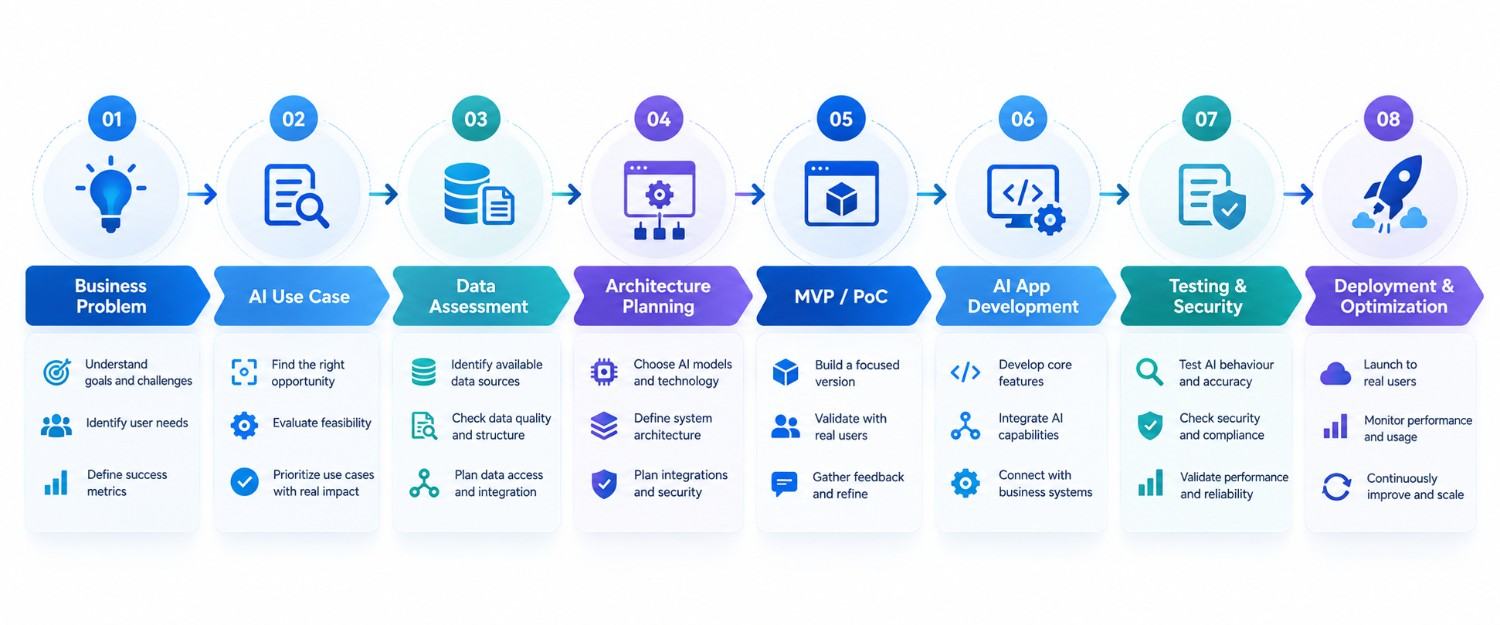
A Practical AI App Development Process
| Stage | What Happens | Main Outcome |
| 1. Business discovery | Understand the business problem and users | Clear project objective |
| 2. AI use-case definition | Determine where AI can add value | Defined AI use case |
| 3. Data assessment | Identify available data and information sources | Data requirements |
| 4. Architecture planning | Select suitable technologies and integrations | Technical architecture |
| 5. MVP/PoC | Build a focused version of the solution | Working prototype |
| 6. Development | Build the application and AI functionality | Functional product |
| 7. Testing | Test application and AI behaviour | Validated system |
| 8. Deployment | Release the application to real users | Production application |
| 9. Monitoring | Track performance and improve the system | Continuous optimization |
This staged approach can reduce the risk of spending heavily on features before the underlying use case has been validated.
Stage 1: Define the Business Problem
Start with the workflow rather than the technology.
For example:
Customer support employees spend a large amount of time answering repetitive questions.
A possible AI solution could be:
An AI assistant that answers routine questions using approved company information and transfers more complex requests to human employees.
That gives the development team a clear problem, user group, and desired outcome.
Stage 2: Validate the AI Use Case
Not every business process is suitable for AI.
Before development begins, consider:
- How often does the task occur?
- How complex is it?
- Is enough data available?
- How accurate does the result need to be?
- What is the risk if the AI makes a mistake?
- Is human review necessary?
- What measurable improvement is expected?
For higher-risk use cases, human oversight may remain an important part of the workflow.
Stage 3: Assess the Data
An AI system can only work effectively with the information available to it.
Potential sources may include:
- company documents
- databases
- APIs
- product information
- customer records
- websites
- knowledge bases
Data quality matters too.
If information is outdated, incomplete, duplicated, or poorly structured, the resulting AI experience can suffer even when the underlying model is capable.
Stage 4: Select the Architecture
The development team then determines what technology the application actually requires.
Depending on the project, this could involve:
- an external AI model API
- an open-source model
- RAG
- fine-tuning
- traditional machine learning
- AI agents
- multiple models
- a hybrid approach
There is no universal AI architecture. The right choice depends on the application’s users, data, performance requirements, security considerations, and budget.
Stage 5: Build the MVP
A business does not necessarily need to launch every planned feature at once.
A smaller MVP can help validate whether the AI solution actually works for users.
| Product Vision | Possible MVP |
| AI customer service platform | AI FAQ assistant |
| AI document platform | Document question-answering |
| AI sales application | Lead qualification assistant |
| AI learning platform | Personalized learning assistant |
| AI operations platform | One automated workflow |
Once the MVP demonstrates value, additional features can be introduced with greater confidence.
Stage 6: Test AI Behaviour
AI applications require more than conventional software testing.
Teams may need to evaluate:
- response accuracy
- relevance
- hallucination risk
- response time
- security
- edge cases
- inappropriate outputs
- data leakage
- overall user experience
NIST’s Generative AI profile also highlights the need to consider risks associated with generative AI throughout the AI lifecycle.
How Much Does AI App Development Cost in Indonesia?
There is no single price that applies to every AI application.
The cost can change significantly depending on the scope, number of platforms, AI functionality, integrations, data requirements, infrastructure, security requirements, and ongoing support.
Recent Indonesian development guides also show significant differences between project estimates depending on application complexity and requirements. These figures should therefore be treated as market estimates rather than fixed industry prices.
Instead of asking for a generic price, it is more useful to understand the factors that influence the quote.
Major AI App Cost Drivers
| Cost Driver | Lower Complexity | Higher Complexity |
| Application | Few screens and simple workflows | Large multi-role product |
| AI | One focused AI feature | Multiple AI capabilities |
| Data | Structured and ready | Large or unstructured datasets |
| Integrations | Few APIs | Multiple business systems |
| Security | Standard requirements | Sensitive or regulated information |
| Infrastructure | Small user base | High-volume production |
| Testing | Standard QA | Extensive AI evaluation |
| Maintenance | Basic support | Continuous optimization |
A Better Way to Request a Quote
When approaching a development company, provide as much information as possible about:
- Target users
- Platforms
- Core features
- AI functionality
- Data sources
- Required integrations
- Expected user volume
- Security requirements
- Target timeline
- Post-launch support
A more detailed scope allows the development team to provide a more meaningful estimate.
Build a New AI App or Add AI to an Existing Product?
Not every business needs to start from zero.
If you already have a working application, integrating AI into the existing product may be a more practical option.
Choose a New AI Product When:
- AI is central to the business idea
- the current software cannot support the required workflow
- users need an entirely different experience
- the AI functionality is the core product proposition
Consider AI Integration When:
- your application already has active users
- you have useful existing data
- your current product already solves the basic problem
- AI can improve an existing workflow
- rebuilding the entire application would add unnecessary cost
| Situation | More Suitable Approach |
| New AI-native business | Build a new product |
| Existing app with repetitive workflows | Add AI capabilities |
| Existing knowledge base | Consider RAG |
| Existing customer support system | Add AI assistance |
| Existing enterprise software | Integrate AI into workflows |
| Unvalidated AI concept | Start with a PoC or MVP |
The best option depends on the current technology, business objectives, budget, and expected users.
Indonesia or Singapore: What Should Businesses Consider?
A business searching for an AI App Development Company Singapore may be comparing technology partners across Southeast Asia rather than focusing on one location alone.
The better question is not simply:
“Which country is better?”
Instead, compare development partners based on:
- technical expertise
- AI engineering capability
- product development experience
- communication
- security practices
- integration experience
- support model
- project methodology
- understanding of your industry
Singapore has also developed formal approaches to AI governance. IMDA’s AI Verify framework, for example, covers areas including transparency, explainability, safety, security, robustness, fairness, data governance, and accountability.
For businesses comparing an AI Product Development Company Singapore with an Indonesia-focused development partner, the project requirements should ultimately guide the decision.
Similarly, if you are looking for an AI Product Development Company Indonesia, check whether the company can support the broader product lifecycle instead of handling only one AI feature.
AI App Development vs AI Product Development
The two terms are closely related, but they usually describe different scopes.
| AI App Development | AI Product Development |
| Focuses on an application | Covers the broader product lifecycle |
| Often focused on features and functionality | Includes strategy, UX, technology and scaling |
| Can involve adding AI to an existing app | Often used for AI-native products |
| Application-focused | More outcome and product-focused |
| Can be one part of a larger product | Can cover the complete product |
For example, adding an AI assistant to an existing mobile application can be considered AI app development.
Building an entire SaaS platform where AI is central to the user experience is closer to AI product development.
UAutomate AI’s product development approach focuses on production-ready AI systems built around business data, AI models, retrieval systems, and integrations rather than simply connecting an application to an LLM API.
Why UAutomate AI for AI App and Product Development?
For businesses evaluating AI development partners, UAutomate AI positions its services around production AI systems rather than AI experimentation alone.
Its company material describes production-ready AI systems that combine large language models, autonomous agents, and workflow orchestration. It also describes embedding AI into existing CRMs, applications, kiosks, and websites.
AI Product Development
UAutomate AI works on AI product development for businesses looking to build products around specific AI use cases.
This can be particularly relevant when AI is not just a feature but an important part of the product itself.
RAG Development
Businesses often want AI applications to work with their own documents and internal knowledge.
RAG can help by retrieving relevant information from connected knowledge sources before an AI model generates an answer.
UAutomate AI provides RAG development capabilities covering areas such as data ingestion, document processing, chunking, and vectorization.
Conversational AI
Conversational AI can give customers and employees a more natural way to interact with business systems.
UAutomate AI’s chatbot offering includes capabilities such as CRM integration, customer support automation, appointment scheduling, internal knowledge assistance, and business workflow connections.
AI Strategy
A successful AI project should begin with the business requirement rather than immediately selecting a model.
UAutomate AI describes a process beginning with a discovery call, followed by user-journey mapping and a proposal covering project scope and costs.
You can explore UAutomate AI’s development services to understand the solutions available for different business requirements.
A Practical Checklist for Choosing Your AI Development Partner
Before signing a development agreement, ask the following questions.
Product Questions
- Does the company understand our business problem?
- Can they help define the MVP?
- Do they understand our target users?
- Can they explain why AI is appropriate for the use case?
Technical Questions
- Which AI models will be used?
- Why were those models selected?
- Can the architecture accommodate future model changes?
- How will business data be connected?
- Is RAG required?
- How will integrations work?
Security Questions
- How will sensitive information be protected?
- Where will data be processed and stored?
- What access controls will be implemented?
- How will AI output be evaluated?
- What happens when the AI produces an incorrect response?
Commercial Questions
- What is included in the project scope?
- What is excluded?
- Are infrastructure costs separate?
- Are AI/API usage costs separate?
- What support is available after launch?
A Simple Vendor Evaluation Scorecard
| Evaluation Area | Importance |
| Business understanding | High |
| AI engineering | High |
| Product development | High |
| Data and integration expertise | High |
| Security approach | High |
| UX capability | Medium |
| Post-launch support | Medium |
| Pricing transparency | High |
| Communication | High |
| Relevant experience | High |
Price is important, but it should not be the only deciding factor.
A low initial quote may not include data engineering, AI evaluation, infrastructure, integrations, security work, or post-launch support.
What Does a Production-Ready AI App Need?
A prototype and a production application are two different things.
A prototype may simply prove that:
“The AI can answer this question.”
A production application needs to go further.
It should be designed around questions such as:
- Can the system provide reliable answers?
- What happens when it does not know something?
- Can sensitive information be protected?
- Can the system handle real user traffic?
- How quickly should it respond?
- Can it connect securely to business systems?
- How will performance be monitored?
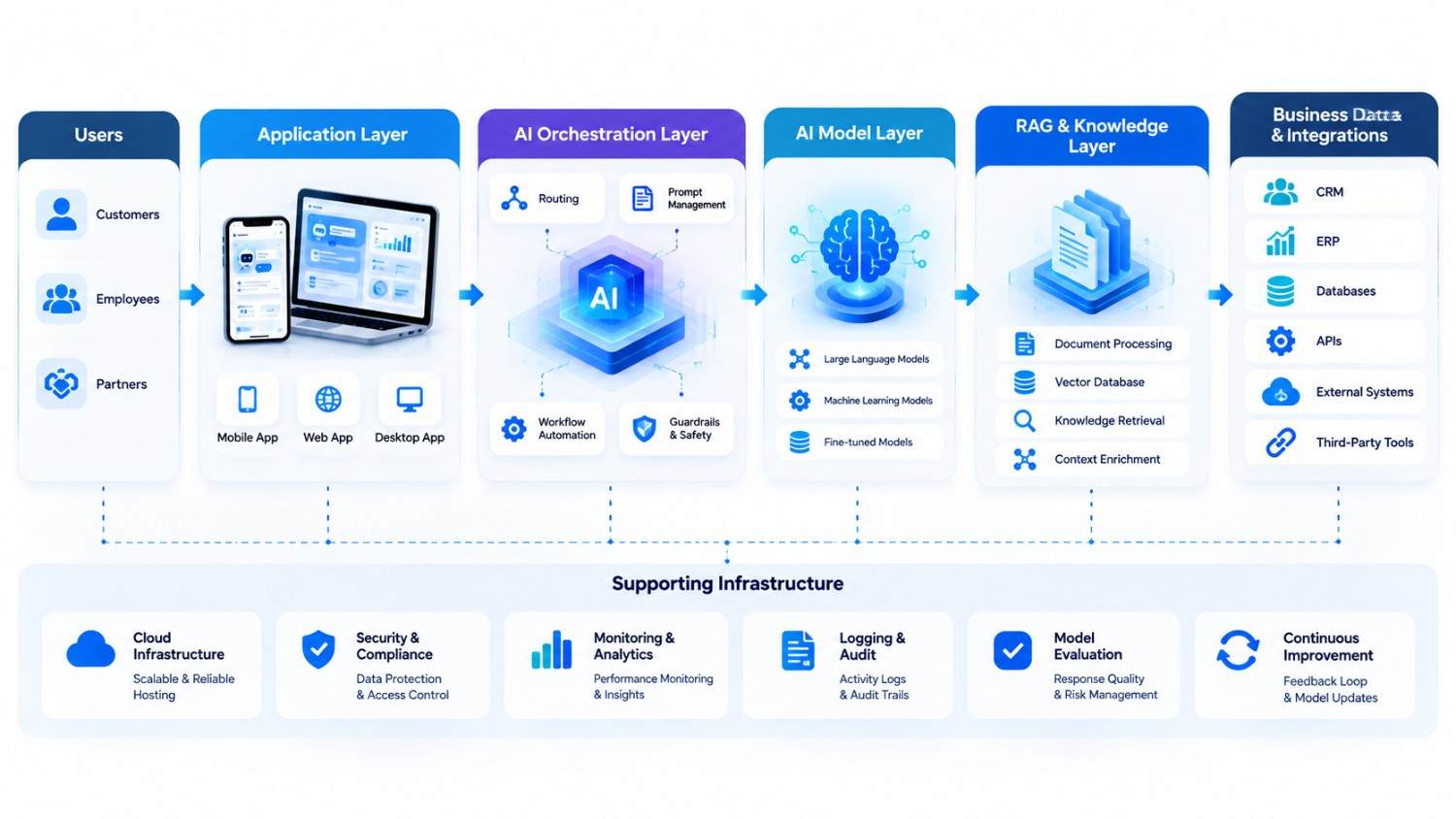
A simplified production setup might look like this:
| Layer | Typical Responsibility |
| User/Application | Mobile or web interface |
| AI Orchestration | Manages requests and AI workflow |
| AI Model | Generates or processes information |
| RAG/Knowledge Layer | Retrieves relevant business information |
| Business Systems | CRM, ERP, database, APIs |
| Security & Guardrails | Controls access and risky behaviour |
| Monitoring | Tracks performance and system issues |
The exact architecture should be designed according to the application’s requirements rather than copied from another project.
8 Questions to Ask Before Starting an AI App Project
1. What problem are we solving?
If the problem cannot be clearly explained, the AI solution may not have a strong business purpose.
2. Who will use the application?
An internal employee application can have very different requirements from a consumer-facing mobile app.
3. What information will the AI need?
Identify whether the application will use public information, company documents, databases, APIs, customer information, or user-generated data.
4. What level of accuracy is required?
A creative writing assistant and an application handling financial or operational information may require very different levels of accuracy and human oversight.
5. Does the AI need to take action?
There is a major difference between:
AI → generates an answer
and:
AI → understands a request → retrieves information → calls a system → performs a permitted action → reports the result
The second type of system requires more careful architecture and permission management.
6. How will success be measured?
Depending on the product, useful measurements might include:
- task completion
- response time
- customer satisfaction
- support workload
- conversion rate
- processing time
- employee productivity
7. What happens when AI gets something wrong?
AI systems should have appropriate fallback mechanisms and escalation paths where mistakes could have meaningful consequences.
8. How will the application evolve?
AI technology changes quickly. Businesses should consider whether their architecture can accommodate new models, changing APIs, growing data volumes, and changing user expectations.
Frequently Asked Questions
How much does it cost to develop an AI app in Indonesia?
There is no universal price. The cost depends on application complexity, AI functionality, platforms, integrations, data requirements, security, infrastructure, and ongoing support. Indonesian market guides also show significant differences between project estimates, which is why businesses should request a scope-based proposal rather than rely on a single generic price.
How long does it take to develop an AI-powered app?
The timeline depends on the scope of the project. A focused proof of concept can take considerably less time than a production application involving multiple integrations, extensive testing, security controls, and large amounts of business data.
A development partner should provide a timeline after understanding the actual requirements instead of promising a fixed number of days for every AI application.
What does an AI app development company do?
An AI app development company helps businesses plan, design, build, test, and deploy applications that use artificial intelligence. Depending on the project, this can include AI model integration, RAG, conversational AI, automation, data engineering, APIs, application development, testing, and post-launch optimization.
Can AI be integrated into an existing mobile application?
Yes. AI can often be added to an existing application without rebuilding the entire product. Possible applications include AI search, conversational assistants, recommendations, document processing, personalization, and workflow automation.
The right approach depends on the existing architecture and the AI functionality required.
What technologies are used to build AI applications?
The technology stack depends on the project. An AI application may use mobile or web frameworks, APIs, databases, cloud infrastructure, LLMs, machine-learning models, vector databases, RAG pipelines, orchestration layers, and third-party integrations.
How do I choose an AI app development company in Indonesia?
Look at the company’s understanding of your business problem, AI engineering capabilities, product-development experience, integration expertise, security approach, testing methodology, communication process, pricing transparency, and post-launch support.
A portfolio can demonstrate experience, but the development process is equally important.
What is the difference between AI app development and AI product development?
AI app development generally focuses on creating an application that includes AI functionality. AI product development is broader and may cover product strategy, UX, architecture, AI engineering, development, deployment, measurement, and scaling.
Can an AI development company build a custom AI solution for my business?
Yes. A custom AI solution can be designed around a company’s specific workflows, users, data, and technology environment. Depending on the business requirement, this could include an AI assistant, RAG system, conversational AI solution, document-processing application, AI automation workflow, recommendation system, or a broader AI-powered product.
Final Thoughts
Building an AI application is not simply about adding an AI model to an existing interface.
The strongest projects start with a clear business problem. They then connect the right data, technology, user experience, security measures, and testing process around that problem.
For businesses evaluating an AI App Development Company Indonesia, the right development partner should be able to bring these different pieces together instead of focusing only on the AI model itself.
Whether you are building an AI-native product, improving an existing application, or connecting AI to internal workflows, the process should begin with understanding the problem, validating the use case, assessing the available data, selecting an appropriate architecture, and defining how success will be measured.
UAutomate AI brings together AI product development, RAG, data and LLM engineering, conversational AI, and workflow orchestration to help businesses move from AI concepts toward production systems.
Have an AI app idea or an existing application you want to enhance with AI? Contact UAutomate AI to discuss your business requirements, technical needs, and potential AI solution.