Quick Answer: How Much Does AI Product Development Cost in Singapore in 2027?
If you are planning to build an AI product in Singapore, the first thing to understand is that there is no single development price that applies to every project.
As a practical 2027 planning framework, a focused AI proof of concept or MVP may require approximately S30,000–S80,000, while a production-ready AI application can move into the S80,000–S200,000+ range. More complex enterprise AI platforms can exceed S$200,000 and reach several hundred thousand Singapore dollars, depending on the product scope, AI architecture, data, integrations, security and scalability requirements.
These figures are indicative planning ranges rather than fixed Singapore market prices or UAutomate AI quotations. Current public pricing guides from Singapore-based AI/software companies also show a wide spread in project costs, reinforcing the fact that AI development pricing depends heavily on what is actually being built.
For businesses evaluating an AI Product Development Company Singapore, the more useful question is therefore not simply:
“How much does AI development cost?”
A better question is:
“What AI capabilities does my business actually need, what architecture will support them, and what will the product cost to build and operate?”
A production AI product may involve considerably more than connecting an application to an LLM. Depending on the use case, it can require data preparation, RAG, APIs, authentication, AI evaluation, monitoring, security controls, workflow automation and integrations with existing business systems.
That is why two products described as “AI applications” can have very different development budgets.
AI Product Development Cost in Singapore: The 2027 Budget Snapshot
Before looking at individual cost factors, it helps to divide AI projects into broad investment levels.
| AI Product Stage | Indicative 2027 Planning Budget | Typical Objective |
| AI Proof of Concept / MVP | S30,000–S80,000 | Validate one focused AI use case |
| Production AI Application | S80,000–S200,000+ | Launch a reliable product for real users |
| Enterprise AI Platform | S200,000–S600,000+ | Build a complex and scalable AI environment |
| Highly Specialized AI System | S$300,000+ | Advanced ML, computer vision, voice, multi-agent or specialized applications |
Important: These are planning bands, not guaranteed project quotations. A relatively simple project may cost less, while a highly specialized application may cost considerably more.
What Can Move Your Project Into a Higher Budget?
The biggest variables are usually:
- Number and complexity of AI features
- User interface and application requirements
- AI model selection
- RAG or knowledge retrieval
- AI agents and workflow automation
- Proprietary business data
- Data preparation and processing
- Third-party integrations
- Security and access controls
- Cloud infrastructure
- Testing and AI evaluation
- Expected user volume
- Post-launch maintenance
A useful way to visualize the investment is through a project cost ladder:
| Stage | Main Question | Potential Cost Impact |
| Business problem | What are we trying to solve? | Sets the project scope |
| AI capability | What should AI actually do? | Determines technical complexity |
| Data | What information does AI need? | Determines data engineering effort |
| Integrations | What systems must AI connect to? | Adds backend/API work |
| Security | What level of protection is required? | Adds architecture and testing |
| Deployment | How many users and what scale? | Determines infrastructure |
| Operations | How will AI be monitored and maintained? | Creates recurring costs |
Why Two AI Products Can Cost Very Different Amounts
Consider two companies that both want an “AI assistant.”
The first company wants an assistant that answers questions from a small collection of approved FAQs.
The second wants an assistant that can:
- Search internal documents
- Retrieve customer information
- Check CRM records
- Create support tickets
- Send emails
- Follow company policies
- Respect different employee permissions
- Escalate sensitive requests to humans
- Keep track of actions
Both products may be called AI assistants, but their engineering requirements are completely different.
| Requirement | Basic AI Assistant | Business AI Product |
| LLM integration | ✓ | ✓ |
| Custom knowledge | Optional | ✓ |
| RAG | Sometimes | Often |
| Database | Basic | Advanced |
| CRM integration | No | ✓ |
| Workflow automation | Limited | ✓ |
| User permissions | Basic | Advanced |
| Monitoring | Basic | Advanced |
| Human approval | Optional | Often required |
| Security controls | Standard | Higher |
| Scalability | Limited | Production/enterprise |
| AI evaluation | Basic | Continuous |
This is why an AI App Development Company Singapore should not estimate a project simply because the client says “I need an AI chatbot.”
The architecture behind that chatbot matters.
What Actually Determines AI Product Development Cost?
Instead of treating AI development as one large expense, it is better to examine the individual decisions that influence the budget.
1. Business Use Case and Product Scope
The first cost driver is the problem the AI product needs to solve.
A document summarization application is very different from an AI system that analyzes information and then triggers business actions.
| AI Use Case | Typical Complexity |
| Text summarization | Low |
| Content generation | Low–Medium |
| Customer support assistant | Medium |
| Internal knowledge assistant | Medium |
| AI sales assistant connected to CRM | Medium–High |
| AI workflow agent | High |
| Multi-agent business platform | High |
| Custom ML system | High–Very High |
The important lesson is simple:
Start with the business problem, not the technology budget.
If the business objective is unclear, it becomes much harder to decide which AI features are genuinely necessary.
2. AI Architecture
Your choice of architecture can have a significant effect on development effort and long-term operating costs.
Depending on the product, an AI system might use:
- LLM APIs
- Retrieval-Augmented Generation
- Vector databases
- AI agents
- Tool calling
- Workflow orchestration
- Traditional machine learning
- Computer vision
- Voice AI
- Multiple AI models
A typical enterprise AI product may include
| Layer | Purpose |
| User interface | Allows customers or employees to interact with the product |
| Application layer | Handles business logic and user requests |
| AI orchestration | Determines how AI capabilities are used |
| AI models | Generate, classify, analyse or reason |
| Knowledge layer | Provides access to business information |
| Database | Stores application and business data |
| Integrations | Connects CRM, ERP and third-party systems |
| Security | Controls identity, permissions and data access |
| Monitoring | Tracks application and AI performance |
Adding more layers does not automatically make a product better. The goal is to build the simplest architecture capable of solving the business problem reliably.
Where Does Your AI Product Budget Actually Go?
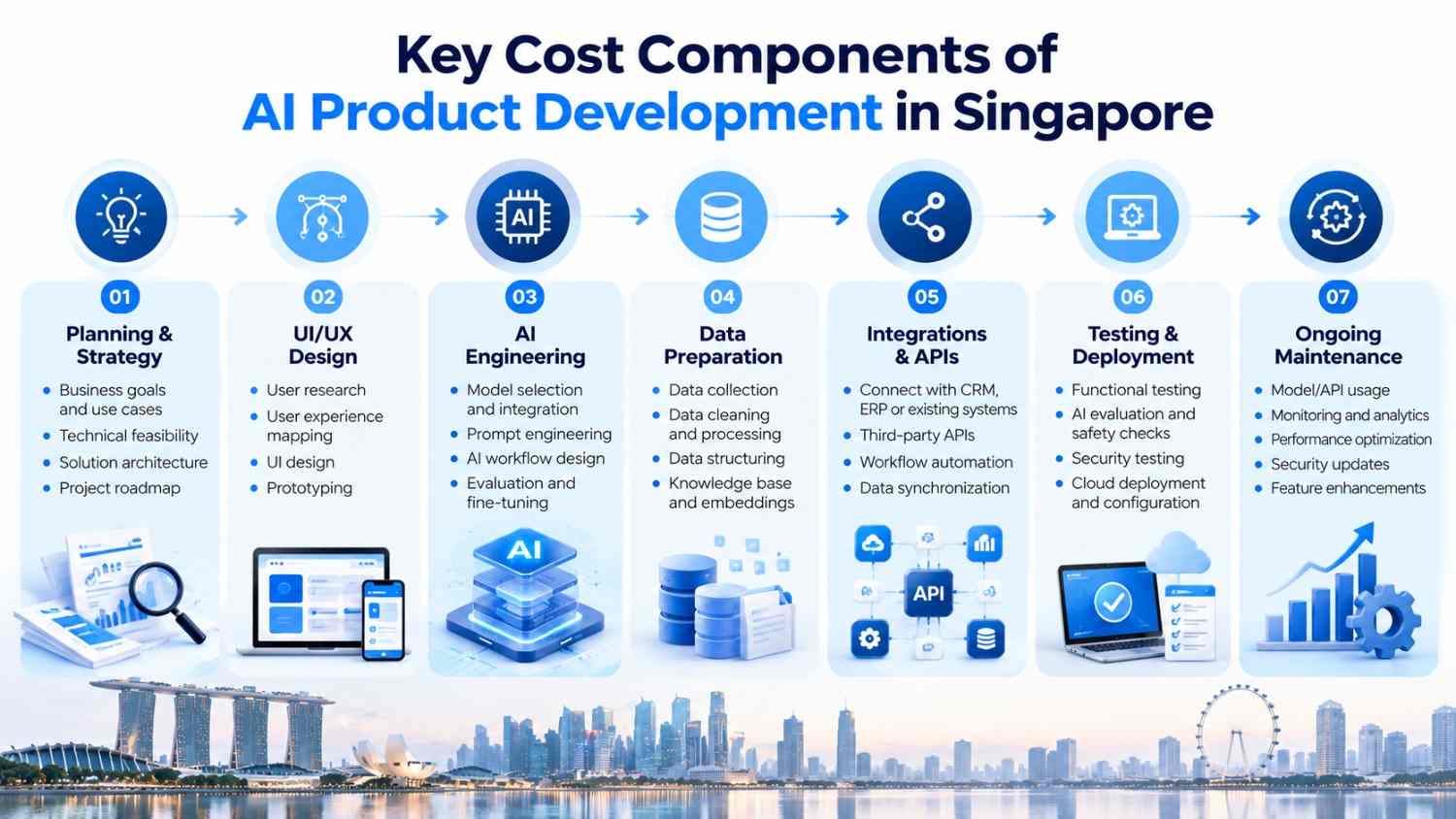
One of the most common mistakes businesses make is looking only at the cost of “AI development.”
A production AI product can contain several different areas of engineering.
| Cost Component | What It Covers |
| Discovery | Requirements, use-case analysis and technical feasibility |
| Product design | UX, UI and user journeys |
| Application development | Frontend and backend |
| AI engineering | Models, prompts, orchestration and AI workflows |
| Data engineering | Data collection, cleaning and transformation |
| RAG | Retrieval, embeddings and knowledge infrastructure |
| Integrations | CRM, ERP, APIs and third-party services |
| Security | Authentication, permissions and data protection |
| Testing | Functional testing and AI evaluation |
| Deployment | Cloud and production configuration |
| Monitoring | Reliability, performance and AI quality |
| Maintenance | Fixes, improvements and future changes |
This broader view is important because AI systems need to be evaluated and managed throughout their lifecycle.
NIST’s AI Risk Management Framework is designed to help organisations incorporate trustworthiness considerations into the design, development, use and evaluation of AI systems. Its Generative AI Profile also identifies risks and risk-management considerations specific to generative AI. .
Build vs Integrate vs Buy: Which Approach Makes Sense in 2027?
Not every company needs to build an AI product completely from scratch.
In some situations, integrating AI into existing software may be a more practical investment.
Option 1: Buy an Existing AI Tool
An existing product can make sense when:
- The business problem is relatively standard
- The company does not need proprietary workflows
- Complex integrations are unnecessary
- AI is not a core competitive differentiator
Best suited for: standard productivity, writing, summarization and general AI assistance.
Option 2: Add AI to Existing Software
If your company already has a CRM, ERP, customer portal or internal application, AI can often be added to the existing environment.
For example:
| Existing System | Possible AI Enhancement |
| CRM | Lead qualification and follow-ups |
| Customer portal | AI support assistant |
| ERP | Natural-language business queries |
| Internal knowledge base | RAG-powered assistant |
| Email system | Email classification and drafting |
| Booking system | AI scheduling assistant |
This can be attractive because the company does not necessarily need to replace its existing software.
Option 3: Build a Custom AI Product
A custom AI product is more appropriate when:
- AI is central to the product
- The workflow is unique
- Proprietary data creates competitive value
- Existing products cannot meet requirements
- The company needs control over the user experience
- Multiple business systems need to work together
This is where choosing an experienced AI development company Singapore can become important.
The right development partner should help determine whether custom development is actually necessary rather than automatically recommending the most expensive architecture.
How AI Architecture Changes Development Cost
Different AI architectures solve different problems.
LLM-Powered Applications
An LLM-powered application may use an existing foundation model to perform tasks such as:
- Content generation
- Text summarization
- Classification
- Information extraction
- Natural-language interfaces
- Draft generation
For these products, much of the engineering work may involve integrating the model into a reliable application rather than training a model from scratch.
RAG-Based AI Products
Retrieval-Augmented Generation, commonly called RAG, allows an AI system to retrieve relevant information from a connected knowledge source before generating an answer.
A simplified RAG implementation may involve:
Business Documents → Data Processing → Embeddings/Index → Retrieval → LLM → Response
This can be useful for:
- Internal knowledge assistants
- Customer support
- Document intelligence
- Policy search
- Product information
- Technical documentation
UAutomate AI’s RAG resources describe using retrieval systems to connect AI with business documents, knowledge repositories and other approved information sources.
The cost of a RAG product can increase when the business has large volumes of documents, complicated permissions, multiple data sources or frequent data updates.
AI Agents and Workflow Automation
AI agents introduce another level of product complexity.
Rather than simply responding to a question, an AI agent can potentially:
- Understand a request
- Retrieve relevant information
- Select an appropriate tool
- Call an API
- Perform an action
- Check the result
- Continue the workflow
- Ask a human for approval when required
For example, an AI sales workflow could qualify a lead, retrieve information from a CRM, prepare a response and update the relevant record.
UAutomate AI currently positions its AI offering around production AI systems, including autonomous agents, LLM engineering and workflow orchestration.
Agentic systems also introduce additional governance considerations. Singapore’s IMDA Model AI Governance Framework for Agentic AI recommends measures around limiting agent powers, meaningful human accountability, technical controls and user transparency. That makes governance part of the product conversation, not simply a post-development checklist.
What Makes AI Product Development More Expensive in Singapore?
The location itself is not the only factor. The requirements of the business and its operating environment can significantly influence the budget.
Security and Data Protection
If an AI product handles personal data, the business needs to consider applicable obligations under Singapore’s Personal Data Protection Act.
The Personal Data Protection Commission outlines obligations including accountability, notification, consent, purpose limitation, accuracy and protection of personal data.For an AI product, these considerations can influence:
- Data architecture
- User permissions
- Data storage
- Access controls
- Security testing
- Data retention
- Third-party services
- Governance processes
Security therefore should not be treated as something to add immediately before launch.
Beyond application security and data protection, businesses building AI products should also consider responsible AI practices. Singapore’s Model AI Governance Framework provides guidance around areas such as internal governance, human involvement in AI-assisted decision-making, operations management, data management and stakeholder communication
A practical security checklist
| Question | Why It Matters |
| What data does the AI access? | Determines security requirements |
| Is personal data involved? | May trigger applicable PDPA obligations |
| Who can access the information? | Determines permission architecture |
| Where is information stored? | Affects infrastructure and governance |
| Which external APIs receive data? | Requires vendor and data-flow assessment |
| How are actions logged? | Supports monitoring and accountability |
| What happens when something goes wrong? | Determines recovery and escalation processes |
Data Can Become One of the Biggest AI Development Challenges
Many businesses assume an AI project begins when developers connect an LLM.
In practice, the work can begin much earlier.
Imagine a company has:
- Hundreds of PDFs
- Years of internal documentation
- Multiple versions of policies
- Spreadsheet data
- CRM information
- Customer records
- Scanned documents
- Knowledge stored across different platforms
Before AI can reliably use that information, it may need to be collected, cleaned, structured, classified, processed, indexed and secured.
Data-readiness checklist
| Question | Why It Matters |
| Where is the data stored? | Determines integration requirements |
| Is the data structured? | Affects processing complexity |
| Is the information accurate? | Directly affects AI output quality |
| Are there duplicate versions? | Can create conflicting information |
| Who can access each source? | Determines permission requirements |
| Does it contain personal information? | May affect privacy and security requirements |
| How frequently does it change? | Determines update and synchronization needs |
This is one reason an AI product quote should not be based solely on the number of screens or features in the application.
Don’t Budget Only for Development: Calculate Total Cost of Ownership
The initial development budget is only one part of the financial picture.
After launch, an AI product may continue to incur costs related to:
- AI model/API usage
- Cloud infrastructure
- Data processing
- Storage
- Monitoring
- Security
- Maintenance
- Evaluation
- Product improvements
A useful budgeting table
| Cost Category | Initial Build | Recurring Cost |
| UX/UI | ✓ | Usually limited |
| Application development | ✓ | Maintenance |
| AI integration | ✓ | Model/API usage |
| RAG infrastructure | ✓ | Storage + processing |
| Cloud infrastructure | Setup | ✓ |
| Monitoring | Setup | ✓ |
| Security | ✓ | Ongoing maintenance |
| AI evaluation | ✓ | ✓ |
| New features | — | ✓ |
For example, model-related costs can depend on usage volume, the models selected, the amount of input/output processed and how many AI steps a workflow requires.
That means a low-cost MVP can still become expensive to operate if its architecture is not designed with usage and scalability in mind.
How to Reduce AI Product Development Cost Without Sacrificing Quality
Reducing cost does not necessarily mean choosing the cheapest vendor or the least capable AI model.
A better strategy is to remove unnecessary complexity.
Start With One High-Value Use Case
Instead of attempting to build an AI platform for an entire organisation, begin with one measurable problem.
For example:
“Reduce the time customer-support employees spend searching for product information.”
That is much easier to scope than:
“Build an AI platform for customer service.”
A clearly defined problem makes it easier to decide which features are necessary.
Build an MVP Before the Full Platform
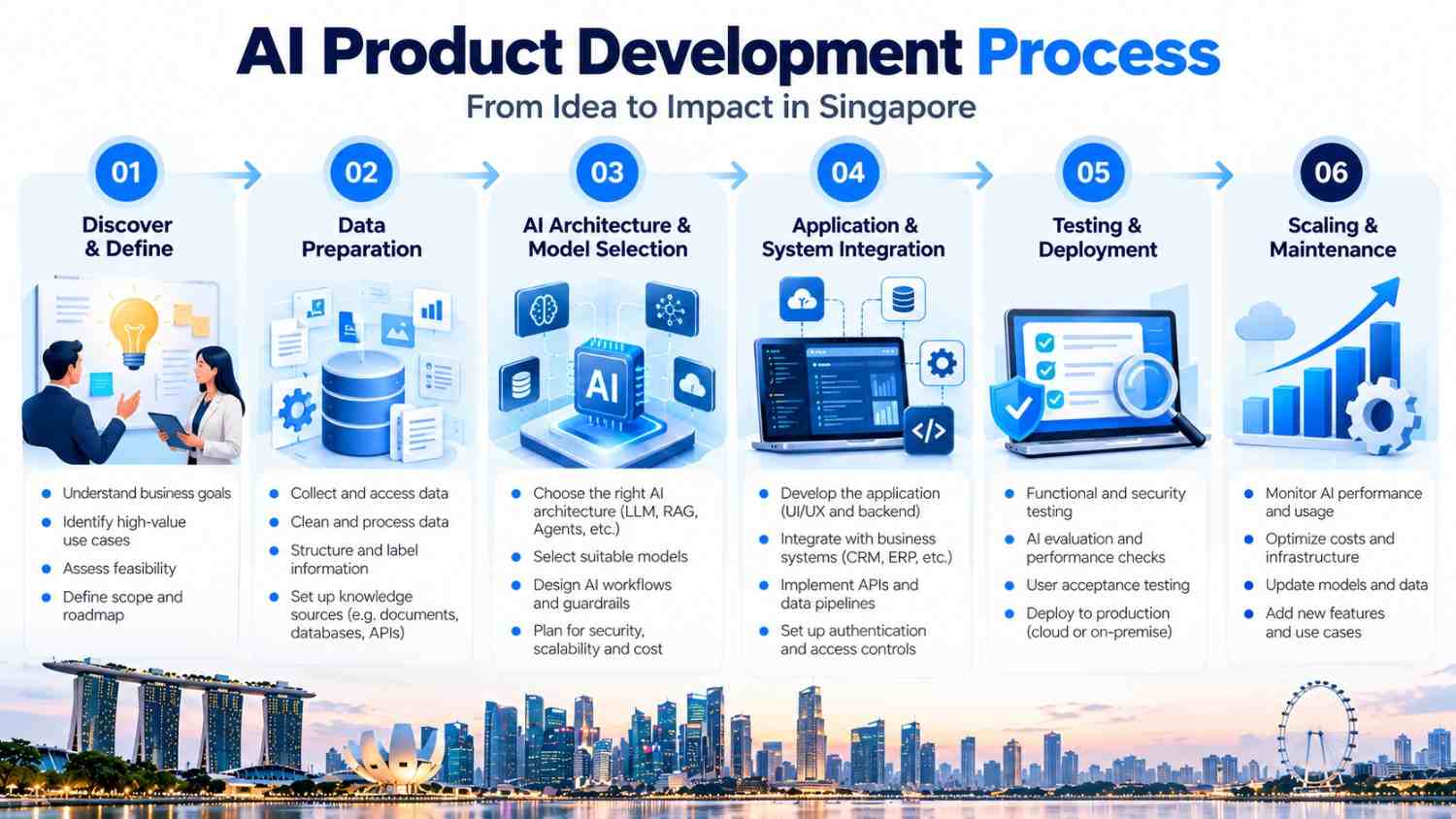
A practical approach is:
| Phase | Objective |
| Discovery | Understand the problem |
| Proof of concept | Validate technical feasibility |
| MVP | Test with real users |
| Feedback | Identify what works and what does not |
| Production | Harden the product |
| Scale | Add users, features and integrations |
This approach can reduce the risk of spending heavily on features before there is evidence that customers or employees actually need them.
Use Existing Foundation Models Where Appropriate
For most business applications, building and training a foundation model from scratch would be unnecessary.
A custom AI product can often combine existing models with:
- Proprietary business data
- RAG
- Business rules
- APIs
- Workflow orchestration
- Custom interfaces
- Security controls
The competitive advantage may therefore come from how the AI is integrated into the business, rather than from building a new foundation model.
Do Not Fine-Tune Automatically
Fine-tuning is not necessarily the first solution when a company wants an AI system to understand internal information.
Ask:
Does the AI need to learn a new behaviour, or does it simply need access to changing business knowledge?
If the issue is access to current company information, a retrieval-based approach may be more appropriate in some cases.
The architecture should be selected based on the use case rather than following an AI trend.
A Practical 2027 AI Product Budgeting Framework
Before requesting quotations from an AI Product Development Company Singapore, answer the following questions.
| Planning Question | Example Answer |
| What business problem are we solving? | Reduce customer-support workload |
| Who will use the product? | Customers and support staff |
| How many users are expected? | 5,000 monthly users |
| What information does AI need? | Product documentation |
| Does AI need private company data? | Yes |
| Is RAG required? | Potentially |
| Does AI need to perform actions? | Yes |
| Which systems need integration? | CRM and ticketing |
| What security level is required? | Enterprise |
| What is included in the MVP? | AI support assistant |
| How will success be measured? | Resolution rate and response time |
Once these questions have been answered, a development partner can create a more meaningful technical scope and cost estimate.
A Simple AI Product Cost Estimation Model
For internal planning, separate the initial investment from recurring expenses.
Initial Investment
Product Development + AI Engineering + Data + Integrations + Security + Testing + Deployment
Ongoing Investment
AI Usage + Infrastructure + Monitoring + Maintenance + Enhancements
This distinction is important because a project that looks affordable during development may require a very different operating budget once thousands of users begin interacting with the system.
Three Examples of AI Product Budgets
Instead of assuming every AI product fits one price bracket, consider three different scenarios.
Scenario 1: AI Knowledge Assistant
A company wants employees to ask questions about internal SOPs, policies and documentation.
Possible requirements
| Requirement | Needed? |
| Document ingestion | ✓ |
| Search/retrieval | ✓ |
| RAG | ✓ |
| Authentication | ✓ |
| Access control | Potentially |
| Web interface | ✓ |
| AI evaluation | ✓ |
| CRM integration | Optional |
Likely category: AI MVP or production knowledge system.
The complexity can increase significantly if employees should only be allowed to retrieve documents appropriate to their roles.
Scenario 2: AI Customer Support Product
A company wants an AI system that answers customer questions and connects to existing business systems.
Possible requirements include:
- Customer-facing interface
- RAG
- CRM integration
- Ticketing integration
- Human escalation
- Analytics
- Monitoring
| Component | Purpose |
| AI assistant | Handles customer enquiries |
| Knowledge layer | Provides approved information |
| CRM | Retrieves customer context |
| Ticketing | Escalates unresolved issues |
| Human support | Handles sensitive or complex cases |
| Analytics | Measures performance |
Likely category: Production AI application.
Scenario 3: AI Agent Platform
A company wants AI agents capable of executing business workflows.
Potential requirements include:
- Multiple agents
- Tool calling
- API integrations
- Business rules
- Permissions
- Approval checkpoints
- Monitoring
- Auditability
| Capability | Example |
| Lead agent | Qualifies an incoming lead |
| CRM tool | Retrieves customer information |
| ERP tool | Checks product/inventory information |
| Communication tool | Drafts or sends messages |
| Approval layer | Requests human confirmation |
| Monitoring | Tracks agent behaviour |
Likely category: Advanced or enterprise AI system.
The key point is that the budget should reflect the engineering complexity and business risk, not simply the number of AI features advertised.
How to Choose an AI Development Company in Singapore
Choosing a development partner should not come down to the cheapest quotation.
A lower initial price can become expensive if important work is excluded or the architecture needs to be rebuilt later.
Ask These Questions Before Signing
1. What AI architecture do you recommend?
The development company should explain why a particular architecture is appropriate for your use case.
2. What happens to our business data?
Ask:
- Where will it be stored?
- Who can access it?
- How is access controlled?
- Which third-party systems process it?
- How are updates handled?
3. How will AI quality be measured?
Ask about:
- Evaluation datasets
- Accuracy
- Hallucination testing
- Guardrails
- Monitoring
- Human review
NIST’s AI Resource Center includes resources focused on testing, evaluation, verification and validation of AI systems.
4. What is included in the quotation?
Clarify whether the estimate includes:
- UX/UI
- Frontend
- Backend
- AI engineering
- Data processing
- Integrations
- Testing
- Deployment
- Documentation
- Training
- Support
5. What are the ongoing costs?
Always distinguish:
Build Cost ≠ Operating Cost
A good proposal should make both visible.
Why UAutomate AI for AI Product Development in Singapore?
UAutomate AI positions its AI development offering around production-ready AI systems rather than treating AI as a standalone chatbot feature.
Its current website highlights AI product development, AI strategy, RAG development, conversational AI, workflow automation and AI systems integrated with existing business tools.
For businesses working with proprietary knowledge, UAutomate AI also provides RAG and AI knowledge assistant solutions designed around business documents, knowledge repositories and controlled access.
UAutomate AI’s approach to AI product development
| Stage | What Happens |
| Business discovery | Understand the operational problem |
| Use-case definition | Identify where AI can create measurable value |
| User journey mapping | Define how people will interact with the product |
| Architecture | Select the appropriate AI and software architecture |
| Development | Build the application and AI capabilities |
| Integration | Connect existing business systems |
| Testing | Validate application and AI performance |
| Deployment | Move the product into production |
| Optimization | Improve performance based on real usage |
UAutomate AI’s published project-start process describes a discovery call followed by user journey mapping, a formal proposal covering scope and costs, and then engineering deployment after approval.
Its service portfolio also includes AI agents, RAG, conversational AI and other AI-led workflow solutions.
This approach can be particularly useful for businesses that want to connect AI with existing workflows instead of creating another isolated software tool.
Frequently Asked Questions
1. How much does AI product development cost in Singapore in 2027?
A practical planning range can start around S30,000–S80,000 for a focused AI MVP, move toward S80,000–S200,000+ for a production AI application, and exceed S$200,000 for complex enterprise platforms.
These figures should be treated as indicative planning ranges rather than a fixed Singapore market average.
2. What is the average cost of building an AI-powered app in Singapore?
There is no dependable single average because “AI-powered app” can describe very different products.
A relatively simple application using an existing LLM may require much less engineering than a production system involving RAG, proprietary data, multiple APIs, advanced security and AI agents.
For this reason, project complexity is more useful than a single average price.
3. How much does an AI App Development Company Singapore charge?
The quotation depends on what the company is actually building.
An application containing authentication, AI orchestration, RAG, databases, integrations, analytics and monitoring will generally require more engineering than a simple AI feature.
Businesses should request a scope-based quotation that clearly separates development, infrastructure and ongoing AI costs.
4. Does RAG increase AI product development cost?
It can.
A RAG implementation may involve:
- Data ingestion
- Document processing
- Embeddings
- Vector storage
- Retrieval logic
- Access controls
- Evaluation
- Data synchronization
However, RAG can be an appropriate architecture when an AI application needs to work with private or frequently changing business information.
5. Is it cheaper to build an AI product using an existing LLM?
Using an existing foundation model can avoid the significant investment associated with developing a model from scratch.
However, the total product cost still includes application development, data, integrations, security, evaluation, infrastructure and model usage.
The model is only one component of the overall product.
6. How much does AI app development cost in Singapore?
A focused AI application may fit within an MVP-level budget, while a production system with proprietary data, complex integrations and advanced AI workflows can require a substantially larger investment.
The most reliable way to estimate cost is to define the users, features, data sources, integrations and AI capabilities before requesting a quotation.
7. How long does it take to build an AI product?
The timeline depends on the scope and complexity.
A focused proof of concept can be delivered much faster than an enterprise platform requiring complex integrations, security controls, AI evaluation and production infrastructure.
A phased approach can help:
Discovery → MVP → User Validation → Production → Scale
8. Should a business build an AI agent or a traditional AI application?
It depends on what the system needs to do.
If the product mainly needs to answer questions, summarize information or generate content, a conventional AI application may be sufficient.
If it needs to use tools, access business systems and complete multi-step tasks, an agentic approach may be more appropriate.
However, greater autonomy also creates additional governance considerations. Singapore’s IMDA framework recommends appropriate limits on agent powers, meaningful human accountability and technical controls for responsible agentic AI deployment.
Final Takeaway: What Should You Budget for AI Product Development in Singapore in 2027?
The cost of AI product development is not determined simply by the word “AI.”
It is determined by the product you actually need to build.
A business planning an AI product should consider:
| Planning Area | Key Question |
| Business problem | What are we trying to improve? |
| Users | Who will use the product? |
| AI capability | What should AI actually do? |
| Data | What information does AI need? |
| Architecture | Do we need LLMs, RAG, agents or another approach? |
| Integrations | Which systems need to connect? |
| Security | What information needs protection? |
| Scale | How many users and interactions are expected? |
| Operations | What will the product cost after launch? |
| ROI | How will success be measured? |
For a business considering AI Product Development Singapore, the smarter approach is therefore not to ask a development company for a generic AI price.
Instead, define the business problem, identify the smallest useful MVP, understand the data and integration requirements, select an appropriate AI architecture, and calculate both the initial development cost and ongoing operating cost.
If you are looking for an AI Product Development Company Singapore to turn an AI concept into a production-ready business solution, UAutomate AI can help assess the use case, select an appropriate architecture, connect AI with existing systems and develop a practical implementation roadmap.
Ready to estimate your AI product? Start with the business problem, not the technology bill.
Book an AI consultation with UAutomate AI.