Mobile apps have become a key part of the way businesses connect with customers, employees and partners. But simply having an app is no longer enough in many industries. People want faster answers, personalised experiences, easier interactions and services that understand what they want.
That’s where artificial intelligence can bring in a new layer of value.
An AI-enabled mobile app can interpret natural language requests, recommend products or services, analyse information, automate repetitive tasks, help employees and assist customers in completing actions with less effort.
For businesses in Singapore, jumping on the AI bandwagon just because it’s trendy isn’t a solid reason to invest. The real question to ask is:
Can AI genuinely tackle a business challenge and deliver measurable value?
This is where the expertise of an AI App Development Company in Singapore comes into play. Rather than just slapping a chatbot or an AI feature onto an existing app, companies should pinpoint where AI can truly make a difference in areas like revenue, productivity, customer experience, operational efficiency, or decision-making.
Singapore is also nurturing a robust AI ecosystem, and businesses must keep in mind the importance of responsible AI practices, data governance, security, and the careful management of personal information. The IMDA and PDPC in Singapore have put together resources and guidance on AI governance and the use of personal data in AI systems.
For those looking into an AI mobile application, the opportunity goes beyond merely adopting new technology.
It’s about blending:
Enhanced user experiences + smarter operations + measurable business outcomes.
This guide delves into practical AI mobile app use cases for businesses in Singapore, how to gauge ROI, what influences development costs, and how to determine if your business needs an AI feature, an AI-enhanced app, or a completely new AI product.
Why AI Mobile Apps Are Shifting from a Technology Choice to a Business Strategy
Traditional mobile applications typically revolve around set user journeys.
A customer opens an app, searches for a product or service, fills out their information, submits a request, and then waits for the system to respond.
AI transforms how users engage with an application.
Instead of forcing every customer to follow the same exact route, an intelligent application can understand what the user is asking and provide a more tailored response or action.
For instance, a conventional appointment app might require a customer to:
Open app → Navigate to appointment section → Select service → Pick a date → Submit request.
An AI-enabled experience could allow the customer to simply describe what they need and receive relevant assistance based on their request.
The difference is not just technical. It can affect how quickly customers get help, how efficiently employees work, and how effectively a business handles opportunities.
Singapore businesses can potentially use AI within mobile applications for:
- Customer support
- Personalised recommendations
- Lead qualification
- Document processing
- Business intelligence
- Predictive insights
- Voice interaction
- Internal employee assistance
- Workflow automation
- Search and knowledge retrieval
The key principle is simple:
AI should be connected to a business objective.
What Makes an AI Mobile App Worth the Investment?
Not every mobile application needs AI.
A basic booking application may work perfectly well without artificial intelligence. Similarly, adding a large language model to a simple feature does not automatically make a product more valuable.
AI becomes commercially interesting when it can improve a process that is frequent, expensive, time-consuming, difficult to scale, or dependent on large amounts of information.
A useful way to evaluate an opportunity is to look at four stages:
1. Identify the Business Problem
Start with the problem instead of the technology.
For example:
- Customers ask the same questions repeatedly.
- Employees spend hours searching through documents.
- Sales teams receive too many unqualified leads.
- Managers struggle to interpret large amounts of business data.
- Customers receive generic recommendations.
2. Identify the AI Opportunity
Next, determine whether AI can genuinely improve the situation.
Possible capabilities include:
- Natural-language processing
- Recommendation systems
- Document intelligence
- Predictive analytics
- Conversational AI
- Computer vision
- Voice AI
- AI agents
3. Connect AI to the Mobile Experience
The AI capability should then be integrated into a useful customer or employee experience.
4. Define the Business Outcome
Finally, decide how success will be measured.
| Question | What it helps determine |
| Is the problem frequent? | Whether AI can create repeated value |
| Is the problem expensive or time-consuming? | Potential cost-saving opportunity |
| Is useful data available? | Whether AI can produce meaningful results |
| Can the outcome be measured? | Whether ROI can be calculated |
| Can AI outperform a simpler solution? | Whether AI is actually necessary |
If the answers are positive, the business case for AI becomes stronger.
7 High-Value AI Mobile App Use Cases for Singapore Businesses
The most valuable AI applications are not necessarily the ones with the most impressive technology.
They are the ones where AI can make a measurable difference to a real business process.
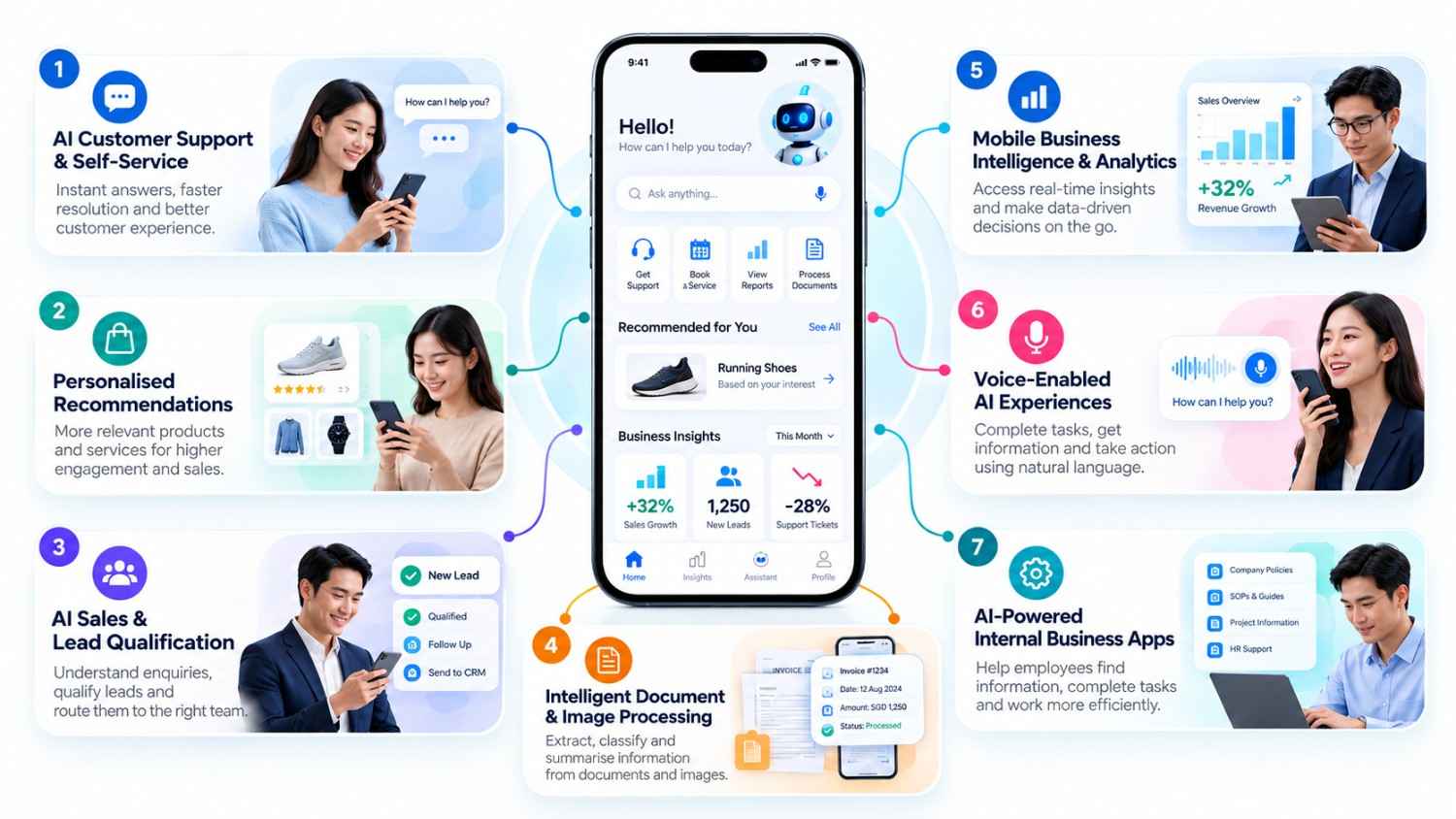
1. AI-Powered Customer Support and Self-Service
Customer support is one of the most practical areas for AI-powered mobile applications.
Instead of asking users to search through multiple help pages or wait for a support representative, an AI assistant can understand questions written in natural language and retrieve relevant information.
For example, a customer could ask:
“Can I move my appointment from Thursday to Friday?”
Instead of presenting a generic FAQ page, the application could understand the request, access relevant information, and guide the customer toward the appropriate next step.
Potential applications include:
- Frequently asked questions
- Order and delivery queries
- Appointment assistance
- Account-related questions
- Product information
- Service troubleshooting
- Support-ticket creation
- Human-agent escalation
The business value should be measured using actual performance indicators.
Useful KPIs
- Average response time
- Number of support interactions handled
- Human escalation rate
- Cost per support interaction
- Customer satisfaction
- Resolution time
UAutomate AI currently positions its AI chatbot and knowledge-assistant capabilities around customer support, internal knowledge, CRM integration, booking, and workflow automation.
2. Personalised Product and Service Recommendations
A conventional mobile application may display the same products or services to many users.
AI can potentially make these experiences more relevant by considering information such as user behaviour, preferences, previous interactions, product information, and context.
For example, an e-commerce application could use AI to recommend products based on a customer’s previous activity.
A service business could similarly recommend relevant services based on the customer’s stated requirements.
This can be particularly useful for:
- E-commerce
- Retail
- Hospitality
- Fitness
- Education
- Financial services
- Subscription businesses
The important part is to connect recommendations with a measurable business objective.
| Business objective | Potential KPI |
| Increase sales | Conversion rate |
| Increase basket size | Average order value |
| Improve retention | Repeat purchase rate |
| Increase engagement | Session frequency |
| Improve relevance | Recommendation interaction rate |
The objective is not simply to make recommendations more sophisticated.
The objective is to determine whether more relevant recommendations create better business results.
3. AI-Powered Sales and Lead Qualification
Mobile applications can also become intelligent sales tools.
Imagine a potential customer explaining their requirements through a mobile application rather than completing a long and rigid enquiry form.
AI can potentially interpret the request, identify important information, ask relevant follow-up questions, categorise the enquiry, and pass structured information to the sales team or CRM.
A typical implementation could include:
Customer Enquiry
The customer describes their requirement in natural language.
AI Understanding
The system identifies intent, requirements, and relevant information.
Lead Qualification
The application asks additional questions where necessary.
CRM Integration
Relevant information is transferred to the appropriate business system.
Sales Follow-Up
The sales team receives a more structured and potentially better-qualified enquiry.
Potential business metrics include:
- Lead response time
- Number of qualified leads
- Lead-to-opportunity conversion
- Sales productivity
- Cost per qualified lead
- Appointment-booking rate
UAutomate AI’s current AI workflow capabilities include lead management, CRM workflow automation, AI-powered task routing, and AI agents that can perform defined business tasks.
4. Intelligent Document and Image Processing
Mobile devices provide businesses with an important advantage: employees can capture information wherever they are.
An employee could photograph an invoice, receipt, form, document, or other business record through a mobile application.
AI can then potentially:
- Read the document.
- Extract relevant information.
- Classify the document.
- Summarise important details.
- Send structured information to another system.
- Request human verification where required.
For example, an invoice-processing application could work through the following stages:
| Stage | What happens |
| Capture | Employee photographs or uploads the document |
| Recognition | OCR identifies text and document elements |
| Extraction | Important fields are identified |
| Validation | Information is checked against business rules |
| Integration | Structured data is sent to the relevant system |
| Review | Human approval is requested when necessary |
This can be useful for organisations where employees regularly process documents away from a desktop.
Potential KPIs include:
- Processing time per document
- Manual data-entry hours
- Error rate
- Documents processed per employee
- Cost per processed document
UAutomate AI lists document intelligence capabilities including invoice and contract extraction, OCR, summarisation, document indexing, and semantic business search.
5. AI-Powered Business Intelligence on Mobile
Business intelligence is traditionally associated with desktop dashboards and reporting platforms.
But decision-makers are not always sitting at their desks.
A mobile application can give managers access to AI-assisted insights while they are travelling, attending meetings, visiting customers, or managing operations.
Instead of manually checking multiple dashboards, a manager could ask a question such as:
“Which sales region underperformed this month?”
The system could retrieve relevant business information and present the answer in a concise format, depending on the data and integrations available.
Potential applications include:
- Sales forecasting
- Inventory insights
- Operational monitoring
- Customer behaviour analysis
- Revenue reporting
- Performance summaries
- Exception alerts
The value should be measured through actual business outcomes.
| Area | Example KPI |
| Reporting | Time required to prepare reports |
| Forecasting | Forecast accuracy |
| Operations | Time to identify issues |
| Management | Decision-making time |
| Revenue | Opportunities identified |
| Productivity | Employee hours saved |
6. Voice-Enabled AI Mobile Experiences
Voice can make mobile applications easier to use in situations where typing is inconvenient.
This can be particularly useful for field workers, sales teams, service professionals, or customers who want to complete tasks without navigating multiple screens.
Potential applications include:
- Voice search
- Appointment booking
- Customer support
- Field-service assistance
- Voice notes
- Sales assistance
- Internal employee queries
- Hands-free workflows
For example, a field employee could verbally ask for information about a customer or service request and receive a response through the application.
The business case should focus on whether voice reduces friction and improves task completion rather than simply whether the technology works.
UAutomate AI currently offers voice AI solutions covering voice assistants, call automation, multilingual interactions, and voice-enabled workflows.
7. AI-Powered Internal Business Applications
AI mobile applications are not limited to customer-facing products.
Businesses can also create internal applications that help employees find information, complete tasks, and make decisions more efficiently.
Examples include:
- Employee knowledge assistants
- Field-service assistants
- Internal policy search
- Sales assistants
- AI reporting tools
- Operational dashboards
- Document assistants
- Training applications
Consider a field employee who needs to check a company procedure while working at a customer location.
Instead of searching through multiple documents, the employee could ask the internal AI assistant a question and retrieve relevant information from approved company sources.
This makes AI useful not only for customer experience but also for everyday employee productivity.
AI Mobile App Use Cases at a Glance
| Use Case | AI Capability | Primary Business Benefit | Suggested KPI |
| Customer support | Conversational AI / RAG | Faster support | Resolution time |
| Recommendations | Predictive / recommendation AI | Better relevance | Conversion rate |
| Lead qualification | AI agents / classification | Better sales efficiency | Qualified leads |
| Document processing | OCR / AI extraction | Less manual work | Processing time |
| Business intelligence | Predictive analytics | Faster decisions | Reporting time |
| Voice interaction | Speech + AI | Reduced interaction friction | Task completion |
| Internal assistant | RAG / knowledge AI | Employee productivity | Time saved |
The right use case depends on the organisation’s users, existing workflows, available data, technology infrastructure, and commercial objectives.
Which Singapore Industries Can Benefit From AI Mobile Apps?
AI mobile applications can be adapted across industries, but the business opportunity is different in each sector.
Retail and E-commerce
Retail and e-commerce businesses can use AI mobile experiences for:
- Product recommendations
- AI shopping assistants
- Customer support
- Personalised offers
- Visual product search
- Order assistance
Potential ROI areas: conversion, average order value, customer retention, and support efficiency.
Financial Services and FinTech
Potential applications include:
- Customer financial assistants
- Document processing
- Transaction insights
- Personalised information
- Support automation
- Internal knowledge tools
Because financial applications can involve sensitive information, privacy, security, access controls, and governance should be considered from the beginning.
Healthcare
Potential applications may include:
- Appointment assistance
- Patient communication
- Document summarisation
- Administrative support
- Internal knowledge retrieval
Healthcare applications require particular attention to privacy, security, accuracy, and appropriate human oversight.
Logistics and Field Services
AI can support:
- Delivery insights
- Route-related decision support
- Field-worker assistance
- Document processing
- Operational alerts
For field-based employees, having relevant business information available through a mobile device can reduce the need to return to a desktop system for every task.
Professional Services
Potential applications include:
- Document analysis
- Internal knowledge assistants
- Client support
- Meeting summaries
- Business intelligence
- Workflow automation
How to Measure the ROI of an AI Mobile App
The biggest mistake a business can make is treating AI implementation itself as the goal.
It is not.
The investment should be connected to measurable business outcomes.
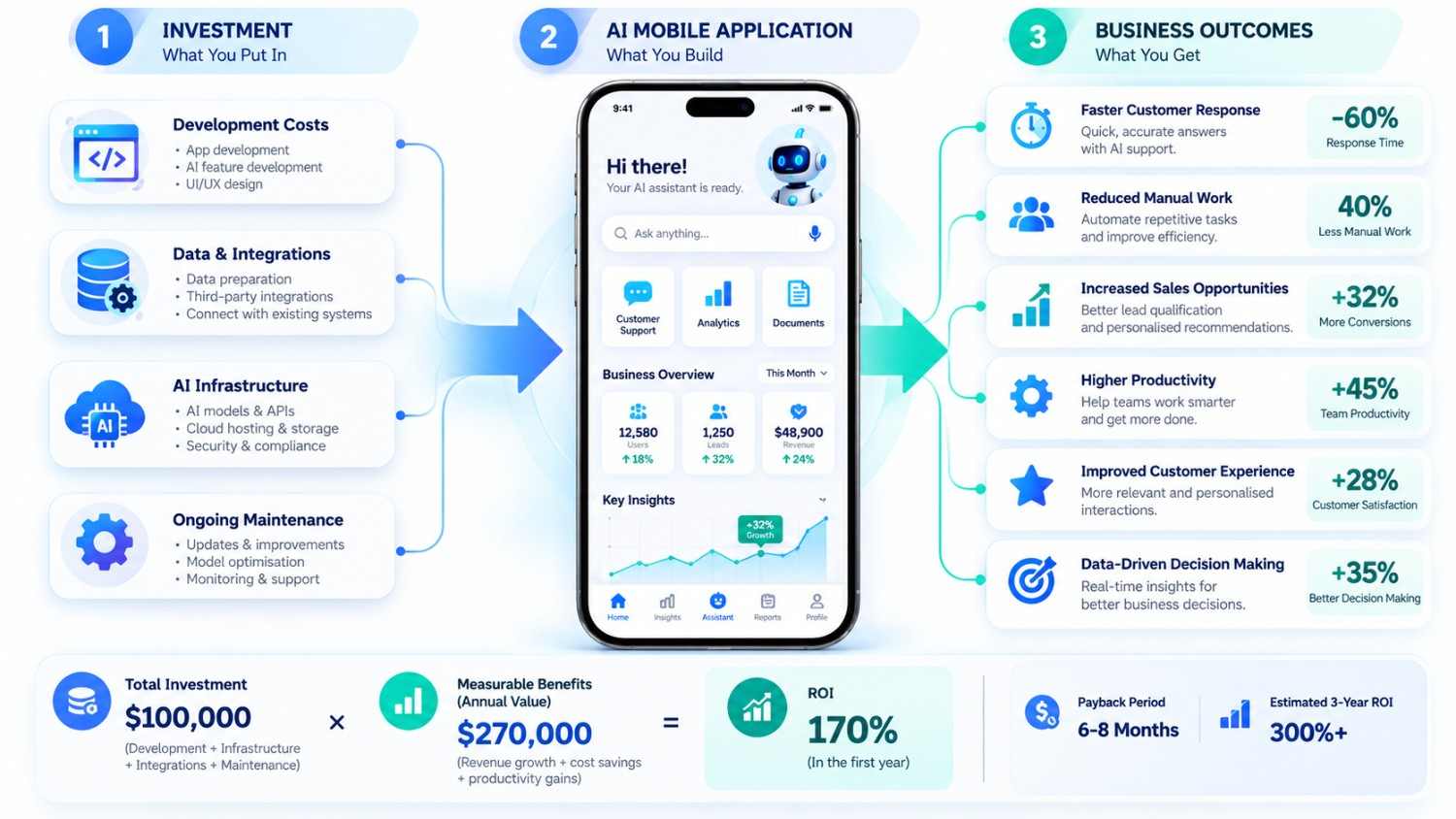
A practical approach is to look at the investment, the business change created by the application, and the financial value of that change.
AI investment may include:
- Product discovery
- Mobile application development
- Backend development
- AI integration
- Data preparation
- Infrastructure
- AI/API usage
- Security
- Testing
- Monitoring
- Maintenance
- Ongoing optimisation
Potential financial benefits may include:
- Additional revenue
- Reduced operating costs
- Employee time saved
- Lower processing costs
- Increased customer retention
- Improved conversion
- Faster service delivery
A basic ROI formula is:
ROI = (Financial Benefit − AI Investment) ÷ AI Investment × 100
However, the calculation should be based on the organisation’s actual baseline rather than an industry-wide assumption.
A Practical AI Mobile App ROI Scorecard
| ROI Category | What to Measure | Example KPI |
| Revenue | Additional commercial value | Revenue per user |
| Conversion | Users completing desired actions | Conversion rate |
| Cost savings | Reduction in manual workload | Cost per transaction |
| Productivity | Employee time saved | Hours saved/month |
| Customer experience | Improvement in interactions | CSAT / response time |
| Retention | Returning users | Repeat usage |
| Operations | Faster processes | Processing time |
Not every AI project needs to track every metric.
For example, an internal document-processing application may have little direct impact on revenue but could significantly reduce employee workload.
A recommendation engine, on the other hand, may be evaluated primarily through conversion, revenue per user, and retention.
The metrics should therefore be selected according to the purpose of the application.
Example: Turning an AI Feature Into a Business Case
Consider a hypothetical Singapore service company that receives a large volume of repetitive customer enquiries.
The company is considering an AI mobile assistant.
Rather than making a broad claim such as “AI will improve customer service,” the company should establish a baseline and define measurable targets.
Example business case
| Metric | Current Baseline | Target |
| Average response time | 30 minutes | 5 minutes |
| Repetitive enquiries handled manually | High | Reduced |
| Human escalations | 100% | Lower percentage |
| Support workload | Baseline | Lower |
| Customer satisfaction | Baseline | Improvement target |
These figures are illustrative only. Actual targets should be based on the company’s existing performance data.
This approach makes the business case easier to evaluate because management can compare the investment against measurable changes.
What Does AI Mobile App Development Cost in Singapore?
There is no single price that accurately represents the cost of developing an AI mobile application.
A relatively simple mobile application with one AI feature is very different from an enterprise solution connected to CRM, ERP, databases, internal documents, analytics platforms, and multiple AI services.
Several factors can affect the total investment.
1. AI Capability
A basic conversational feature can have a very different development scope from:
- Predictive analytics
- Computer vision
- Recommendation systems
- AI agents
- Document intelligence
- Multi-step workflow automation
2. Mobile Platform
The project scope may vary depending on whether the application requires:
- iOS
- Android
- Cross-platform development
- Web and mobile applications
3. Data Requirements
If AI needs access to internal documents, customer records, product catalogues, or operational data, additional data preparation and integration work may be necessary.
4. Business Integrations
CRM, ERP, payment, scheduling, inventory, communication, and other third-party systems can increase implementation complexity.
5. Security and Governance
Applications handling sensitive information may require additional measures for:
- Authentication
- Authorisation
- Encryption
- Access control
- Logging
- Data minimisation
- AI evaluation
- Human approval
6. Ongoing AI Costs
AI applications can involve recurring expenses related to model usage, APIs, infrastructure, monitoring, and maintenance.
Therefore, businesses should evaluate:
Initial development investment + ongoing operating costs
rather than considering only the initial development quotation.
Build AI Into an Existing App or Develop a New AI Product?
This is an important strategic decision.
Not every business needs to create a completely new application to benefit from AI.
Choose AI Integration When:
- Your existing application already has active users.
- The current product solves the core customer problem.
- You have useful customer or operational data.
- AI can improve an existing workflow.
- Your current architecture can support the required functionality.
Consider a New AI Product When:
- AI is central to the product’s value proposition.
- The existing application was not designed around the new workflow.
- You are creating a new business model.
- The user experience needs to be redesigned around natural-language interaction.
- Proprietary data or AI workflows are central to the product.
A Simple Decision Checklist
| Situation | More Suitable Direction |
| Existing app + clear AI improvement | Add AI to existing application |
| Existing users + new intelligent feature | AI enhancement |
| New AI-first business model | New AI product |
| Existing architecture cannot support new experience | Consider rebuilding |
| AI is only a small supporting feature | Integration may be sufficient |
For organisations exploring AI Product Development Singapore, this distinction is important because an AI-first product requires product strategy, data planning, AI engineering, UX design, infrastructure, testing, and ongoing evaluation—not simply connecting an application to an AI API.
How to Choose an AI Development Partner in Singapore
Choosing an AI development company should involve more than comparing project quotations.
The right partner should understand both the technology and the business problem.
Look for these capabilities:
| Capability | Why It Matters |
| AI strategy | Helps prevent unnecessary AI implementation |
| Mobile development | Ensures the AI experience works effectively on mobile |
| Backend engineering | Connects AI with business systems |
| Data engineering | Makes business information usable by AI |
| API integration | Connects CRM, ERP and other tools |
| Security | Protects sensitive business information |
| AI evaluation | Helps assess output quality |
| Analytics | Connects technology with business KPIs |
| Post-launch support | Allows continuous optimisation |
A strong AI development company Singapore should be able to discuss questions such as:
- What problem are we solving?
- What data is available?
- What happens if the AI produces an incorrect answer?
- Where should human approval remain?
- How will the system connect with our existing software?
- What will the ongoing AI operating cost be?
- How will success be measured after launch?
These questions are often more important than simply asking which AI model the development company uses.
Security and Responsible AI Should Be Part of the ROI Conversation
Security and responsible AI should not be treated as items to address only after development.
If an application processes customer information, financial information, employee information, documents, or other sensitive data, privacy and governance need to be considered during planning and implementation.
Singapore is also developing a strong AI ecosystem, while businesses need to consider responsible AI practices, data governance, security, and the appropriate handling of personal information. Singapore’s IMDA and PDPC have published resources and guidance around AI governance and the use of personal data in AI systems.
This means responsible AI is not only a compliance consideration.
It can also affect the long-term business value of the application.
A reliable AI solution needs appropriate:
- Data access controls
- Security measures
- AI evaluation
- Monitoring
- Human oversight where necessary
- Governance processes
For businesses operating in Singapore, these considerations should be included in the project from the beginning rather than added at the end.
Responsible AI should be considered throughout the development lifecycle, from design and testing to deployment and ongoing monitoring. Organisations can also use established frameworks such as the NIST AI Risk Management Framework to structure their approach to AI risk and trustworthiness.
Why UAutomate AI for AI App Development in Singapore?
UAutomate AI’s current AI offering extends beyond standalone chatbot development.
Its capabilities include custom AI software, AI knowledge assistants, document processing, AI workflow automation, AI integrations, AI agents, voice AI, business intelligence, and secure AI infrastructure.
This allows businesses to approach mobile AI as part of a larger technology ecosystem rather than treating the mobile application as an isolated product.
For example, an AI-powered mobile application may need to communicate with:
- Customer databases
- CRM systems
- ERP platforms
- Internal documents
- Business APIs
- AI models
- Analytics platforms
- Workflow systems
The mobile application becomes the user-facing layer, while the intelligence and business logic operate across the wider technology environment.
UAutomate AI’s relevant capabilities include:
Custom AI Software Development
For AI-powered applications, dashboards, internal tools, and business platforms.
AI Knowledge Assistants
For retrieving information from company documents, SOPs, policies, and internal knowledge.
AI Document Processing
For document extraction, OCR, summarisation, indexing, and intelligent retrieval.
AI Workflow Automation
For connecting AI with repetitive business processes, CRM workflows, lead management, approvals, and task routing.
AI Intelligence Integration
For connecting AI with CRMs, ERPs, databases, APIs, cloud systems, and internal software.
AI Agents and Autonomous Systems
For workflows where AI needs to retrieve information, make decisions within defined boundaries, and execute actions.
Business Intelligence & AI Analytics
For transforming business data into operational insights and reporting.
For businesses evaluating an AI Product Development Company Singapore, this broader capability can be useful when the mobile application needs to work together with existing business systems.
A Better Way to Decide: The AI Mobile App Opportunity Matrix
Before starting development, businesses can score potential use cases based on business value, available data, implementation effort, and expected ROI.
| Use Case | Business Impact | Data Availability | Implementation Complexity | ROI Potential |
| Customer FAQ assistant | High | High | Low–Medium | High |
| Product recommendation | Medium–High | Medium–High | Medium | High |
| Document processing | High | High | Medium | High |
| Predictive analytics | High | Medium | High | Medium–High |
| Voice assistant | Medium–High | Medium | Medium–High | Medium–High |
| Internal knowledge assistant | High | High | Medium | High |
| Experimental AI feature | Unclear | Unclear | High | Uncertain |
The most valuable use case is not necessarily the most technically advanced one.
A stronger candidate is usually the one that combines:
High business impact + suitable data + manageable complexity + measurable ROI.
From AI Idea to Measurable Business Outcome
A practical AI mobile project should move through several clear stages.
Step 1: Define the Business Challenge
Identify the process that is creating the greatest friction, cost, delay, or missed opportunity.
Step 2: Select the Highest-Value AI Use Case
Determine whether AI can solve or improve the problem more effectively than conventional software.
Step 3: Define Success Metrics
Decide what success looks like before development begins.
Step 4: Assess Data and Integrations
Identify the data sources, APIs, CRM, ERP, documents, and other systems that the application will need.
Step 5: Validate Feasibility
Test whether the required AI functionality can produce sufficiently reliable results.
Step 6: Build an MVP or Pilot
Start with the smallest useful version that can demonstrate value.
Step 7: Test With Real Users
Collect feedback and identify issues with accuracy, usability, performance, or workflow integration.
Step 8: Measure the Business Impact
Compare the results against the baseline established before implementation.
Step 9: Optimise and Scale
Improve the application based on real-world performance before expanding it to additional users or business processes.
This approach reduces the risk of investing heavily in an AI feature before understanding whether customers or employees actually need it.
Frequently Asked Questions About AI Mobile Apps for Singapore Businesses
What is an AI mobile app for a business?
An AI mobile app is a mobile application that uses artificial intelligence to perform tasks such as understanding natural language, generating responses, making recommendations, analysing information, processing documents, predicting outcomes, or supporting business workflows.
The specific AI capabilities depend on the business use case.
How can AI mobile apps improve business ROI?
AI mobile apps can potentially improve ROI by increasing conversions, reducing repetitive work, improving productivity, speeding up customer service, improving recommendations, or helping employees make faster decisions.
The actual ROI depends on the use case and should be measured against defined business KPIs.
What are the best AI mobile app use cases for Singapore businesses?
Common high-value opportunities include AI customer support, personalised recommendations, lead qualification, document processing, predictive analytics, voice assistance, and internal knowledge applications.
The best opportunity depends on the company’s workflow, available data, users, and business objectives.
How much does AI app development cost in Singapore?
There is no fixed price because project scope varies considerably.
AI capability, mobile platforms, data requirements, integrations, security, infrastructure, and ongoing AI usage can all influence the total investment.
Businesses should evaluate both development costs and recurring operating costs.
Can AI be added to an existing mobile application?
Yes. AI can often be integrated into an existing application rather than requiring a completely new product.
Possible additions include AI search, recommendations, customer assistants, document processing, voice interaction, predictive analytics, and workflow automation.
The feasibility depends on the application’s architecture, available data, APIs, and intended AI functionality.
How do businesses measure the ROI of an AI app?
Start by defining a baseline before implementation.
Then compare metrics such as revenue, conversion, support workload, response time, processing time, employee hours, customer retention, and operating costs after deployment.
A basic ROI calculation is:
ROI = (Financial Benefit − AI Investment) ÷ AI Investment × 100
How long does it take to build an AI mobile app?
The timeline depends on the application’s complexity.
A focused AI feature can have a very different development scope from an enterprise application requiring custom AI models, business data integration, multiple platforms, security controls, and extensive testing.
The best approach is to define the MVP and critical business outcome first and then estimate the implementation scope.
How do I choose an AI App Development Company in Singapore?
Look for a partner that can demonstrate experience across AI engineering, mobile development, data integration, security, testing, business-system integration, and post-launch optimisation.
Most importantly, the development partner should be able to connect technical decisions to measurable business outcomes.
Final Takeaway: Build for Business Value, Not for the AI Label
The most successful AI mobile application is not necessarily the one with the most advanced model or the largest number of AI features.
It is the one that solves a meaningful problem for its users and creates measurable value for the business.
For a Singapore company, that could mean reducing repetitive customer-support work, helping sales teams qualify leads faster, processing documents more efficiently, providing personalised recommendations, giving managers better operational insights, or helping employees access critical information from anywhere.
The right starting point is therefore not:
“Where can we add AI?”
Instead, ask:
“Which business problem can AI solve better, and how will we measure the result?”
If your organisation is considering an AI-powered mobile application, start by identifying the highest-value use case, defining the KPI that will determine success, assessing your existing data and systems, and choosing an implementation approach that fits your actual business requirements.
And if you need support evaluating where AI could fit into your mobile product or existing business processes, UAutomate AI can help you explore the right AI approach for your requirements. The focus should be on finding a practical use case, building the right solution, and ultimately determining whether it creates measurable value for your business.