Artificial intelligence is quickly moving from experimentation into real business applications. Companies are using AI to improve customer experiences, automate repetitive work, analyse information, support decision-making, and create entirely new digital products.
For businesses looking for an AI Product Development Company Indonesia, the challenge is not simply finding a way to add AI to an application. The real challenge is building an AI-powered product that solves a genuine business problem, works reliably with business data, integrates with existing systems, and can continue to improve as the business grows.
Indonesia is also developing its wider AI ecosystem. The Indonesian Ministry of Communication and Digital has been working on national AI initiatives, governance, talent development, and an AI Center of Excellence. These efforts are intended to strengthen AI research, innovation, skills, and practical adoption in the country.
For businesses, this creates an opportunity to explore AI more strategically. However, successful AI product development requires more than selecting an AI model or adding a chatbot. It involves product strategy, data, application architecture, AI engineering, security, testing, deployment, and ongoing optimisation.
This guide explains how businesses can approach AI product development in Indonesia, what types of products can be created, how the development process works, what influences cost, and what to look for when selecting an AI development partner.
AI Product Development Is More Than Adding a Chatbot
One of the easiest mistakes to make when starting an AI project is to assume that an AI product is simply a conventional application connected to an AI API.
That may be enough for a small proof of concept. A production-ready AI product usually requires much more planning and engineering.
Depending on its purpose, an AI product may need to:
- Understand natural-language questions
- Retrieve information from private company data
- Make predictions or recommendations
- Automate several steps in a workflow
- Connect with CRMs, ERPs, databases, and other applications
- Manage user permissions
- Handle uncertain or incomplete AI responses
- Monitor AI performance
- Protect sensitive business information
- Scale as users and data increase
UAutomate AI describes its AI engineering capabilities around production-oriented systems including LLMs, autonomous agents, workflow orchestration, RAG systems, conversational AI, document processing, and AI product engineering.
Traditional Software vs AI Product Development
| Area | Traditional Software | AI-Powered Product |
| Core logic | Primarily predefined rules | Rules combined with AI/model behaviour |
| User interaction | Forms, menus and commands | Can include natural-language interaction |
| Data usage | Mainly structured transactional data | Structured and unstructured information |
| Output | Usually predictable | May require evaluation and safeguards |
| Integrations | APIs and databases | APIs, models, data sources and external tools |
| Testing | Functional and performance testing | Functional testing plus AI evaluation |
| Improvement | Mainly through code updates | Code, data, prompts, workflows and models may all evolve |
| Monitoring | Application performance | Application, model and data behaviour |
This difference is important. AI systems can produce different outputs for different inputs, which means product teams need to consider reliability, evaluation, safeguards, and monitoring from the beginning.
Why AI Product Development Is Becoming Important in Indonesia
Indonesia’s AI ecosystem is developing through government initiatives, industry participation, research, and talent development.
In July 2025, Indonesia’s Ministry of Communication and Digital launched the Indonesia AI Center of Excellence in Jakarta as part of its efforts to strengthen the country’s AI capabilities and support the development of its national AI roadmap.
The government has also continued to focus on AI skills and talent development. Initiatives such as the AI Talent Factory are aimed at developing people who can build and implement AI solutions relevant to Indonesia.
For businesses, this creates an environment where AI can be considered as part of a wider technology and product strategy rather than simply as a short-term trend.
Potential applications include:
- Intelligent customer service
- AI-powered e-commerce experiences
- Financial analysis
- Fraud detection
- Document processing
- Business intelligence
- Employee knowledge systems
- Predictive analytics
- Recommendation engines
- AI-powered SaaS platforms
- Workflow automation
- Voice and conversational applications
The strongest opportunities are usually found where AI addresses a specific business problem and produces a measurable improvement.
The First Question Should Not Be “Which AI Model Should We Use?”
Before deciding which model or technology to use, businesses should first understand the problem they are trying to solve.
This is one of the biggest differences between an AI experiment and a properly planned AI product.
Instead of beginning with:
“We want to build something using ChatGPT.”
a stronger starting point would be:
“Our support team receives hundreds of repetitive questions every month. We want an AI system that can answer approved questions using our internal knowledge and send complex or uncertain cases to a human agent.”
The second approach starts with a business problem and then determines where AI can provide value.
The AI Product Development Journey
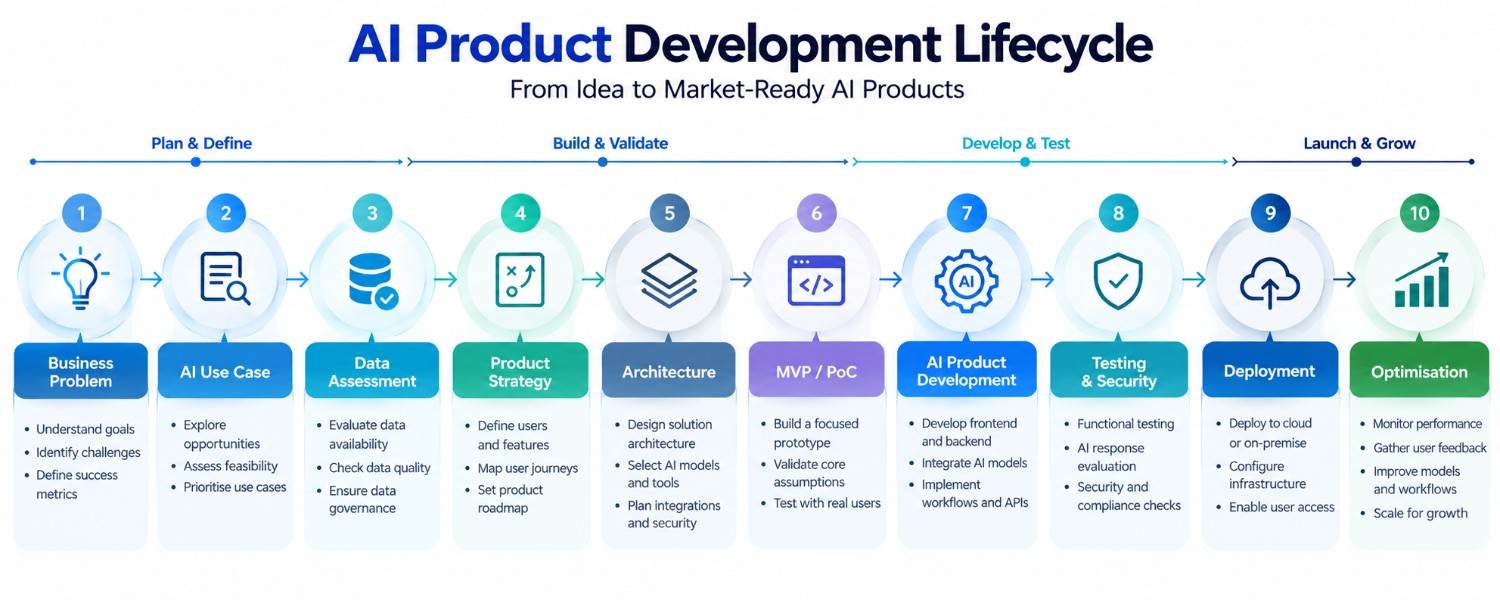
A practical AI product development journey can be organised into the following stages:
| Stage | Main objective | Key questions |
| 1. Business Problem | Define the opportunity | What problem are we solving? |
| 2. AI Use Case | Determine where AI fits | Can AI improve this process? |
| 3. Data Assessment | Evaluate available information | Do we have the right data? |
| 4. Product Strategy | Define users and features | What should the first version include? |
| 5. Architecture | Select the technical approach | How will the application, AI and data work together? |
| 6. MVP / PoC | Test the core idea | Does the solution work in practice? |
| 7. Development | Build the product | How will the complete application operate? |
| 8. Testing & Security | Validate quality and safety | Is it reliable and secure? |
| 9. Deployment | Release the product | Can users access it reliably? |
| 10. Optimisation | Improve performance | What should be changed based on real usage? |
This approach keeps the development process connected to business outcomes instead of technology alone.
What Types of AI Products Can Businesses Build?
The right AI product depends on the company’s objectives, users, available data, industry, and existing technology environment.
1. AI Knowledge Assistants
An AI knowledge assistant allows employees or customers to interact with company information using natural language.
For example, an organisation may want its employees to search across:
- Standard operating procedures
- Product documentation
- Internal policies
- Contracts
- FAQs
- Training materials
- Company knowledge bases
UAutomate AI’s RAG solutions focus on connecting AI knowledge assistants with business documents and internal information.
Typical RAG-Based Knowledge Assistant
| Step | What happens |
| 1 | Business documents are collected |
| 2 | Documents are processed and organised |
| 3 | Relevant information is indexed |
| 4 | A user asks a question |
| 5 | The system retrieves relevant information |
| 6 | The AI generates a response using that context |
| 7 | The response is presented to the user |
This approach can be useful for organisations where employees spend significant time searching through large volumes of internal information.
Businesses dealing with large volumes of internal information can also explore AI knowledge assistants that allow employees to search company documents and business information through natural-language queries.
2. AI Customer Support Products
AI can also become part of a customer-support product.
Depending on the use case, an AI system may help with:
- Frequently asked questions
- Product information
- Order-related questions
- Appointment assistance
- Lead qualification
- Basic troubleshooting
- Human-agent escalation
The goal should not necessarily be to automate every customer interaction.
A better approach is to establish clear boundaries:
What can AI answer?
What information can it access?
Which actions can it perform?
When should the conversation be transferred to a person?
These decisions are part of product design, not just AI configuration.
3. AI Document Processing Products
Many organisations deal with large quantities of documents, including invoices, contracts, applications, reports, forms, and PDFs.
An AI document-processing product can potentially:
- Receive a document
- Extract relevant information
- Classify the document
- Validate selected fields
- Convert information into structured data
- Trigger a business workflow
- Send exceptions to a human reviewer
This type of application can be useful across finance, insurance, logistics, professional services, and other document-heavy industries.
UAutomate AI lists AI document processing and retrieval among its AI solution areas.
4. AI Analytics and Decision-Support Platforms
AI can also be integrated into business intelligence and analytics products.
Instead of requiring managers to manually interpret multiple dashboards, an AI layer can help surface relevant information and provide a more accessible way to interact with business data.
Possible capabilities include:
- Predictive analytics
- Automated reporting
- Business insights
- Trend identification
- Data summarisation
- Operational dashboards
UAutomate AI’s published AI capabilities include predictive analytics, operational dashboards, AI reporting systems, business-insight automation, and data intelligence platforms.
5. AI Learning and Recommendation Products
AI can be used to create products that adapt to individual users.
Examples include:
- AI coaching platforms
- Recommendation systems
- Adaptive learning applications
- Employee training assistants
- Personalised content platforms
The value comes from using relevant information and user interactions to create a more personalised experience.
What Does an AI Product Architecture Look Like?
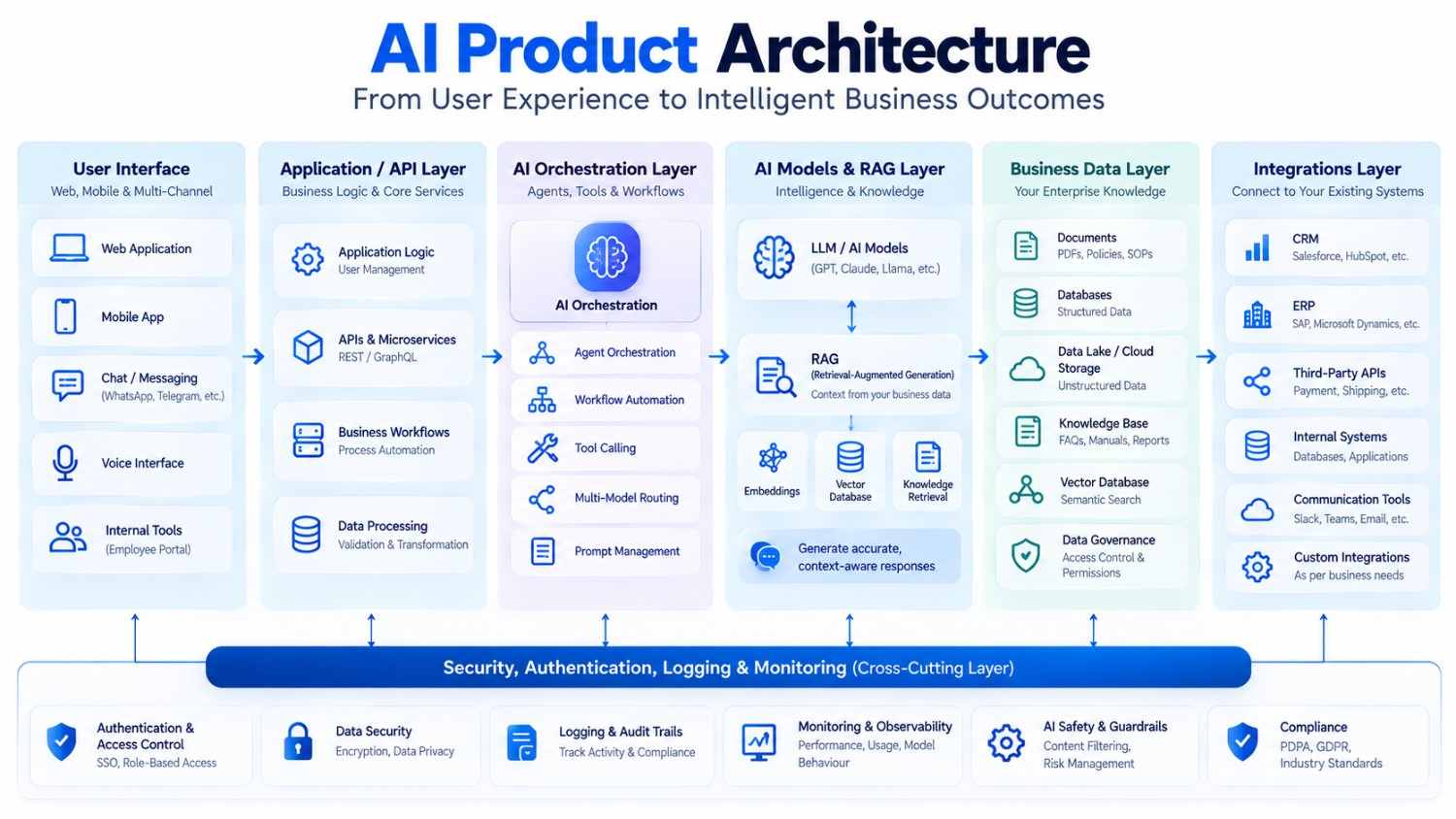
An AI product normally consists of several connected layers. The exact architecture depends on the product, but a typical system may include the following:
| Layer | Purpose |
| User Interface | Provides the customer or employee experience |
| Application Layer | Handles product logic and user requests |
| API Layer | Connects the application with other systems |
| AI Orchestration | Determines how AI models, tools and workflows interact |
| AI / LLM Layer | Performs language, reasoning or other AI tasks |
| RAG Layer | Retrieves relevant information when required |
| Data Layer | Stores application and business information |
| Integration Layer | Connects CRM, ERP, databases and external services |
| Security Layer | Controls authentication, access and data protection |
| Monitoring Layer | Tracks system and AI performance |
UAutomate AI’s published AI architecture approach includes LLM orchestration, RAG, tool calling, integrations, and multi-model approaches rather than treating an AI model as the complete application.
This layered approach can make an AI product easier to manage, secure, test, and scale.
The AI Product Development Process: From Concept to Production
Building an AI product is usually an iterative process. The exact steps can vary, but a structured approach helps reduce unnecessary development work.
Stage 1: Define the Business Problem
The first stage is understanding the problem in enough detail to determine whether AI is actually appropriate.
Important questions include:
- Who is the target user?
- What problem are they experiencing?
- How is the problem currently handled?
- How much time or money does the current process consume?
- Where are the biggest bottlenecks?
- What information is available?
- What outcome would indicate success?
The objective is to establish a clear business case before moving into technical development.
Stage 2: Identify the AI Use Case
Not every business problem needs AI.
For each potential use case, consider:
| Evaluation question | Why it matters |
| Is the process repetitive? | Automation may provide value |
| Is relevant data available? | AI needs appropriate information |
| Does the process involve language, prediction or classification? | AI may be suitable |
| What happens if AI makes a mistake? | Determines required safeguards |
| Can success be measured? | Enables meaningful evaluation |
| Does AI improve the existing process? | Prevents unnecessary AI adoption |
This stage can help businesses avoid investing in an AI solution simply because the technology is available.
Stage 3: Assess Data and Feasibility
AI product development is closely connected to data.
Before development begins, businesses should examine:
- Data availability
- Data quality
- Data ownership
- Data formats
- Data accessibility
- Data sensitivity
- Data freshness
- Data governance
For a knowledge assistant, for example, documents may need to be collected, cleaned, processed, indexed, and connected to a retrieval system before users can obtain useful answers from them.
Stage 4: Design the Product and Architecture
Once the use case has been validated, the product and technical architecture can be planned.
This can include:
- User journeys
- Product features
- AI architecture
- Application architecture
- Model requirements
- Data architecture
- API integrations
- Authentication
- Security requirements
- Monitoring requirements
The goal is to build an architecture that supports the current product while leaving room for future development.
Stage 5: Build an MVP or Proof of Concept
An MVP is useful when a business needs to validate its main product assumption before investing in a larger system.
Suppose a company wants to develop an AI customer-support platform.
Rather than building every possible feature immediately, the first version could focus on:
| MVP component | Purpose |
| Customer interface | Allows users to ask questions |
| Knowledge base | Provides approved information |
| AI retrieval | Finds relevant information |
| AI response | Produces an answer |
| Escalation | Sends uncertain cases to staff |
| Basic analytics | Measures usage and outcomes |
If the initial version demonstrates value, additional features can then be introduced.
This approach helps reduce unnecessary complexity and allows the business to learn from actual users.
Stage 6: AI Product Development
Once the core product idea has been validated, development can expand into a more complete application.
Depending on the requirements, engineering may involve:
- Frontend development
- Backend development
- AI model integration
- Prompt and workflow orchestration
- RAG
- Vector databases
- API integrations
- Authentication
- User management
- Data pipelines
- AI evaluation
- Monitoring
- Cloud deployment
UAutomate AI describes its AI product engineering capabilities around AI-powered tools designed to address specific business challenges, alongside RAG, LLM engineering, conversational AI, and AI automation.
Stage 7: Testing, Security and AI Evaluation
AI products require more than traditional software testing.
Testing may include:
Functional Testing
Does the application perform the functions it was designed to perform?
AI Response Testing
Does the system provide useful, relevant, and consistent responses?
Hallucination Testing
What happens when the required information is unavailable?
Security Testing
Can users access information or functions that they are not authorised to access?
Integration Testing
Does the AI system interact correctly with CRMs, ERPs, databases, and other connected systems?
Performance Testing
Can the system handle the expected number of users and requests?
Failure Testing
What happens if an AI service, API, or database becomes unavailable?
Security is particularly important when an AI application works with private company information. Businesses can also explore practical considerations around AI app security, including access controls, private deployments, and protecting sensitive AI infrastructure.
UAutomate AI’s published security material discusses controls including role-based access, private deployments, encryption, and protected vector databases for business AI systems.
Stage 8: Deployment and Continuous Optimisation
Launching an AI product is not the final stage.
Once users begin interacting with the system, businesses can collect information that helps identify what is working and what needs improvement.
Important metrics may include:
- User adoption
- Response quality
- Error rates
- Response time
- Infrastructure usage
- AI/model costs
- User feedback
- Escalation rates
- Security events
- Business outcomes
A useful post-launch cycle is:
Launch → Measure → Collect Feedback → Identify Issues → Improve → Test → Release → Repeat
This continuous process is particularly important for AI products because models, prompts, data, integrations, and user behaviour can all change over time.
How Much Does AI Product Development Cost in Indonesia?
There is no universal price for developing an AI product.
The total investment depends on what is being built, who will use it, how much data is involved, what integrations are required, and what level of security and scalability is needed.
Major AI Product Development Cost Factors
| Cost factor | Why it affects the budget |
| Product complexity | More functionality requires more development |
| Number of users | Larger scale may require additional infrastructure |
| AI model requirements | Models and usage patterns can have different costs |
| Data preparation | Poor-quality or unstructured data may require additional work |
| Integrations | CRM, ERP and third-party systems add development complexity |
| Security | Sensitive applications may require additional controls |
| UI/UX | Customer-facing products may require more design and testing |
| MVP scope | A larger MVP requires more engineering |
| Infrastructure | Cloud or private deployment requirements affect cost |
| Maintenance | AI products require ongoing monitoring and improvement |
A Better Way to Estimate AI Development Cost
Instead of starting with a generic question such as:
“How much does an AI product cost?”
businesses should first define:
Product scope → Target users → Data → AI requirements → Integrations → Security → Deployment
Once these factors are understood, a development partner can provide a much more meaningful estimate.
Build In-House or Work With an AI Product Development Partner?
There is no universal answer.
An established internal engineering team with AI expertise may prefer to build in-house. A company without those capabilities may find that working with an experienced development partner is more practical.
| Factor | In-House Development | Development Partner |
| AI expertise | Needs to exist or be developed internally | Can be accessed externally |
| Recruitment | May be necessary | Usually not required for the partner’s team |
| Product control | High | Depends on the engagement |
| Technical ownership | Internal | Defined contractually |
| Team setup | Can take time | Development team can already exist |
| Specialist skills | Need to be built internally | Can be provided by the partner |
| Long-term maintenance | Internal responsibility | Can be shared or outsourced |
The best option depends on the organisation’s technical maturity, product requirements, timeline, budget, and long-term strategy.
How to Choose the Right AI Product Development Partner in Indonesia
Selecting an AI development company should involve more than checking whether the company can integrate an AI model.
1. Can They Understand the Business Problem?
A strong development partner should be able to translate business requirements into a realistic product and technical strategy.
2. Can They Build Beyond a Prototype?
Ask about their approach to:
- Architecture
- Security
- Testing
- Deployment
- Monitoring
- Scalability
A proof of concept and a production application are not the same thing.
3. How Do They Handle Business Data?
Discuss:
- Data access
- Data storage
- User permissions
- Encryption
- Data retrieval
- Governance
This is especially important for applications using confidential business information.
4. Can They Integrate With Existing Systems?
An AI product often needs to work alongside technology the company already uses.
These systems may include:
- CRM platforms
- ERP systems
- Databases
- Calendars
- Communication platforms
- Internal applications
5. Do They Have an AI Evaluation Strategy?
A development partner should have a method for determining whether the AI system is performing as expected.
Evaluation can involve test datasets, expected responses, human review, automated checks, performance metrics, and ongoing monitoring.
6. What Happens After Launch?
Ask whether the engagement includes or can support:
- Maintenance
- Monitoring
- AI improvements
- Model updates
- Performance optimisation
- Technical support
7. Can They Start With a Focused MVP?
A capable partner should be able to distinguish between essential features and features that can be introduced later.
This helps keep the first version focused on validating the core business objective.
Indonesia or Singapore: What Should Businesses Consider?
The location of an AI development partner should not be the only factor when choosing a technology provider.
Businesses comparing an AI App Development Company Singapore with an AI App Development Company Indonesia should evaluate the fundamentals of the development partner, including:
- AI engineering capability
- Product development experience
- Data security
- Integration capabilities
- Communication
- Development methodology
- Scalability
- Post-launch support
- Understanding of the target market
Singapore has also seen significant growth in enterprise AI adoption. According to Singapore’s Infocomm Media Development Authority, AI adoption among SMEs increased from 4.2% in 2023 to 14.5% in 2024, while adoption among non-SMEs increased from 44% to 62.5%.
IMDA’s research also indicates that organisations use a mix of general-purpose generative AI tools, domain-specific AI solutions, and customised or proprietary AI tools.
This highlights an important point: businesses do not necessarily need to choose between “using AI” and “building AI.”
The appropriate approach depends on the product, business requirements, data, and level of differentiation required.
For companies considering an AI Product Development Company Singapore, the same fundamentals should apply: product strategy, architecture, AI engineering, data handling, security, scalability, and measurable business outcomes.
Why UAutomate AI Can Be Considered for AI Product Development
UAutomate AI positions itself as an AI engineering partner focused on building and deploying AI systems for business applications.
Its published capabilities include:
- AI product and platform engineering
- Retrieval-Augmented Generation
- Conversational AI
- AI document processing
- LLM workflow orchestration
- AI agents
- AI analytics
- AI automation
- AI learning and training platforms
- AI integrations and tool-calling systems
These capabilities can be relevant when a business needs more than a standalone chatbot and wants AI to become part of a broader application, workflow, knowledge system, or digital platform.
UAutomate AI also describes a discovery-led approach that begins with understanding the client’s requirements and user journeys before moving into proposal, engineering, and deployment.
For a company exploring an AI product, this type of approach can help determine whether the right solution is:
- A new AI product
- An AI feature inside an existing application
- An AI automation workflow
- An AI knowledge system
- An AI-powered business platform
The answer should come from the business requirement rather than from the technology itself.
A Practical AI Product Readiness Checklist
Before approaching an AI development partner, businesses can prepare the following information:
| Question | What to define |
| What business problem are we solving? | The specific challenge |
| Who will use the product? | Customer, employee, partner, etc. |
| What is the primary user journey? | The key action users need to complete |
| What data is available? | Documents, databases, APIs, etc. |
| Is the data structured or unstructured? | Data format and accessibility |
| Which systems need integration? | CRM, ERP, database, third-party services |
| What should AI do? | Specific AI responsibilities |
| What should AI not do? | Boundaries and restrictions |
| What happens when AI is uncertain? | Human escalation or alternative workflow |
| What security requirements exist? | Access, privacy and protection |
| What would make the MVP successful? | Measurable success criteria |
| Which business metric should improve? | Revenue, time, efficiency, conversion, etc. |
The more clearly these questions are answered, the easier it becomes to define the product scope and technical requirements.
What Makes an AI Product Successful?
Technology alone does not determine whether an AI product succeeds.
A strong AI product needs several elements to work together:
| Success factor | Why it matters |
| Business value | Gives the product a clear reason to exist |
| User experience | Makes the technology useful and accessible |
| Product design | Connects AI capabilities to real user needs |
| Technology | Provides the necessary technical foundation |
| Data | Gives the AI system relevant information |
| Security | Protects users and business information |
| Measurement | Shows whether the product is achieving its objectives |
| Optimisation | Allows the product to improve over time |
A technically impressive AI system can still fail if customers do not need it.
On the other hand, a relatively focused AI feature can create significant value when it solves a frequent, costly, or frustrating problem.
The strongest AI products therefore connect technology with a measurable business outcome.
Businesses developing AI products should also consider responsible AI principles such as transparency, privacy, security, robustness and accountability. The OECD AI Principles provide internationally recognised guidance for developing trustworthy AI.
Frequently Asked Questions
1. What does an AI product development company do?
An AI product development company helps businesses plan, build, deploy, and improve products that use artificial intelligence. Depending on the project, this can include product strategy, application development, AI model integration, RAG, data engineering, workflow orchestration, integrations, security, testing, and deployment.
2. How much does it cost to develop an AI product in Indonesia?
The cost depends on the product’s complexity, AI requirements, data preparation, integrations, security, expected user volume, infrastructure, and maintenance requirements. A reliable estimate should be prepared after the product scope and technical requirements have been defined.
3. How long does it take to build an AI product?
The timeline depends on the scope and complexity of the product. A focused MVP can generally require less development work than a full production platform involving multiple AI workflows, integrations, user roles, security controls, and large-scale infrastructure. UAutomate AI states that development timelines vary according to project complexity.
4. What types of AI products can businesses build?
Businesses can develop AI knowledge assistants, customer-support applications, document-processing systems, recommendation engines, predictive analytics platforms, AI SaaS products, learning platforms, conversational AI applications, and workflow automation solutions.
5. What is the difference between AI app development and AI product development?
AI app development generally focuses on creating an application that includes AI functionality. AI product development can cover a broader lifecycle, including identifying the business opportunity, defining the product, validating the idea, designing the architecture, building the application, deploying it, measuring results, and continuously improving it.
6. Should a business build an AI product from scratch?
Not necessarily. Businesses should first determine whether an existing AI product or platform can meet their requirements. Custom development becomes more attractive when the company needs proprietary workflows, specialised integrations, unique data, a differentiated user experience, or greater control over how AI operates.
7. Can AI product development start with an MVP?
Yes. Starting with a focused MVP can help a business validate its core product assumption before investing in a larger system. The MVP should concentrate on the most important user journey rather than attempting to include every possible AI feature.
8. How do I choose the right AI product development company?
Evaluate the company’s ability to understand your business problem, design a suitable architecture, work with your data, integrate existing systems, evaluate AI performance, implement security measures, deploy the product, and support ongoing improvements. Technical capability should be considered alongside communication, transparency, scalability, and post-launch support.
Build the AI Product Around the Problem—Not the Hype
The opportunity for businesses in Indonesia is not simply to add an AI chatbot to an existing application. The larger opportunity is to identify where intelligent technology can improve a product, simplify a workflow, create a better customer experience, or enable an entirely new business capability.
Indonesia’s continued investment in AI talent, research, governance, innovation, and infrastructure shows that artificial intelligence will remain an important part of the country’s technology landscape.
For businesses considering an AI Product Development Company Indonesia, the best starting point is therefore a clearly defined business problem—not a particular AI model.
Define the user.
Understand the workflow.
Assess the available data.
Validate the AI use case.
Build a focused MVP.
Test it carefully.
Secure the system.
Measure the outcome.
Then scale what works.
If you are exploring an AI-powered product, platform, knowledge assistant, automation solution, or AI application, contact UAutomate AI to discuss your requirements and determine the most appropriate development approach.