
Choosing an AI development company in Singapore is no longer just about finding someone who knows how to connect an application to an AI model. Most businesses face the more complex challenge: finding a partner who will understand the business problem and be able to implement an AI solution on existing data and systems so that it can be put to practical use.
The market is saturated with companies offering AI development, application development, chatbots, automation, agents, or other AI-related services. Attractive demo projects say little about the ability of the chosen team to develop a reliable production system.
The critical question to ask yourself when looking for an AI development partner is:
Can this partner understand the business problem and deliver an intelligent solution that would make practical use of AI, be secure, and bring real business value?
Whether you are looking to develop an AI application, an internal knowledge assistant, an AI agent, or an automated workflow system, or an AI-powered product — there are essential questions to ask, red flags to watch out for, and criteria to use when comparing potential vendors. This guide will tell you what to look for when choosing an AI development company.
Before You Shortlist a Vendor, Define What You Want AI to Solve
One of the most common mistakes done by businesses is to search for an AI vendor before even defining what problem they have that AI could solve.
For example, a business could come up with an idea such as ‘We want an AI chatbot’. But upon talking through details and the workflow, it could emerge that the true problem to solve may be something like ‘Our customer service team is spending several hours every day answering repetitive questions, and looking for answers in internal documents’. These are clearly not the same problem, requiring different solutions. The first is just a goal (a description of technology), while the second is a business problem. A competent AI development partner should help you move from the second bullet to an appropriate technical description.
Start With These Five Questions
| Question | What you are trying to understand |
| What business problem are we solving? | The actual reason for investing in AI |
| Who is affected by the problem? | The users and stakeholders |
| How is the process handled today? | Existing workflows and inefficiencies |
| What data and systems are involved? | Technical and integration requirements |
| What should improve after implementation? | The expected business outcome |
This initial exercise will help you avoid creating an expensive AI project with no clear purpose behind it. For example, a business may find that a repetitive and rule-based process would be better automated with regular software. Another business may find that their current process involves documents, natural language, recommendations or decisions, and in such cases AI could create much bigger value than regular software.
A good development partner should be willing to explain to you in what ways AI makes sense and what could be automated with regular software.
A Practical Pre-Vendor Checklist
Before approaching an AI development company, document:
- The business problem
- Current workflow
- Target users
- Existing software and systems
- Available business data
- Security requirements
- Expected outcomes
- Approximate budget
- Desired timeline
- Success metrics
With this information at hand, you’ll not only be able to get more accurate quotes from vendors but also have a more productive conversation in general.
Understand Which Type of AI Solution You Actually Need
“AI development” is a vague concept. An organization that seeks to develop an internal document assistant has different requirements from a firm that wants to create an AI-driven customer-facing application.
Understanding what kind of solution one needs can help in ascertaining whether a vendor has the relevant expertise.
AI-Powered Business Applications
An AI application combines traditional software functionality with AI capabilities.
Examples include:
- AI-enabled dashboards
- Intelligent customer portals
- Internal operational tools
- AI-powered business applications
- Recommendation systems
- Decision-support platforms
UAutomate AI describes its custom AI software development offering as covering AI-powered web applications, dashboards, internal operational tools, business management systems, and customer portals.
This is particularly relevant when AI App Development Singapore is being considered as part of a larger business application rather than as a standalone chatbot.
AI Knowledge Assistants and RAG
If your business has a large repository of documents, policy, contracts, reports, manuals or other files, the challenge may not be in training an AI model from scratch. Rather, it may be in finding the right information for your users quickly.
Retrieval-Augmented Generation (commonly known as RAG) allows an AI-powered application to retrieve relevant information from a knowledge repository, and to use that context when responding.
A Simple RAG Example
| Stage | What happens |
| 1. Business documents | PDFs, policies, SOPs, spreadsheets or other approved information are collected |
| 2. Data processing | The information is prepared for retrieval |
| 3. Search/retrieval | Relevant information is identified based on the user’s question |
| 4. AI generation | The AI model uses the retrieved context to formulate an answer |
| 5. User response | The user receives a response grounded in the available business information |
RAG can be useful for:
- Internal knowledge assistants
- Document search
- Employee support
- Customer support
- Policy search
- Contract information retrieval
- Business knowledge systems
UAutomate AI currently offers AI knowledge assistants and RAG systems designed to work with business documents, SOPs, PDFs, spreadsheets, policies, contracts, and internal data.
When evaluating a vendor, don’t stop at the question, “Do you build RAG?”
Ask how the company handles:
- Retrieval quality
- Permissions
- Data updates
- Incorrect answers
- Evaluation
- Monitoring
- Security
Those details often matter more than the technology label itself.
AI Agents and Autonomous Workflows
AI agents are another area where development experience matters.
A typical chatbot responds to user questions. Also an AI agent may put together info from various sources, use approved tools, decide within set parameters and do actions.
For instance an AI based sales process could include:
- Receiving a customer enquiry
- Understanding the customer’s intent
- Retrieving relevant product information
- Checking the CRMA.
- Preparing a response
- Requesting human approval where necessary
- Updating the CRM
- Recording the interaction
For complex procedures, also see that several specialist agents team up.
Example: Multi-Agent Business Workflow
| Agent | Possible responsibility |
| Research Agent | Finds and summarizes relevant information |
| Data Agent | Retrieves business data |
| Decision Agent | Applies defined business logic |
| Action Agent | Performs approved tasks |
| QA Agent | Reviews output before completion |
| Human Reviewer | Approves sensitive or high-impact actions |
UAutomate AI’s published AI architecture includes RAG, MCP tool access, planning and routing, specialist agents, guardrails, and evaluation.
A serious vendor should therefore be able to explain:
- When an AI agent is appropriate
- Which tools it can access
- Which actions require approval
- How permissions are controlled
- How agent behaviour is evaluated
- What happens when the agent makes a mistake
Don’t Evaluate an AI Vendor Only by the Model It Uses
It is easy to focus on model names when comparing AI development companies.
A business might ask:
“Which AI model do you use?”
That question is relevant, but it should not be the main deciding factor.
More useful questions include:
- Why is that model appropriate for our use case?
- Would another model provide better cost or performance?
- How will the model access our business data?
- How will its responses be evaluated?
- What happens when it produces an incorrect answer?
- How will model changes be tested?
- What happens if a third-party AI service becomes unavailable?
An AI model is only one part of a larger system.
Think About the Complete Technology Stack
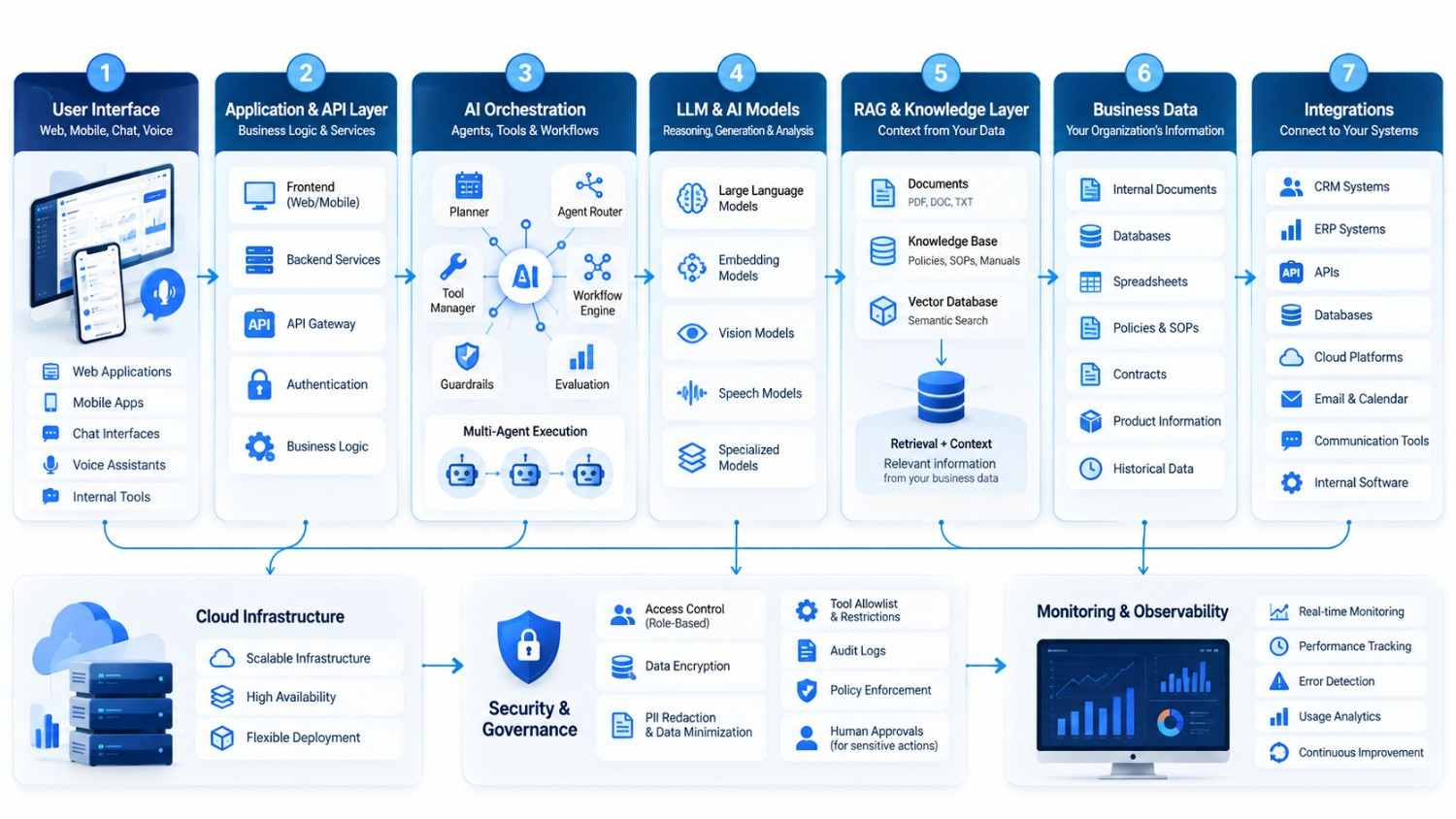
| Layer | Purpose |
| User interface | Where employees or customers interact with the solution |
| Application/API layer | Connects the application with business logic |
| AI orchestration | Controls how models, tools and workflows interact |
| AI models | Generates, classifies, summarizes or reasons over information |
| RAG/knowledge layer | Provides relevant business context |
| Business data | Supplies approved organizational information |
| Integrations | Connects CRM, ERP, databases and other systems |
| Security | Controls access and protects information |
| Monitoring | Tracks performance, errors and system behaviour |
UAutomate AI describes a production-oriented architecture combining RAG, MCP, orchestration, multi-agent execution, guardrails and observability.
This is why AI development Singapore should be evaluated as a complete systems capability rather than simply access to an AI API.
Evaluate Production Experience, Not Just Impressive Demos
A prototype can prove that something is technically possible.
Production development is a different challenge.
Once real users begin interacting with an AI system, businesses need to consider questions such as:
- What happens with unexpected inputs?
- How is AI performance measured?
- What happens when an external API fails?
- How are permissions enforced?
- How are incorrect outputs identified?
- How is the system monitored?
- What happens when business data changes?
- How are updates tested?
Current AI vendor-selection guidance increasingly emphasizes production capability rather than demonstrations alone.
Ask for Evidence
Instead of asking:-“Have you built AI before?”
Ask:-“Can you show us examples of AI systems that moved beyond a prototype and explain how they were operated after deployment?”
You can also ask:
- What business problem did the project solve?
- What architecture was selected?
- Which integrations were required?
- What were the biggest technical challenges?
- How was the system evaluated?
- What happened after launch?
- How was performance monitored?
- What did the team learn from the project?
Production-Readiness Checklist
| Capability | What to look for |
| AI architecture | Clear reasoning behind technology decisions |
| Application development | Production-grade frontend and backend capabilities |
| Data management | Structured approach to business information |
| Integrations | APIs, CRM, ERP, databases and other systems |
| Evaluation | Defined testing and quality metrics |
| Security | Access and data protection controls |
| Monitoring | Logs, performance tracking and error visibility |
| Deployment | A clear production rollout process |
| Support | Maintenance and optimization after launch |
A vendor that can discuss these areas clearly is generally easier to evaluate than one that only presents a polished demonstration.
Security Should Be Part of the Architecture From Day One
AI projects can involve customer information, employee data, sensitive documents, financial information, intellectual property, or other confidential business information.
For this reason, security should not be considered as an addition to be made prior to launch.
The Personal Data Protection Commission of Singapore has issued guidelines on the application of data protection principles to AI systems, and the use of personal data in AI development and deployment.
The AI governance resources of Singapore also address topics including accountability, data, testing and assurance, security, incident management, and trusted AI development and deployment.
Where Does the Data Go?
Before signing with an AI development partner, understand:
- Where data is stored
- Which systems process it
- Which third-party services receive it
- Who can access it
- How long information is retained
- How access is revoked
How Are Permissions Handled?
An internal AI assistant should not automatically expose every company document to every employee.
Depending on the application, the architecture may need:
- Role-based access
- Permission-aware retrieval
- Authentication
- Tool restrictions
- Audit logs
- Data minimization
- PII controls
- Human approval
UAutomate AI’s published AI architecture includes controls such as PII redaction, data minimization, tool allowlists, role-based access control, policy enforcement, human approvals, and audit logs.
Security Questions to Ask Your Vendor
| Question | What you should understand |
| Where is our data processed? | Infrastructure and processing locations |
| Who can access the data? | Roles and permissions |
| Is our data used for model training? | Data usage policies |
| How are credentials managed? | Authentication and access controls |
| Are AI actions logged? | Auditability |
| Can sensitive actions require approval? | Human oversight |
| How are AI failures handled? | Monitoring and escalation |
The goal is not to make every AI project unnecessarily complicated. It is to make sure the security approach matches the sensitivity and risk of the application.
Check Whether the Company Can Integrate With Your Existing Systems
An AI application is rarely useful on its own.
In most cases, businesses want the ability to integrate such technology into their existing systems.
For instance, an AI-based lead qualification tool would be significantly more valuable if it could assess incoming inquiries and update the CRM with the results instead of simply providing a text response.
The following list contains potential integrations:
- CRM
- ERP
- Databases
- APIs
- Calendar
- Internal software
- Cloud platforms
UAutomate AI lists CRM, ERP, database, API, cloud, and internal software integrations among its AI integration capabilities.
Integration Evaluation Checklist
| Area | Question to ask |
| Existing software | Which systems must the AI solution connect to? |
| APIs | Are APIs already available? |
| Authentication | How will secure access be managed? |
| Data exchange | What information needs to move between systems? |
| Real-time requirements | Does information need to be updated immediately? |
| Permissions | What actions can the AI system perform? |
| Failure handling | What happens when an integration fails? |
| Monitoring | How will integration errors be detected? |
A vendor should be able to discuss these requirements before development begins.
Evaluate the Team, Not Just the Company Website
A company’s website tells you what it offers.
The project team determines what you actually experience during development.
Ask:
Who will design the architecture?
You should know who is responsible for the major technical decisions.
Who will build the application?
Understand which developers or engineers will be involved.
Who handles AI evaluation?
AI quality should be tested rather than assumed.
Who manages deployment?
Production deployment requires planning around infrastructure, security and operational requirements.
Who supports the solution after launch?
This is especially crucial for AI since models, APIs, business data and workflows evolve over time.
One good question to raise during your conversations with the vendor is:
“Who from the team we are talking to today will be actually working on our project?”
This answer gives a glimpse into the company’s approach to the delivery of the solution.
Compare Proposals by Value, Not Just the Lowest Price
Price matters, but comparing AI vendors solely on the quoted development cost can be misleading.
Two proposals may appear similar at first glance while including very different levels of work.
| Area | Vendor A | Vendor B |
| Discovery | Included | Included |
| AI architecture | Basic | Detailed |
| Integrations | 2 | 5 |
| Evaluation | Limited | Included |
| Security | Basic | Detailed |
| Deployment | Included | Included |
| Monitoring | Not specified | Included |
| Post-launch support | 30 days | 90 days |
| Development cost | Lower | Higher |
The cheaper proposal may not actually be cheaper if important work has been excluded.
For example, additional development, integrations, infrastructure, monitoring or maintenance may appear later as separate costs.
Separate One-Time and Recurring Costs
One-time costs may include:
- Discovery
- Architecture
- UI/UX
- Development
- Integration
- Data preparation
- Testing
- Deployment
Recurring costs may include:
- Cloud infrastructure
- AI model/API usage
- Monitoring
- Maintenance
- Data processing
- Support
- Future development
Ask the vendor to separate these costs clearly.
That makes it easier to estimate the actual total cost of ownership rather than comparing only the initial quotation.
Don’t Forget Ownership and Handover
Before signing an agreement, clarify exactly what your organization will own.
Depending on the project, this may include:
- Source code
- Application
- Business data
- Documentation
- Prompts
- Workflows
- Configuration
- Infrastructure accounts
- Knowledge base
- Integration credentials
- Evaluation datasets
You should also understand what happens if you eventually decide to change development partners.
Ownership Checklist
| Area | Question |
| Source code | Who owns the code? |
| Data | Who owns and controls the business data? |
| Infrastructure | Who controls the relevant accounts? |
| Documentation | What documentation will be provided? |
| Knowledge base | Can it be exported or transferred? |
| Integrations | Can another technical team maintain them? |
| Handover | What happens if the vendor relationship ends? |
Ownership terms should be written into the agreement rather than left to assumptions.
Test the Vendor Before Making a Large Commitment
You do not always need to begin with a large AI transformation project.
A focused discovery engagement or proof of concept can help determine whether the proposed approach is technically and commercially viable.
But a proof of concept should have a clear purpose.
A weak PoC asks: “Can we build an AI chatbot?”
A stronger PoC asks: “Can this AI system retrieve the right information from our approved documents, follow our access rules, and complete the target workflow within our required performance level?”
A Practical PoC Evaluation
| Stage | What happens |
| Business use case | Define the specific problem |
| Sample data | Use representative business information |
| Technical hypothesis | Decide what needs to be proven |
| Prototype | Build a focused version |
| Evaluation | Test against agreed criteria |
| Business validation | Review the result with actual users |
| Production decision | Decide whether to scale |
Define success criteria before development begins.
| Metric | Example evaluation |
| Accuracy | Does the system provide useful answers? |
| Retrieval quality | Does it find the right information? |
| Response time | Is the system fast enough? |
| Reliability | Does it behave consistently? |
| Security | Are permissions respected? |
| Integration | Does it work with existing systems? |
| Business impact | Does it improve the target process? |
10 Questions to Ask Before Hiring an AI Company in Singapore
Before choosing a vendor, ask the same basic questions to each shortlisted company.
- What similar systems have you developed?
Ask about experience with similar systems to your requirement rather than a long wish list of other technologies.
- Which projects have seen final production?
Ask what happened after the demo/prototype.
- What architecture do you think we should aim for?
The vendor should be able to explain and justify their recommendation.
- Would you recommend RAG, agents, automation, traditional software or a mix of these?
This indicates if the vendor is using a solution-led or problem-led approach.
- How will our data be used?
Ask about where it will be stored and who will have access to it.
- How will you measure the performance of the AI?
Ask about testing and validation sets, feedback loops, monitoring and improvement.
- How will the AI connect to our systems?
Ask about the interfaces, databases, CRM, ERP or other systems that will be required.
- What are the one-time and recurring costs?
Ask for a breakdown of costs so you understand what you are paying for. Make sure that development costs are separated from operational costs.
- Who will own the finished system?
Make sure that you understand who owns the source code, data, infrastructure, documentation and other assets.
- What support or maintenance will be provided?
Ask about maintenance, monitoring, troubleshooting, performance management and future development.
Watch out for These Red Flags
Not all vendors are equally prepared to handle production development.
Below are some of the red flags that should raise concern.
Red Flag 1: The conversation starts with technology
If the first meeting is focused on models, prompts and other aspects of AI without asking enough questions about the business processes, ask more questions.
Red Flag 2: They promise perfect AI accuracy
AI requires testing, validation, monitoring and the right controls. Avoid vendors that are not transparent about these details.
Red Flag 3: They cannot explain their architecture
You may not be an expert in engineering, but any competent vendor should be able to explain their technical solution on a level that is easy to understand.
Red Flag 4: Security is mentioned only at the end
When building a system that will contain business or personal data, security should be part of the design process.
Red Flag 5: Their pricing is vague
A competent vendor should be able to provide a detailed breakdown of costs that includes deliverables, exclusions and factors that may lead to additional expenses.
Red Flag 6: They cannot explain support after launch
Depending on the complexity there may be a need for monitoring, maintenance, optimization and other services after launch.
Red Flag 7: Everything must use AI
A competent vendor should recognize when other approaches are more efficient compared to AI-driven solutions
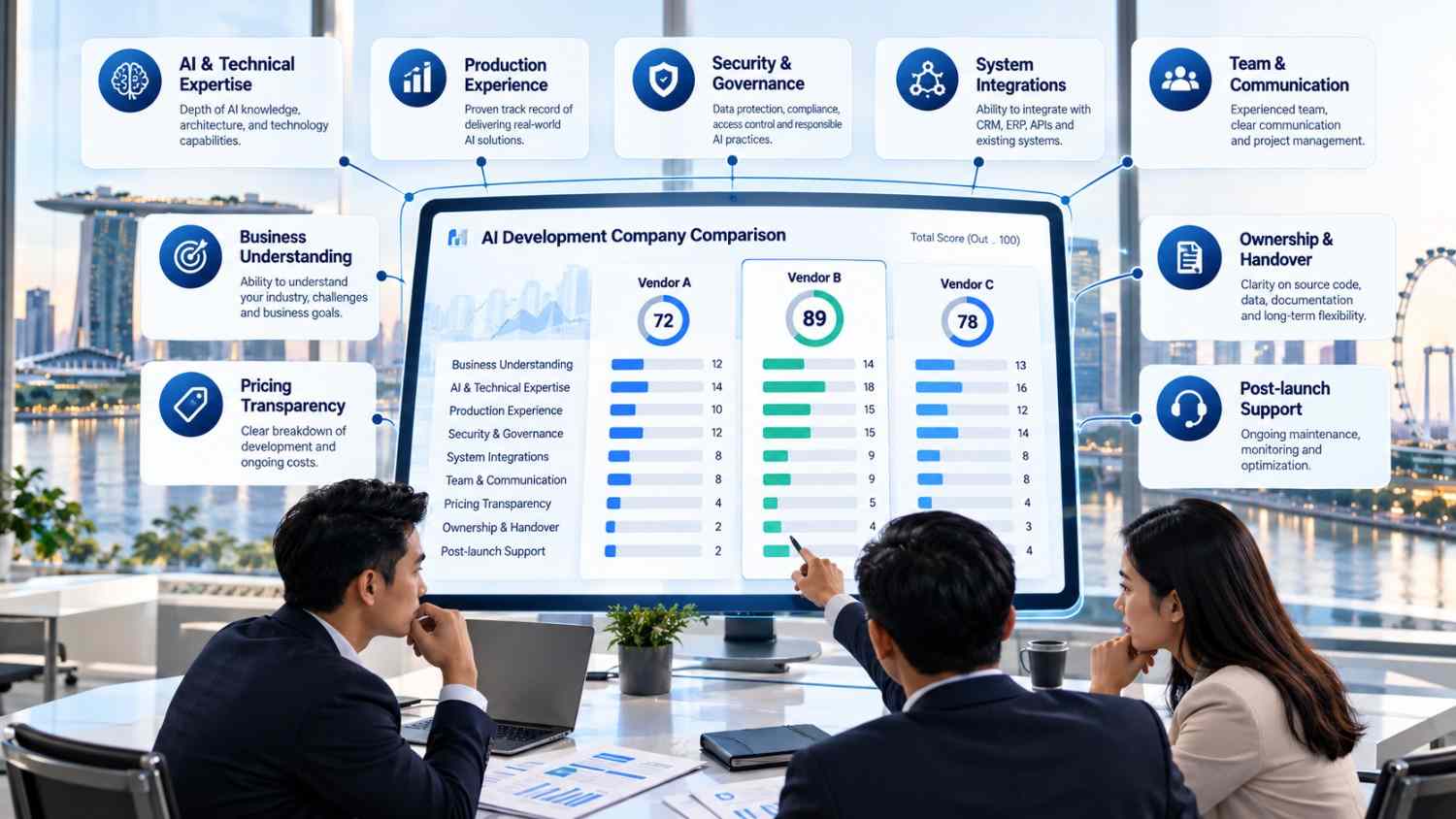
Use a Scorecard to Compare AI Development Companies
Once you have shortlisted several vendors, avoid making the final decision based purely on personal preference.
A simple scorecard can make the comparison more objective.
Recommended 100-Point Evaluation Framework
| Evaluation criterion | Weight |
| Understanding of your business problem | 15 |
| AI & technical capability | 20 |
| Production experience | 15 |
| Security & governance | 15 |
| Integration capability | 10 |
| Team & communication | 10 |
| Pricing transparency | 5 |
| Ownership & handover | 5 |
| Post-launch support | 5 |
| Total | 100 |
You can score each vendor from 1–10 and apply the weighting.
Example Vendor Comparison
| Vendor | Technical | Production | Security | Integration | Support | Overall |
| Vendor A | 8 | 7 | 7 | 9 | 6 | 7.4 |
| Vendor B | 9 | 9 | 9 | 8 | 9 | 8.9 |
| Vendor C | 7 | 6 | 8 | 7 | 7 | 7.0 |
The exact numbers are less important than using the same criteria for every vendor.
This also prevents one attractive factor, such as a low price or impressive demo, from dominating the entire decision.
Why UAutomate AI Can Be Considered for AI Development in Singapore
Once you understand how to evaluate an AI development partner, you can apply the same criteria to UAutomate AI.
UAutomate AI positions its services around production-ready AI systems, combining LLMs, agent frameworks and orchestration layers with business applications and workflows.
Its current service portfolio covers several of the areas discussed in this guide.
Custom AI Software Development
Businesses that need more than a chatbot can explore custom AI-powered applications, dashboards, operational tools, business management systems, and customer portals.
This can be relevant when AI needs to become part of a broader business application rather than remain a separate tool.
AI Knowledge Assistants and RAG
UAutomate AI develops RAG-based knowledge assistants that can work with business documents, SOPs, PDFs, spreadsheets, policies, contracts, and internal data.
For organizations with large amounts of internal information, this provides a way to make approved business knowledge easier to access through an AI interface.
AI Workflow Automation
UAutomate AI also provides AI workflow automation for areas such as process automation, lead management, CRM workflows, approval systems, and task routing.
The point is not necessarily to generate text by using AI; the bigger purpose is to connect AI to the processes in which employees are already engaged
AI Agents and Multi-Agent Systems
UAutomate AI offers AI agents and multi-agent systems for research, retrieval, task execution, and business operations.
For advanced procedures, specialist agents can be coordinated for different components of a task, while controls can be implemented for actions that require further oversight.
AI Integrations
UAutomate AI cites CRM, ERP, database, API, cloud, and internal software integrations among the AI integrations that the company offers.
This is important because the extent to which an AI solution is useful frequently depends on the extent to which it can be connected to the systems in which business information and procedures are already embedded.
Voice AI and Conversational Systems
UAutomate AI offers Voice AI solutions for customers and business interactions, including voice assistants, call automation, and voice-enabled workflows.
Its chatbot offering is similarly focused on customer service, lead qualification, knowledge retrieval, and workflow integration rather than just scripted dialogues.
Security, Governance and Observability
The UAutomate AI’s published architecture includes controls such as role-based access, PII redaction, tool allowlists, audit logs, policy enforcement, human approvals, and AI evaluation and observability. These controls are valuable in the context of third-party AI systems that process business data and perform actions.
What the Right AI Partner Should Ultimately Deliver
Choosing a vendor should not end with selecting a technology stack.
The real outcome should be a solution that connects the business objective to a working AI system.
The AI Development Journey at a Glance
| Stage | Key question |
| Business objective | What are we trying to improve? |
| AI use case | Where can AI provide meaningful value? |
| Data & workflow | What information and processes are involved? |
| Architecture & security | How should the solution be designed safely? |
| Development | How will the application or AI system be built? |
| Integration | How will it connect to existing systems? |
| Testing | How will performance and reliability be validated? |
| Deployment | How will the solution move into production? |
| Monitoring | How will performance and issues be tracked? |
| Optimization | How will the solution improve over time? |
| Business results | Did the project deliver the expected outcome? |
This is the difference between buying an AI demonstration and building an AI business capability.
Final Decision: Choose the Partner That Can Take AI From Idea to Operations
The best AI development partner is not necessarily the company with the most significant technology stack, the broadest catalog of AI models, or the most impressive demos
The best fit is one that understands your business problem, suggests the right technology, works with your data, integrates with your systems, builds security into the architecture, evaluates the performance of AI models, and supports the solution once deployed.
At the same time, for organizations in Singapore, data protection, governance, accountability, and other responsible AI requirements must also be considered when selecting an AI development partner. The AI Governance resources in Singapore cover areas such as data, accountability, testing, security, and trusted AI development and deployment
In summary, the ideal AI development company Singapore partner should be able to support the end-to-end lifecycle of AI development and deployment.
Problem → Strategy → Architecture → Development → Integration → Testing → Deployment → Optimization.
If you are exploring an AI application, AI product, RAG knowledge assistant, AI agent, or workflow automation project, the next step is to discuss the business use case before deciding on the technology.
Frequently Asked Questions
How do I choose an AI development company in Singapore?
Start by defining your business problem and then evaluate potential partners based on technical capability, production experience, security, integrations, AI evaluation, pricing transparency, ownership, and post-launch support. Do not select a vendor solely because it demonstrates a particular AI model or chatbot.
What should I look for in an AI development company?
Look for a combination of business understanding, AI engineering capability, application development experience, integration expertise, security practices, and production support. The company should also be able to explain why a particular AI architecture is appropriate for your use case.
How much does AI development cost in Singapore?
AI development costs vary significantly depending on factors such as application complexity, integrations, data preparation, AI architecture, infrastructure, testing, and ongoing model or API usage. A simple AI-enabled feature and a production AI platform can have very different development and operating requirements.
What questions should I ask an AI development company before hiring?
Ask about relevant production projects, proposed architecture, data handling, integrations, evaluation methodology, security, development team, ownership, recurring costs, and post-launch support. It is also useful to ask what the vendor would recommend not building with AI.
How do I know whether an AI development company has real production experience?
Ask for examples of systems that have gone beyond demonstrations or prototypes. Ask how the systems are monitored, evaluated, and maintained, and what technical challenges the team encountered after deployment.
What is the difference between an AI development company and an AI app development company?
An AI development company may provide a broader range of services, including AI agents, RAG systems, workflow automation, AI infrastructure, integrations, and AI applications. An AI app development company may focus more specifically on building applications with AI capabilities. The right choice depends on the scope of your project.
How long does it take to develop an AI application?
There is no single timeline. The duration depends on the use case, required features, data readiness, integrations, architecture, testing, and deployment requirements. A focused proof of concept may be significantly smaller than a production AI platform connected to multiple business systems.
Ready to Explore an AI Solution for Your Business?
Selecting the right AI partner begins with identifying the problem to be solved.
Whether you’re considering AI app development Singapore, an AI knowledge assistant, RAG, agents, workflow automation, voice AI, or a custom AI product, UAutomate AI can advise on the proper technical approach for your business needs.
Talk to UAutomate AI about your AI use case, and learn about a realistic path from idea to production.
→ Book an AI consultation with UAutomate AI