Industrial companies produce a great deal of data daily. We see in equipment manuals, maintenance reports, production records and inspection reports that value is present. At the same time, it is also very hard to find what you are looking for when you need it. That is where Industrial AI Solutions comes into play which helps companies in organizing this information and transform it into action. By way of AI, machine learning, document analysis and data analytics, industrial teams are able to access technical info more easily, look into equipment issues and make in the moment decisions. As opposed to spending hours to find disjointed records, employees can use smart apps to find what they need and put that info to use in improving daily operations.
Why Industrial Businesses Struggle to Use Their Technical Knowledge Effectively
Many industrial companies have in-depth technical documentation and operational data. We are to make this info available to the people that need it.
Technical Information Is Scattered Across Multiple Systems
Equipment manuals, reports of production, maintenance records and we have that of different systems. Staff may put in a great deal of time into locating a certain detail or operating instruction. This in turn also increases the chance of using out of date information.
Experienced Employees Hold Critical Operational Knowledge
Experienced engineers and technicians gain their in-depth knowledge from years of practical work. But much of that knowledge is not written down. When employees leave or switch roles that which they know practically leaves with them.
Finding Information During Equipment Failures Takes Time
When equipment breaks down maintenance teams require access to equipment history, past repair records and troubleshooting information. We find that going through many documents delays investigation and maintenance.
Operational Decisions Depend on Incomplete Information
Production managers require accurate data on equipment performance, production delays and quality issues. When data is in separate systems which don’t talk to each other, issues of the past repeat more.
| Operational challenge | Business impact | How AI can help |
| Scattered documents | Slow information retrieval | Intelligent document search |
| Undocumented employee knowledge | Difficult knowledge transfer | Knowledge assistants |
| Disconnected maintenance records | Slower troubleshooting | Historical record retrieval |
| Manual reporting | Delayed insights | Automated data analysis |
| Limited production visibility | Reactive decisions | Pattern identification |
What Industrial AI Actually Does: Connecting Technical Knowledge with Operational Intelligence
Industrial AI is the application of AI technologies in manufacturing, engineering, equipment management and operational decision making.
For instance consider a maintenance engineer which is in the process of studying in depth a series of temperature variations in a machine. Instead of going over multiple reports by hand an AI application could access relevant maintenance records, identify past similar incidents and present info from approved technical documents.
Different technologies make these applications possible:
- Machine learning: Identifies patterns in historical and incoming operational data.
- Natural language processing: Helps applications understand written questions and technical information.
- Generative AI: Creates summaries and responses using available information.
- Retrieval-Augmented Generation (RAG): Retrieves relevant information from approved sources before generating answers.
- Computer vision: Analyses images and videos for inspection and defect identification.
Traditional automation and AI-enabled systems serve different purposes.
| Traditional systems | AI-enabled systems |
| Follow predefined instructions | Identify patterns in information |
| Depend mainly on structured inputs | Process structured and unstructured data |
| Generate predefined reports | Produce contextual summaries |
| Require manual document searches | Support natural-language searches |
| Follow scheduled maintenance | Support condition-based analysis |
AI does not replace every existing industrial system. Combining conventional automation, software and AI is often a more practical approach.
According to the NIST roadmap on artificial intelligence and machine learning for smart manufacturing, AI is creating opportunities across industrial data analytics, advanced sensing, robotics, digital twins and manufacturing operations.
Five Practical Ways AI Improves Technical Knowledge and Operational Insights
AI adds value when it solves issues that industrial teams have. Here are five practical examples.
1. Industrial Knowledge Assistants for Faster Technical Information Retrieval
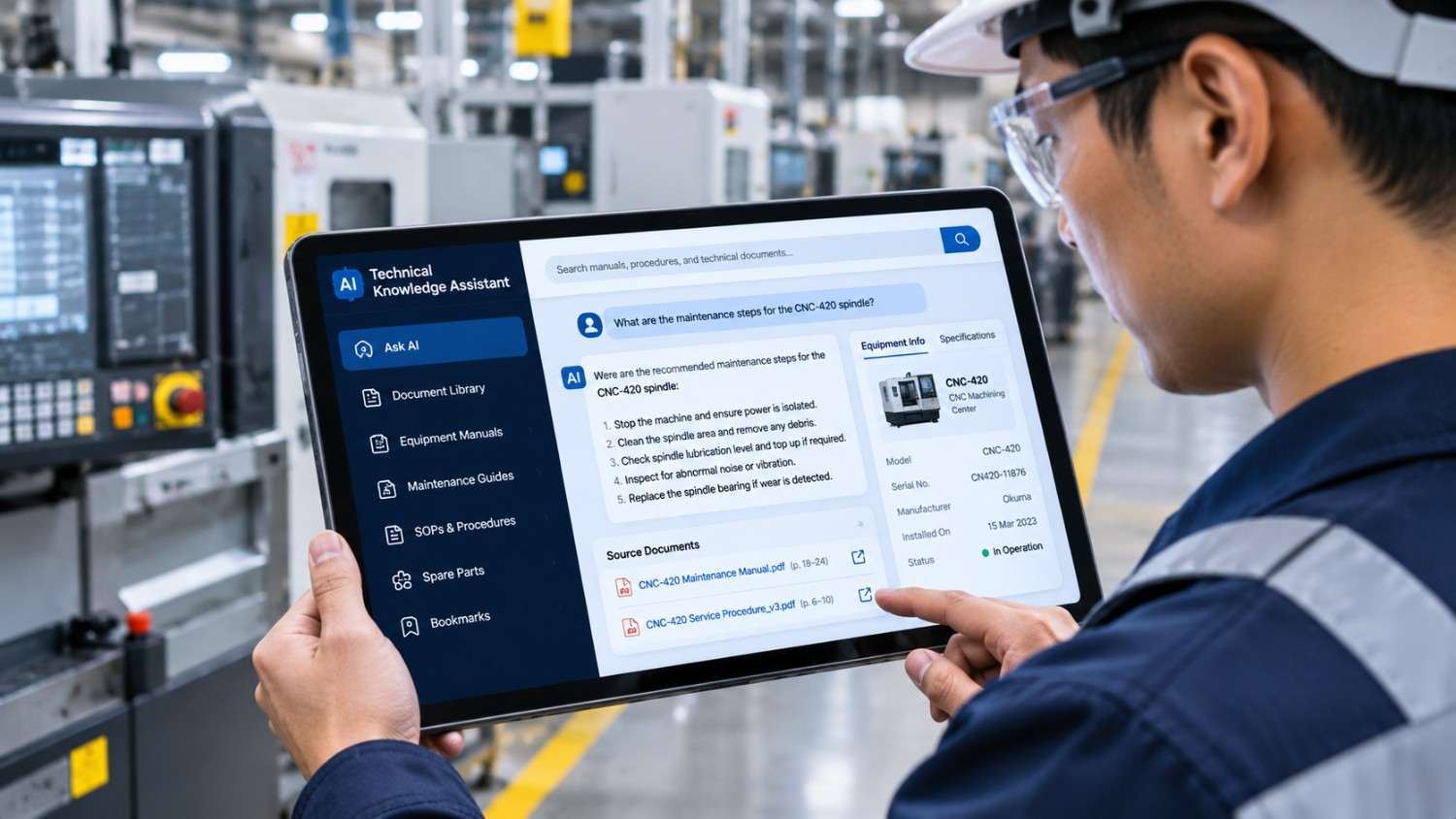
Industrial knowledge assistants which employees use to access information without going into and through many documents.
In a manufacturing setting that has access to hundreds of equipment manuals and operating procedures an engineer may have to review many different files in which they are looking for a specific set of instructions.
A knowledge assistant with RAG can index into approved documents and return relevant sections when employees ask.
For example, an engineer might ask: For instance an engineer may ask:.
What is the procedure for checking hydraulic pressure?
The application will put together the appropriate responses which in turn will include references to the original document.
Common capabilities include:
- Searching equipment manuals and technical specifications.
- Retrieving standard operating procedures.
- Answering questions using approved documents.
- Providing document and page references.
- Restricting information according to employee roles.
This makes existing technical knowledge easier to access across departments.
Manufacturers looking to understand how these technologies work in real production environments can also explore our guide to industrial AI solutions in Singapore and their practical applications for manufacturers
2. Technical Document Intelligence and Automated Information Extraction
Industrial companies use inspection reports, equipment specs, supplier docs and maintenance records.
Document intelligence which includes optical character recognition (OCR) and natural language processing for the extraction and organization of info.
For instance an application may identify equipment numbers, inspection dates, component specifications and maintenance notes from uploaded documents.
| Document type | Information AI can extract | Business application |
| Equipment manuals | Specifications and instructions | Technical reference |
| Maintenance reports | Fault descriptions and service history | Maintenance analysis |
| Inspection reports | Defect observations | Quality tracking |
| Supplier documents | Product details | Procurement support |
| Engineering documents | Technical information | Document management |
The extracted data can be put into searchable records or integrated with present applications.
Scanned in documents and in depth engineering tables may require extra validation. It is also of great importance that technical details be checked against their original sources.
3. AI-Powered Troubleshooting and Maintenance Support
Maintenance teams are a repeat of the same issues time and again. From past incident reports, repair records and equipment manuals technicians are to research into that which is familiar.
For instance if a production conveyor system breaks down an AI assistant may access past stoppage reports, maintenance notes and approved trouble shooting guides.
It could present:
- Similar historical incidents.
- Relevant maintenance records.
- Applicable troubleshooting procedures.
- Areas requiring further investigation.
- References to original technical documents.
This is to have employees reuse what they know instead of going in with no base.
AI put out the suggestions which should be taken as advice. Technicians to check in person on equipment conditions and follow the set safety procedures before proceeding.
4. Predictive Analytics for Better Operational Decisions
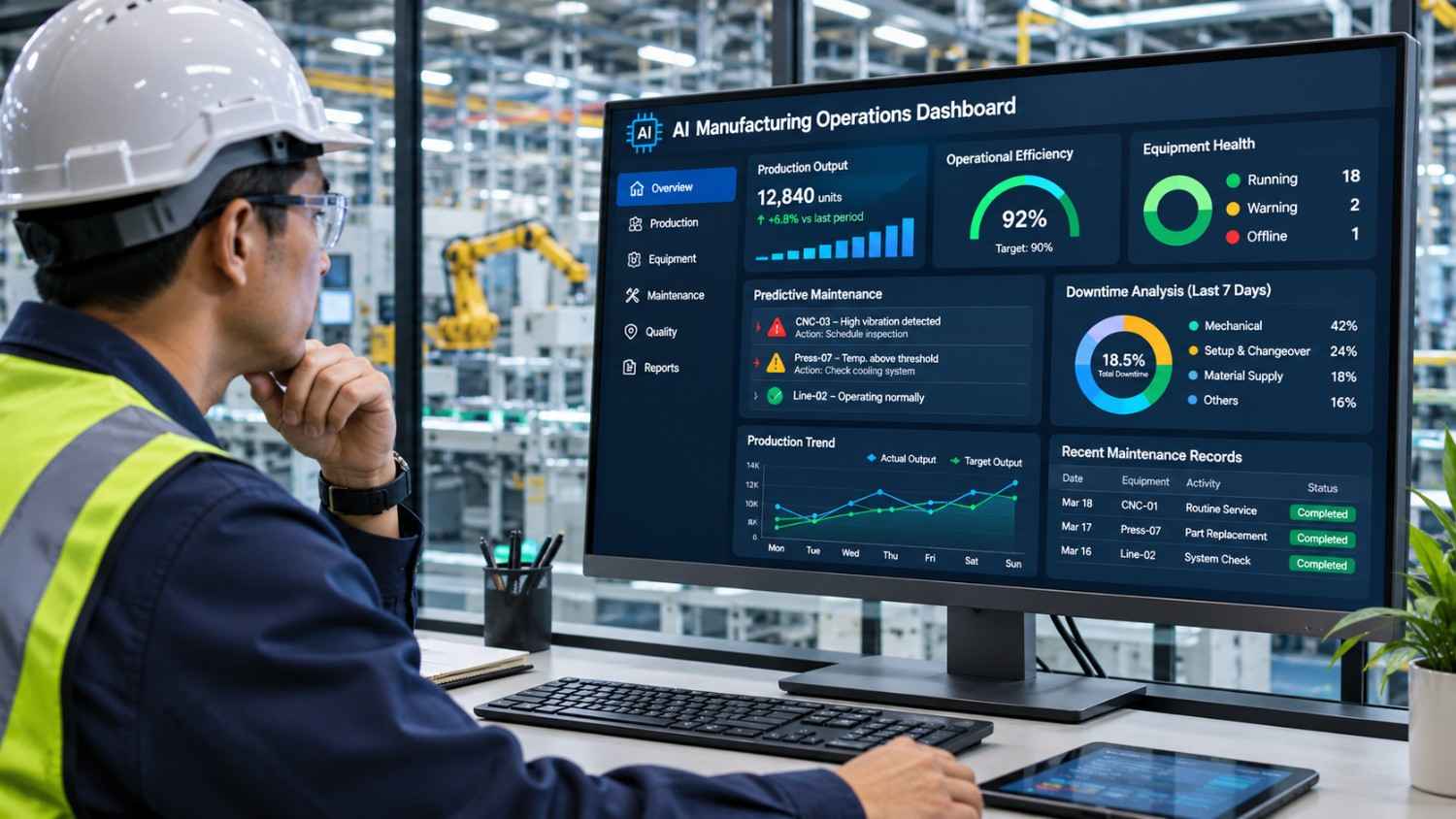
Industrial machines produce data through sensors, monitoring devices and control systems.
Machine learning algorithms can determine which patterns to look for which in turn may signal equipment condition changes.
For instance, out of the ordinary vibration, temperature or pressure changes may serve as a telltale for maintenance teams.
Predictive analytics can support businesses with:
- Monitoring equipment performance.
- Identifying unusual operating conditions.
- Planning maintenance activities.
- Analysing recurring equipment interruptions.
- Understanding maintenance requirements.
Predictive maintenance is not a sure fire way to prevent failures. What it does is to put in place models which if good and the data used is of high quality and is a regular affair will work.
5. Computer Vision for Industrial Monitoring and Quality Inspection
Computer vision is a field which has software that interprets what is seen by cameras and inspection systems.
In the manufacturing field it can be used for quality checks and production monitoring.
For example a computer vision system that is properly trained may look at product images to determine present defects which may include scratches, imperfections in surface finish or missing parts.
Other applications include:
- Detecting visible product defects.
- Monitoring production activities.
- Checking packaging and labels.
- Identifying missing components.
- Supporting visual safety monitoring.
From Raw Industrial Data to Actionable Insights: How an AI System Works
A typical implementation involves five stages.
Developing an AI application is not just about connecting an AI model to a set of documents. We have to collect, prepare, process and present the info in a useful format.
A typical implementation involves five stages.
Step 1: Collect Information From Industrial Sources
Identify the appropriate information sources which may include equipment manuals, maintenance systems, ERP platforms, manufacturing execution systems (MES), sensors and operational reports.
Step 2: Organise and Prepare Technical Data
Clean out and classify the collected information. May include OCR, document extraction, metadata tagging and out of date record removal.
Step 3: Apply Suitable AI Models
Select the appropriate technologies for your application. RAG which supports document retrieval, machine learning which analyzes operational patterns, computer vision which processes inspection images.
Step 4: Deliver Insights Through Applications
Present results in a knowledge base, through a dashboard, in an internal web app or maintenance interface.
Step 5: Enable Human Review and Action
Employees review the info and determine what action is to be taken. For example a maintenance supervisor may look into an equipment alert before putting in a work order for an inspection.
AI implementation process at a glance
| Stage | Main activity | Expected output |
| 1. Data collection | Gather documents and operational data | Relevant information |
| 2. Data preparation | Clean and organise records | Searchable data |
| 3. AI processing | Apply suitable AI technologies | Analysed information |
| 4. Insight delivery | Present findings through applications | Answers, trends and alerts |
| 5. Human validation | Review and approve actions | Informed decisions |
The system should also be monitored regularly to account for changes in equipment, documentation and operational requirements.
Industrial AI Applications Across Different Business Environments
The most suitable AI application depends on the industry, available data and specific operational challenges.
| Industry | Potential AI application | Operational value |
| Manufacturing | Quality inspection and production analytics | Better production visibility |
| Industrial automation | Technical knowledge assistants | Easier engineering information access |
| Engineering and maintenance | Troubleshooting support | Consistent investigations |
| Electronics manufacturing | Visual defect detection | Quality assurance |
| Supply chain operations | Demand forecasting | Better planning |
Manufacturers can use AI to analyse production information and support maintenance planning. Industrial automation companies can make engineering documentation easier to search. Maintenance teams can retrieve service histories, while supply chain departments can use historical data for forecasting.
Each application requires an assessment of data availability, technical requirements and expected business outcomes.
Businesses planning to connect production monitoring, inventory management and maintenance activities can also read our guide to manufacturing software development in Singapore .
Singapore is also encouraging AI adoption across manufacturing through initiatives such as the Sectoral AI Centre of Excellence for Manufacturing, which focuses on applications including quality assurance, operations optimisation, predictive maintenance and industrial automation.
What Should Businesses Consider Before Implementing Industrial AI?
A solution that works during a demonstration may not perform reliably in a complex industrial environment. Businesses should consider several factors before starting development.
1. Data Quality and Availability
Outdated manuals, incomplete maintenance records and inconsistent equipment identifiers can affect AI results. Businesses should review their existing data and establish processes for maintaining accurate records.
2. Integration With Existing Industrial Systems
An AI application should work with existing ERP, MES, SCADA and maintenance systems wherever practical. Integration depends on available APIs, permissions and infrastructure.
3. Data Security and Access Permissions
Industrial documents may contain confidential engineering and operational information. Businesses should consider authentication, role-based access, secure storage, audit logs and appropriate deployment options.
4. Accuracy, Reliability and Human Oversight
AI-generated answers should be checked against approved sources. Critical maintenance decisions and safety procedures must remain subject to appropriate human review.
5. Scalability and Long-Term Maintenance
Businesses should consider future integrations, data volumes, model monitoring, application maintenance and employee training before selecting an architecture.
Choosing the Right Industrial AI Development Partner
Selecting a development partner is important because industrial AI projects require both technical expertise and an understanding of business operations.
Before selecting a provider, consider the following:
| Evaluation criteria | What to look for |
| Industrial knowledge | Understanding of manufacturing workflows |
| AI engineering | Experience with RAG and machine learning |
| System integration | Ability to connect existing applications |
| Data security | Suitable access controls |
| Testing | Clear validation processes |
| Ongoing support | Monitoring and maintenance |
A suitable partner should first understand the business problem and available data. Technology selection should follow this assessment.
How UAutomate AI Helps Businesses Build Intelligent Industrial Operations
UAutomate AI develops industrial software, AI-enabled applications, business process automation and connected digital systems.
Through its industrial AI solutions, the company helps industrial businesses explore ways to make technical information more accessible and operational data more useful.
Industrial Knowledge Assistants
UAutomate AI develops knowledge assistants that help employees retrieve information from approved technical documents and internal knowledge sources.
Using RAG, these applications can support document searches, grounded responses, source references and role-based access.
Technical Document Intelligence
Industrial documents can be difficult to organise and search manually. UAutomate AI develops document intelligence applications supporting OCR, document classification, information extraction and structured summaries.
Explore its AI document processing and retrieval capabilities.
Troubleshooting and Maintenance Support
AI applications can help technicians retrieve service information, review historical incidents and access diagnostic references. This supports maintenance investigations while keeping operational decisions under human supervision.
Operational Data Intelligence
Connecting and organising operational information can help teams understand performance patterns and investigate potential issues.
UAutomate AI’s manufacturing software solutions support businesses exploring improved production and maintenance workflows.
Custom AI Engineering and System Integration
Some businesses need a technical knowledge assistant, while others require applications connected to existing ERP, MES or maintenance systems.
UAutomate AI also provides custom software engineering and enterprise systems integration capabilities to address different technology requirements.
Frequently Asked Questions About Industrial AI
1. What are industrial AI solutions?
These are software applications that use artificial intelligence and machine learning to support industrial activities such as document retrieval, predictive maintenance, quality inspection and operational analysis.
2. How is AI used in manufacturing operations?
AI can analyse production data, identify unusual equipment behaviour, support quality inspections and help employees retrieve technical information.
3. How can AI improve industrial maintenance?
AI can analyse historical maintenance records, identify patterns and retrieve information about previous equipment incidents. It can also support predictive maintenance when suitable equipment data is available.
4. What is the difference between industrial AI and traditional automation?
Traditional automation follows predefined instructions and control logic. Industrial AI adds capabilities such as pattern recognition, prediction and contextual information retrieval. Both can work together.
5. Can AI analyse technical documents and equipment manuals?
Yes. Document processing and RAG-based applications can extract information, index documents and retrieve relevant sections in response to employee questions.
6. How does generative AI help industrial businesses?
Generative AI can summarise technical documents, answer questions using approved information, retrieve maintenance records and prepare operational reports.
7. What data is required to implement industrial AI?
A knowledge assistant may require equipment manuals, SOPs and maintenance records. Predictive maintenance may require sensor readings, historical failure records and operating data.
8. How much does it cost to develop a custom industrial AI solution?
The cost depends on project complexity, data volume, AI requirements, integrations, deployment and security. Businesses should define their use case and technical scope before requesting an estimate.
Conclusion: Turn Industrial Knowledge Into Better Operational Decisions
Industrial businesses have at their disposal technical and operational data of great value. The issue is in making that information available and useful to the employees that need it. We see which Industrial AI solutions we put in place can improve technical know-how access, support in maintenance investigation and in getting teams to see operational trends. For wide scale success we require proper data, secure integration, reliable engineering and human oversight. At UAutomate AI we help businesses to see these possibilities in custom AI applications, knowledge assistants, document intelligence and operational data solutions. To get more out of your industrial knowledge, look into Industrial AI solutions and get into discussion with the UAutomate AI team.