Why Modern AI Products Need More Than an LLM
Businesses exploring AI product development in Singapore are looking for more than what is present in a basic chatbot that only answers a few questions. They are after AI powered apps that get to know their business, that work with their present data and which in turn help teams to do routine tasks better.
In many cases creating a practical AI product is beyond just integrating an application to a Large Language Model (LLM).
Imagine a company that is putting together an AI assistant for their customer support team. The assistant is to field questions on company policies, look at order details, and help out with response preparation. A stand alone LLM may put forth a very good answer but it also can’t access private documents or get into live order info without the right hooks.
This is what we see with Retrieval-Augmented Generation (RAG) which also includes AI agents and LLM architecture.
Each technology has a different role. RAG in this case is for an AI which puts together relevant info, AI agents which for complex tasks span many steps, and LLMs which take in requests and put out responses. When these elements work together with the right security measures and business oriented integrations they can support much more useful applications.
In this report we will look at how the tech works, which business cases see the most benefit from it, and what issues companies should look into before putting in an AI powered solution.
1. What Does a Production-Ready AI Product Actually Need?
AI products are software applications which use artificial intelligence to solve an issue, support a decision, or improve a business process.
A basic AI chatbot may only need a user interface and a connection to a LMM. More complex applications may require access to the company’s private data, customer information, business APIs and also internal processes.
For instance an AI based customer support platform will have to address a customer’s query, find out the relevant product policy, determine the present order status, and put together an appropriate response.
Each step of the process is different for each application. The model does language work, the retrieval system identifies relevant info, and the backend deals with access to business systems.
The essential components of an AI product
| Component | What it does |
| User interface | Allows users to ask questions, provide instructions, and interact with the application |
| Application and API layer | Handles requests, authentication, and business logic |
| Large Language Model (LLM) | Understands language and generates responses |
| RAG pipeline | Retrieves relevant information from approved knowledge sources |
| Agent orchestration | Coordinates multi-step tasks and tool usage |
| Business integrations | Connects the AI application with CRMs, databases, and other software |
| Security and monitoring | Helps control access, track activity, and evaluate performance |
Not every AI product needs all these components. An application that summarises text may work well with a simple LLM integration. An internal knowledge assistant may need RAG, while an application that performs actions across several business systems may require agent orchestration.
The important thing is to start with the business problem and build an architecture around it. Adding more AI components does not automatically make a product better.
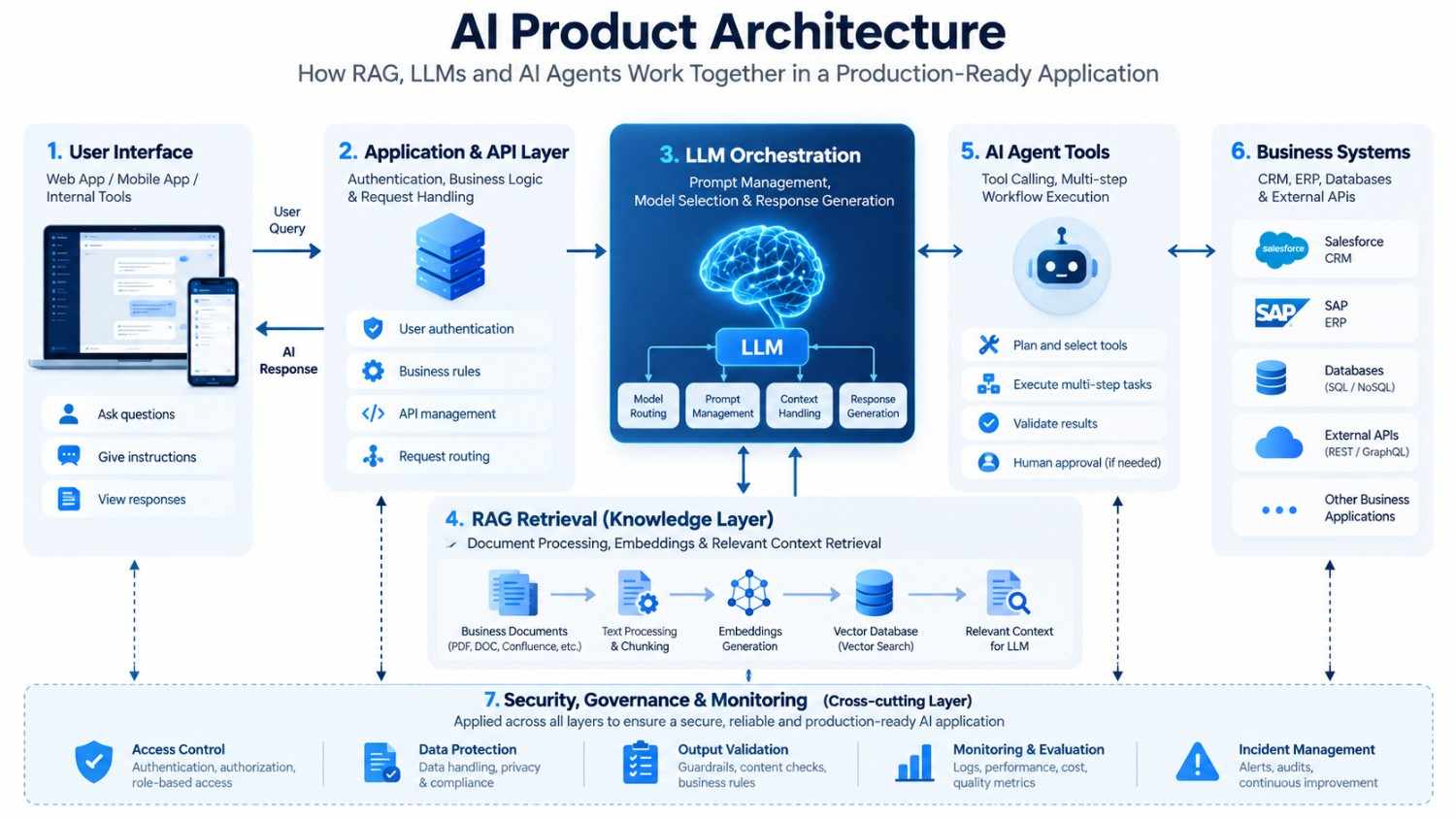
2. Inside an AI Product Architecture: From User Query to Business Action
To understand AI architecture, it helps to look at what happens after someone submits a request.
Suppose an employee asks an AI assistant to explain a company policy and prepare a response to a customer. The application must receive the request, identify the relevant information, process it through the AI system, and return a useful answer.
How the different layers work together
Think of an AI product as a series of connected layers, with each one handling a specific responsibility.
| Layer | Role in the application |
| 1. User interface | Receives the user’s question or instruction |
| 2. Application layer | Checks the request and applies business rules |
| 3. Authentication | Determines whether the user is allowed to access the requested information |
| 4. LLM orchestration | Coordinates the model, context, and required processing steps |
| 5. RAG and agent tools | Retrieves relevant information or requests approved actions |
| 6. Business systems | Provide data from CRMs, databases, and external APIs |
| 7. Response validation | Checks the result and applies any necessary controls |
| 8. Monitoring | Records relevant activity and helps identify performance issues |
The process starts when a user puts in a request via a website, mobile app, or internal dashboard. The backend then validates the request before passing it to the AI elements.
The orchestration layer is what determines how a request is to be handled. Based on the use case it may send the request straight to an LLM, retrieve info via RAG, or use an approved tool.
Once the info is available the model puts out a response. The app then validates the result, checks permissions and presents the answer to the user.
This multi-tiered approach we put in place which in turn makes it easy to identify issues, test out separate components, and change out certain elements of the system without having to redevelop the entire application.
For a deeper look at production architecture, read:Generative AI with RAG
- RAG Development Singapore: Connecting AI to Business Knowledge
In terms of business AI applications we see that the issue is which data the model has access to.
LLMs may have a grasp of general concepts, but do not include a company’s current internal policies, private documents, or product info.
RAG which is also to say that which has become a common term for it, puts forth to solve this issue by getting relevant info from an external knowledge base and then presenting it to the model which in turn uses it to answer questions.
For companies which are into RAG development in Singapore this is a useful play for internal know how assistants, customer support applications, document search, and company specific question answering systems.
How does RAG work?
A typical RAG system has two main stages: preparing the knowledge base and answering questions.
Stage 1: Preparing the knowledge base
- Collect documents: Gather approved sources such as PDFs, company policies, product manuals, and internal knowledge articles.
- Extract and clean information: Convert the documents into usable text and remove unnecessary formatting where appropriate.
- Split documents into sections: Divide longer documents into smaller chunks that can be retrieved more effectively.
- Generate embeddings: Convert the text into numerical representations that help identify semantically related content.
- Create a search index: Store the information and its representations in a suitable retrieval system, such as a vector database.
Stage 2: Answering a question
- A user submits a question through the application.
- The retrieval system searches for relevant passages.
- The application supplies the retrieved information to the LLM as context.
- The model generates a response based on the available context and instructions.
- The application may return supporting sources or escalate the question if the evidence is insufficient.
For example, an employee asking about the company’s leave policy could receive an answer based on the relevant policy document rather than relying entirely on the model’s general knowledge.
Where can businesses use RAG?
RAG can support several practical business applications.
- Internal knowledge management: Help employees find information in company handbooks, standard operating procedures, and internal documentation.
- Customer support: Retrieve relevant troubleshooting instructions, product manuals, and service policies.
- Document intelligence: Search across contracts, reports, and other business documents to locate specific information.
- Product knowledge assistants: Answer questions using approved product specifications, documentation, and service information.
RAG versus fine-tuning: What’s the difference?
RAG and fine-tuning are often discussed together, but they solve different problems.
RAG provides relevant external information to the model at request time. Fine-tuning uses additional training to adapt a model’s behaviour for particular tasks.
| Requirement | RAG | Fine-tuning |
| Access changing company documents | Often a good fit | Does not automatically provide access to updated documents |
| Retrieve supporting passages | Yes, through a retrieval system | Not by itself |
| Adapt output style or task behaviour | Can use prompting and instructions | Can be useful for suitable tasks |
| Update source knowledge | Update the knowledge base and retrieval index | May require further training for learned changes |
| Answer questions about private documents | Often a practical starting point | Usually not the first choice on its own |
RAG is not a guarantee of accuracy. If the retrieval system finds the wrong document or the source itself contains incorrect information, the generated response can still be misleading. The system also needs appropriate document permissions, access controls, and processes for keeping information current.
For additional technical guidance, read AWS’s overview of Retrieval-Augmented Generation.
4. AI Agent Development Singapore: Moving from Answers to Actions
Retrieving information is useful, but some business processes require more than an answer.
Consider a sales team that receives dozens of enquiries every day. An AI assistant could draft email responses, but a more advanced workflow might also classify leads, retrieve relevant service information, check availability, and prepare a record in the company’s CRM.
This is where AI agents can become useful.
An AI agent combines a model with instructions, tools, and a way to coordinate steps toward a defined goal. Depending on the design, it can decide which approved tool to use, inspect the result, and determine what to do next.
What makes an AI agent different from a chatbot?
A conventional chatbot primarily responds to user messages. An agent-based system can coordinate several actions, although the level of autonomy depends on its implementation.
For example, a customer service agent could:
- Read a customer’s enquiry.
- Retrieve the relevant return policy.
- Request order details through an approved API.
- Check whether the requested action meets company rules.
- Prepare a response or submit a request for human approval.
- Report the result to the employee or customer.
The system should not automatically perform every action it can technically access. Permissions, business rules, and approval requirements need to be defined before deployment.
Single-agent versus multi-agent architecture
Some workflows can be managed by one agent. Others may benefit from multiple agents with separate responsibilities.
| Factor | Single-agent system | Multi-agent system |
| Structure | One agent coordinates the task | Multiple agents handle distinct responsibilities |
| Complexity | Generally simpler to test and maintain | Requires coordination and handoffs |
| Suitable use cases | Lead qualification, support assistance, document workflows | Complex processes with clearly separated specialist tasks |
| Main challenge | Defining appropriate tools and task boundaries | Managing communication, shared state, and failures |
Using multiple agents does not automatically improve results. It can increase latency, cost, and the number of interactions that need to be tested.
For many applications, a single agent or a conventional workflow with a few LLM calls is sufficient. The architecture should match the complexity of the task rather than follow a trend.
Where can AI agents help businesses?
Potential applications include lead qualification, appointment scheduling, document processing, customer service, and internal operational workflows.
The key question is whether the agent can complete a clearly defined task reliably and safely. A system that generates a convincing answer but fails to complete the actual workflow may offer little practical value.
5. LLM Architecture Explained: Choosing the Right Model and Orchestration Layer
Choosing an LLM is an important decision, but it is only one part of designing an AI application.
Businesses also need to consider response quality, speed, cost, data-handling requirements, integration complexity, and the effort involved in maintaining the application.
Hosted APIs versus self-hosted models
Two common approaches are using a model through a hosted API or deploying an open-weight model within infrastructure the business manages.
| Consideration | Hosted model API | Self-hosted or open-weight model |
| Initial infrastructure work | Often lower | Usually higher |
| Operational responsibility | Shared with the service provider | Greater responsibility for hosting and maintenance |
| Model selection | Depends on the provider’s available models | Depends on available models and infrastructure |
| Deployment control | Depends on provider capabilities and contractual terms | Can offer greater control over the deployment environment |
| Cost considerations | Usage-based fees may apply | Compute, hosting, engineering, and maintenance costs apply |
A hosted API may be suitable for a business that wants to test an idea without managing model infrastructure. Self-hosting may make sense when the organisation has specific requirements around deployment control, customization, or infrastructure.
The decision should account for the full cost of operating the solution, not just the model’s price.
What does the orchestration layer do?
The orchestration layer connects the model with the rest of the application. It determines how information is supplied to the model and how its outputs are handled.
Depending on the product, it may:
- Select an appropriate model for a request.
- Add relevant information retrieved through RAG.
- Require responses in a defined format.
- Request information or actions through approved tools.
- Manage timeouts, retries, and errors.
- Record relevant information for monitoring and evaluation.
For example, a product might use a smaller model for simple classification and a more capable model for complex document analysis. This can help manage costs, but the approach should be tested to ensure the selected models perform well enough for their assigned tasks.
Prompting, RAG, and fine-tuning: Which should you choose?
| Approach | When it is useful |
| Prompt engineering | When clear instructions and suitable context can guide the model |
| RAG | When the application needs relevant, private, or changing information |
| Fine-tuning | When a model needs adapted behaviour for a suitable, well-defined task |
| Tool calling | When the application needs to retrieve information or request actions from external systems |
These approaches are not mutually exclusive. A customer support assistant, for example, may use prompts to define its role, RAG to retrieve product information, and tool calling to obtain current order details.
The most suitable combination depends on the application’s requirements, available data, and expected performance.
6. How RAG, AI Agents, and LLMs Work Together
The real value of these technologies becomes clearer when they are used to solve a specific business problem.
Imagine a Singapore-based e-commerce company developing an AI assistant for its customer support team. A customer asks:
“Can I return this item, and has my replacement order shipped?”
The application needs two different types of information. It must retrieve the company’s return policy and check the customer’s current order status.
A practical example of the complete workflow
| Step | What happens | Technology involved |
| 1 | The customer submits the question | User interface |
| 2 | The system verifies access to the order | Authentication and business rules |
| 3 | The relevant return policy is retrieved | RAG |
| 4 | The current order status is requested | Business API |
| 5 | The available information is combined into a response | LLM |
| 6 | The result is checked against applicable rules | Application logic and validation |
| 7 | The response is presented or escalated | User interface and workflow controls |
RAG supplies the policy information, the API retrieves the latest order status, and the LLM turns the available information into a clear response. An AI agent can coordinate these steps if the task requires multiple decisions or tool calls.
The application should also handle situations where information is missing. If the order API is unavailable, it should not invent a shipping status. If a return requires approval, it should follow the company’s established process rather than bypassing it.
This is the difference between simply adding an AI model to a website and developing an AI product around an actual business workflow.
7. Choosing the Right AI Architecture for Your Business
Businesses do not necessarily need RAG, AI agents, and multiple models in every application. The best approach is to identify the task, understand the information required, and determine whether the application needs to take action.
The following table provides a starting point.
| Business requirement | Architecture to consider | Key question |
| Draft emails or summarise text | LLM application | Can the task be completed with clear instructions and context? |
| Search internal policies | RAG | Are the documents accurate, current, and permission-controlled? |
| Retrieve live order information | LLM with API integration | Can the application securely retrieve current records? |
| Coordinate multi-step tasks | Agent or controlled workflow orchestration | Which actions require approval? |
| Build an AI-powered mobile application | AI application architecture with suitable backend services | How will privacy, latency, and usability be managed? |
| Analyse structured business data | Database queries and appropriate analytical tools | How will calculations and outputs be validated? |
A useful starting point is to choose the simplest architecture that meets the requirements.
If we have a standard API that we can use to get the info out, we may not need an autonomous agent. When employees are to go through thousands of internal documents for what they need, RAG may play better than fine tuning does. If the product is to do many actions in coordination with each other, an agent or controlled workflow may be in order.
The goal isn’t to implement all available AI solutions. We want to develop a solid product which also is a solution to a real issue.
For more information, read UAutomate AI’s AI product development guide and its article on the future of AI products in SaaS.
8. Security, Governance, and Reliability in Singapore AI Products
A very technical and impressive AI product can still have issues if it deals out private info, brings up old docs, or goes beyond what it is authorized to do.
Security and reliability to be addressed at the start of the development process.
What should businesses pay attention to?
Authentication and access control: The application is to verify users’ identities and grant access to info and tools as is fit for their privileges. Through RAG we do not expect the user to have access to information which they are not authorized to.
Data protection: Businesses should be aware of the info which is sent to external modeling providers and review related retention, processing and contractual terms.
Prompt injection: User inputs and which the system has no control over should not be able to take over system functions or get extra privileges.
Tool restrictions: Agents have access to only approved operations. For sensitive or irreversible actions we may require explicit human approval.
Testing and monitoring: Teams are to assess response accuracy, retrieval quality, latency, cost, and failure behavior. Also monitoring is to detect issues post deploy.
Incident handling: Proper logs and response protocols are for teams to use in the investigation of errors and security incidents.
In Singapore for which the Personal Data Protection Act (PDPA) applies, issues of compliance should be evaluated on data, use case, and parties involved.
The Personal Data Protection Commission’s guidance on AI systems is a useful starting point for understanding relevant data-protection considerations.
You can also explore UAutomate AI’s guide to AI application security and PDPA considerations.
No individual technology or architecture automatically guarantees compliance. Businesses should assess their specific legal, contractual, and operational requirements before deployment.
9. From Architecture Design to AI App Development Singapore
Once the architecture is chosen that is the first step, which then is followed by the task of creating an application which is user friendly.
A structured development approach which enables teams to identify and address their assumptions early and also to see technical limitations at the outset which in turn prevents the investment in features that do not resolve the issue at hand.
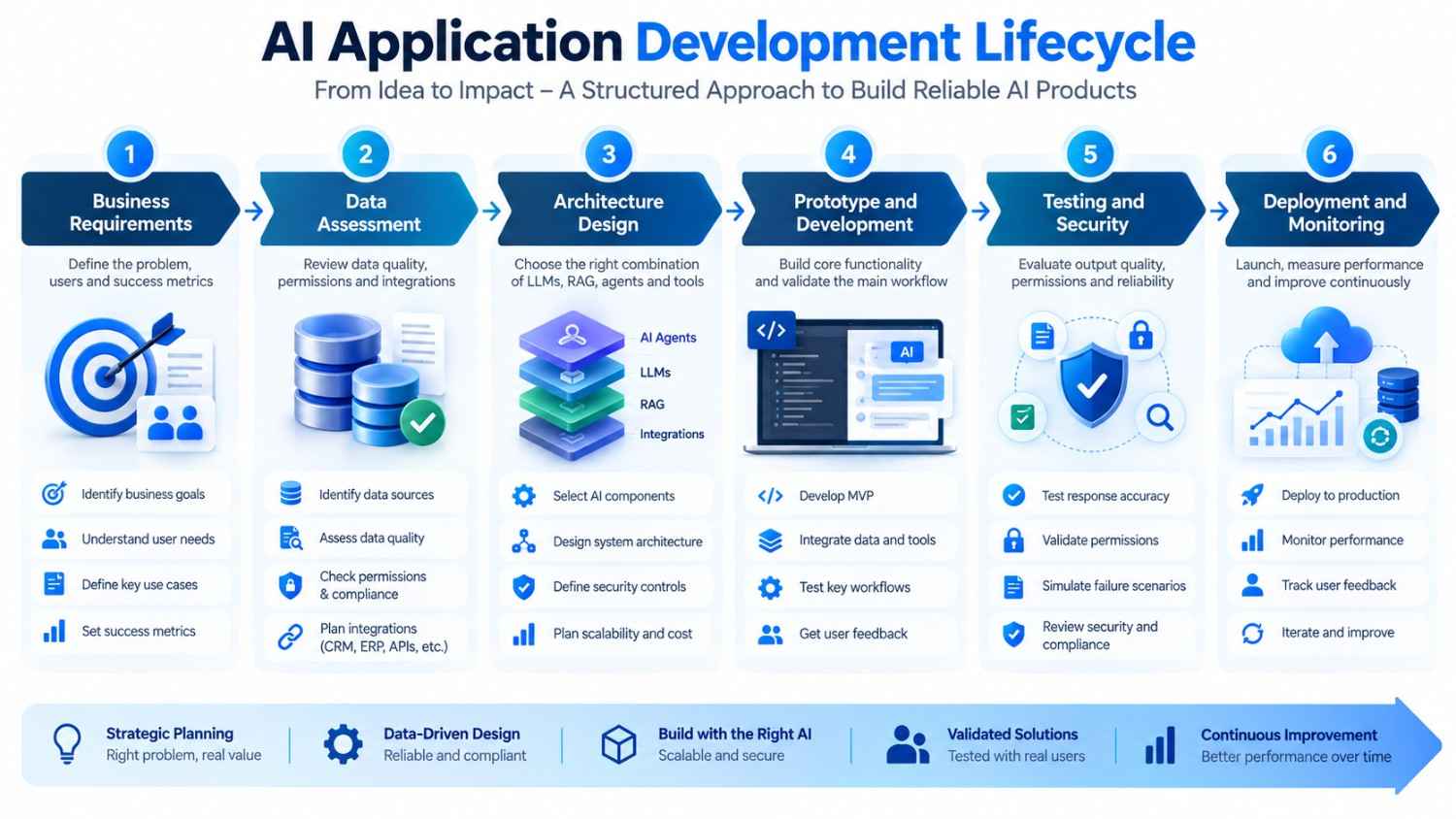
A practical AI development roadmap
Step 1: Identify the business issue.
Start out by which users are involved, what the workflow is, and which problem the product is to solve. Put in place measurable criteria like response quality, time spent in document search, or the ratio of issues resolved without escalation.
Step 2: Review data and systems integration.
Identify what data is required, how often it updates, who has access to it, which business units care about it.
Step 3: Develop a small scale model.
Test out which is the most uncertain element of your proposed solution. For a RAG application that may be the quality of retrieval which you put forward. For an agent which is the performance of the tool calls to break or to which the agent is calling out to under different conditions.
Step 4: Build the bare bones version.
Build out the core user interface, backend, AI elements and operational controls. Don’t add in extra features until the basic workflow has been proven.
Step 5: Test out real world situations.
Test out in normal conditions as well as in the hard ones which may include missing info, conflicting docs, failed APIs, unauthorized requests, and unexpected model outputs.
Step 6: Deploy, track, and enhance.
Track quality of responses, time to response, costs, and what the users have to say. Review failures, update the knowledge base as needed, and improve the application as requirements change.
A proof of concept and a production ready application are a different ball park. What we see in terms of development time and cost is very much a function of the product’s complexity, data readiness, integration needs, security requirements and testing which we have to do.
Businesses must put forth requests for quotes which detail a clear project scope instead of which they put forward that all AI applications will scale the same.
10. Why Consider UAutomate AI for AI Product Development?
UAutomate AI provides AI engineering and development services for businesses exploring ways to incorporate artificial intelligence into their products and workflows.
Its website and company overview describe capabilities relevant to businesses looking beyond standalone chatbots and exploring AI-powered applications.
Depending on the project, relevant areas may include:
- RAG and knowledge assistants: Helping users search and retrieve information from approved business documents.
- AI agents and workflow orchestration: Coordinating tasks across defined tools and business systems.
- AI application development: Building custom applications around specific business requirements.
- Document processing: Extracting and retrieving useful information from business documents.
- System integration: Connecting AI functionality with relevant software and operational workflows.
For example, a company planning an internal knowledge assistant may need document retrieval and access controls, while a business automating a multi-step process may require integrations and controlled agent workflows.
The right solution must be chosen after considering the business objective, technical needs, available data and the results you hope to achieve.
When choosing an AI Product Development Company Singapore don’t focus on the technology being offered. Ask how the system will be tested. Find out how sensitive actions are controlled. Know what happens if an AI component stops working.. Understand how the product will be supported after it goes live.
These questions help businesses make choices before starting an AI development project.
Frequently Asked Questions
- What is AI product development?
AI product development is the process of creating software that uses intelligence to solve a specific problem. This can include language models, data retrieval, automation, predictive systems and connections with existing business tools.
- How does RAG work in an AI application?
RAG stands for Retrieval-Augmented Generation. It pulls information from an outside source—like company documents or manuals—and gives it to a large language model as context. This helps the model give answers based on trusted information.
- What is the difference between RAG and AI agents?
RAG helps an AI application find information to support its answer. AI agents can do more—they can plan steps, use approved tools and complete complex tasks. An agent can use RAG as one of its tools so both can work together.
- How do LLMs, RAG and AI agents work together?
LLMs understand user requests. Create responses. RAG finds useful information to support those responses. Agents coordinate actions. Manage multiple steps. Together they form a system that includes business logic, access rules and checks to support a workflow.
- How do I choose an AI product development company in Singapore?
Look at how the company understands your business challenge. Check their proposed architecture, engineering skills, security methods, integration options, testing plans and support after launch. Also ask how performance will be measured and how issues or unexpected behavior will be managed.
- How much does it cost to develop an AI application in Singapore?
Costs vary based on complexity, model choice, data prep, integrations, infrastructure, security and ongoing maintenance. A simple prototype is different from a production app with many connections. Get a quote that includes both build and long-term operational costs.
- Is RAG better than tuning for business applications?
There’s no best approach. RAG works well when the application needs up-to-date information. Fine-tuning is useful when you want to change how a model behaves for a task. Some projects benefit most by using both.
- How can businesses make AI agents safer?
Use permissions, approved tools, verified inputs, defined business rules, activity logs and human approval for important actions. Test what happens when things go wrong. Prevent access and operations to keep agent-based systems secure.
Build an AI Product Around the Right Architecture
Creating an AI product isn’t just about picking a strong model. It requires a business goal, good data, a solid architecture, proper connections and safety measures that make the system practical to use.
For companies exploring AI Product Development Singapore the first step is deciding whether the use case needs a language model alone RAG for knowledge lookup AI agents, for structured multi-step tasks or a mix of these.
The right architecture is the one that solves the business problem while balancing reliability, security, complexity and cost.
UAutomate AI supports businesses in exploring AI engineering building knowledge assistants automating workflows and creating custom AI solutions. If you’re planning an AI-powered product. Want to add AI to your current processes reach out to UAutomate AI to discuss your goals and find the right way forward.