Transforming Business Issues Into AI Solutions
Running a business is a juggle of many small tasks which take up valuable time. We have employees that spend a great deal of time in document search, customer support teams which field very similar questions repeatedly, and the operations teams which try to get info to run between different software systems. Individually some of these may be bearable. As a group they can bring a business to its knees.
This in turn is what an AI App Development Company Indonesia does for businesses which is to put forth practical uses for AI. Instead of adding in AI which is a trend at the moment we aim to develop apps that solve specific problems, improve present workflows and which in turn help teams better utilize their data.
For instance, a company may have a need for a software which extracts info from invoices, which in turn uses internal docs to answer questions, or which helps customer service representatives to be more consistent. Each of these requirements may call for a different solution and what works best will depend on the business’ present systems, data, and goals.
In this report we will look at how AI implements in the Indonesian business setting, what to think about before you start a project, what goes into development costs, and how to choose which technology to use. Also we will see how UAutomate AI’s AI solutions play into various business needs.
Start From the Business Problem, Not the AI Technology
Before picking out a model for AI or going into which development tools to use, take a step back to look at the issue your business is trying to address.
Consider a company that has employees devote many hours weekly to report analysis, review of customer records, and development of very similar reports. Also, we may not see a solution in adding another software tool. What we first need to do is identify what is causing the delay in the first place and which processes can be improved.
Some common challenges worth investigating include: Here are some issues which are common to look at:
- Repetitious admin tasks which pull employees away from more important work.
- Slow customer queries response time due to info being in many systems.
- Manual document which is delayed or which requires to be corrected multiple times.
- Issue of access to accurate info in company files and databases.
- Reporting processes in which staff do paperwork.
What are good AI applications to pursue?
Begin with an assessment of present processes. Note which tasks are performed by which team members, what systems they use, where delays happen, and what the issues are when things go wrong.
Then look at what issues AI would improve in. Some tasks do better from a rules based automation approach and some from that of language understanding, document interpretation or information retrieval.
For example: A distributor processes what may be a very large number of supplier invoices. Staff input into an accounting system the invoice numbers, issue dates, supplier information, and total costs of the bills. We could use a smart software solution which is AI based to instead do the extracting of that info from the invoices, also have it check off the data against set rules and report out of which items require human review.
The goal is not to do away with all manual processes. Instead we aim at reducing repetitive work while at the same time we preserve the accuracy and business oversight which is required.
Before development gets started, set a base line with average processing time, error frequency, and the number of documents handled each month as performance indicators. These will help you to determine if the finished product has seen significant improvement.
What Does An AI Enabled Business Application Do?
AI has a large role in many business functions. Also it is the case that those who do best are very focused on a particular task as opposed to those which attempt to solve everything at once.
| Application type | Example use case | What the business can measure |
| AI knowledge assistant | Find answers in approved company documents | Time spent searching for information |
| Document processing | Extract and validate invoice details | Processing time and correction rate |
| Customer support assistant | Draft responses using approved product information | Response time and resolution rate |
| Predictive analytics | Analyse historical sales or operational data | Forecast accuracy |
| Workflow automation | Classify incoming requests and route them to the right team | Processing delays and manual handoffs |
| AI-enabled reporting | Summarise business information for managers | Time required to prepare reports |
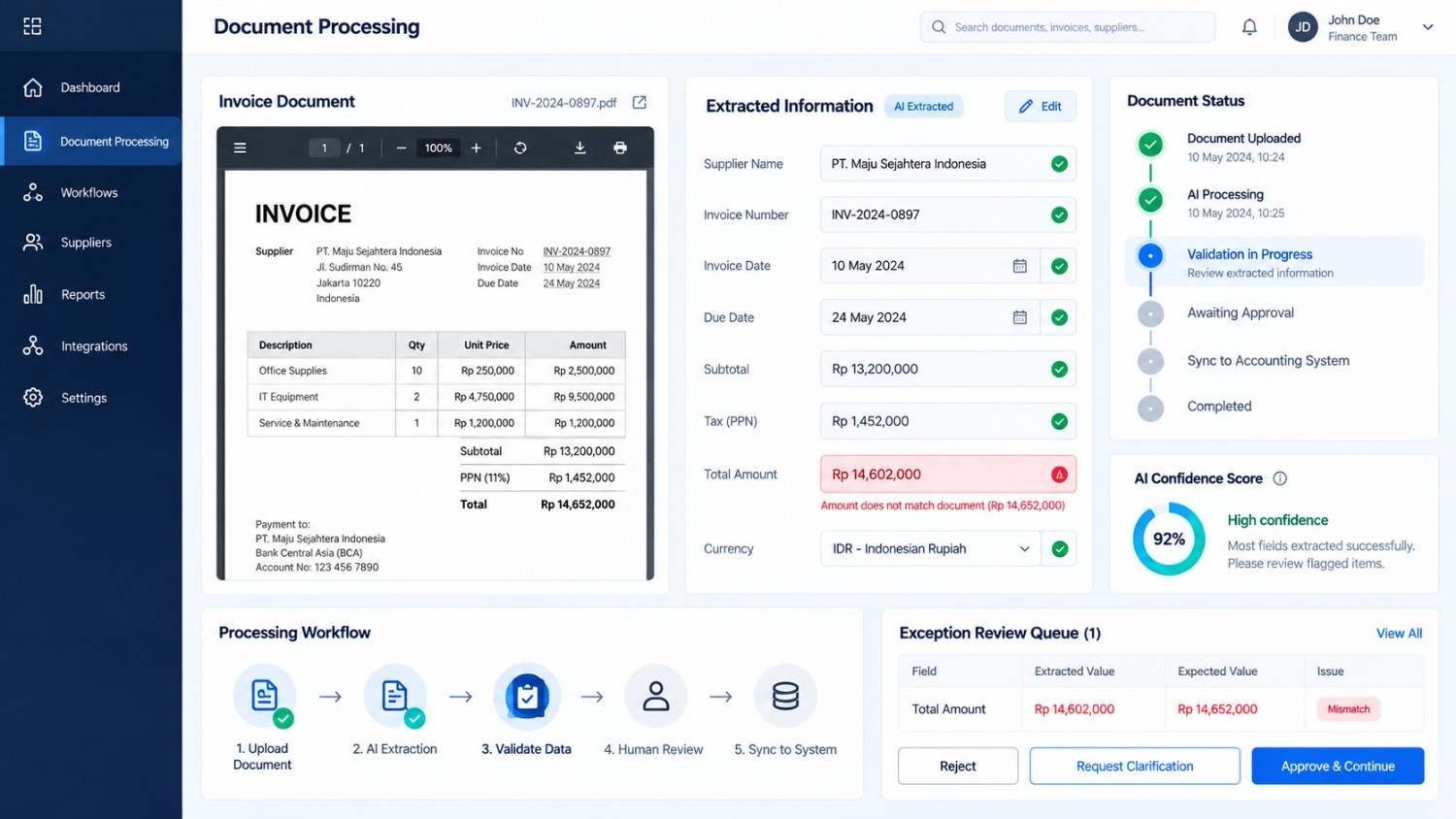
In the case of an employee that is in search of a specific clause in a large scale contract we see that instead of opening up many documents and going through the process of manual search, an AI application is able to put forth relevant passages and also do the summary for easy review.
A RAG system which pulls in relevant info from approved company sources before generating an answer. This makes the responses more related to the organization’s own documentation which in turn makes them more useful; although at the end they require proper evaluation.
Read UAutomate AI’s guide to Retrieval-Augmented Generation to understand how AI applications can work with business data.
The important point is that different tasks require different technical approaches. A forecasting application may need statistical methods or machine learning, while a document assistant may rely on language models and document retrieval.
Businesses planning a larger AI initiative may also need to consider product strategy, architecture, testing, and long-term scalability. Our guide to AI product development in Indonesia explores how businesses can move from an initial idea to a market-ready AI product.
AI Use Cases Across Indonesian Industries
In each industry we see different daily issues which shape what is the right application to use. A retailer may be looking for support with customer inquiries at the same time a logistics company may be focused on improving docs processing or detecting delivery anomalies.
Here are some examples of what businesses may do.
Retail and e-commerce
Retailers deal with product inquiries, customer feedback, order issues, and large volumes of product info. An AI application may be put to use for classifying in coming questions, to pull up product info, to compile customer feedback, or to aid staff in preparing responses.
For example a customer support representative may pull up on approved delivery and return policies before writing out a response. The staff member will go over the response before sending it out when the issue requires human input.
Financial services
Financial services companies may look into AI for use in document classification, internal knowledge management, and initial document review. These applications in turn support staff which deal with large sets of info.
However in the case of financial issues we require that which is proper control, validation, and human input. Do not assume an AI put forth recommendation is a definitive go ahead for a financial decision.
Manufacturing and logistics
Manufacturers and logistics companies work with inventory reports, maintenance docs, delivery info, and operational reports.
AI may play a role in which of these records we keep, identifying out of the ordinary trends, to also include in reports issues with delivery, or to support predictive maintenance when we have the proper data.
Professional services
Accounting offices, consultancies and other professional services which handle contracts, reports, correspondences and client docs. We have an internal knowledge base which allows authorized staff to access the info they need without opening up many files.
Healthcare administration
Healthcare organizations can look into electronic health records classification, appointment support, and information retrieval.
In regards to personal health information and clinical decision systems we see those which have greater need for privacy, accuracy, and professional responsibility. Also each case should be looked at for its particular application before we go ahead with implementation.
Across all these fields the first best step is usually to identify a single well defined workflow. Once that has been put in and we see value from it the company may then choose to roll it out to other processes.
Custom AI Application, AI Integration, or Ready-Made Software?
Not every business needs a completely new application. Sometimes an existing tool can meet the requirement; in other cases, integrating AI into current software or developing a custom solution may be more appropriate.
| Approach | When it makes sense | What to consider |
| Ready-made AI software | The business needs a common capability, such as summarisation or basic assistance | Features, subscription costs, data handling, and customisation limits |
| AI integration into existing software | The business already has suitable systems and wants to extend their capabilities | API availability, compatibility, permissions, and integration effort |
| Custom AI application | Existing tools cannot meet important workflow or business requirements | Development scope, testing, ownership, and long-term maintenance |
In the present, a company is using a CRM platform which they wish to see sales personnel use more efficiently. We see that integrating an AI assistant into the present platform may be a better solution than to build a brand new CRM system.
On the other hand, a company which has a very specific approval process or is customer facing may require more tailoring which ready made software does not provide.
The fit should be the main issue in this decision. A basic which meets the marks very well may in fact be a better use of resources than a very complex application which includes features the business doesn’t use.
From Idea to Production: AI Development Process
Developing a good AI application goes beyond that of just creating a prototype. The application has to work with proper data, integrate into present processes, and perform well when live users begin to use it.
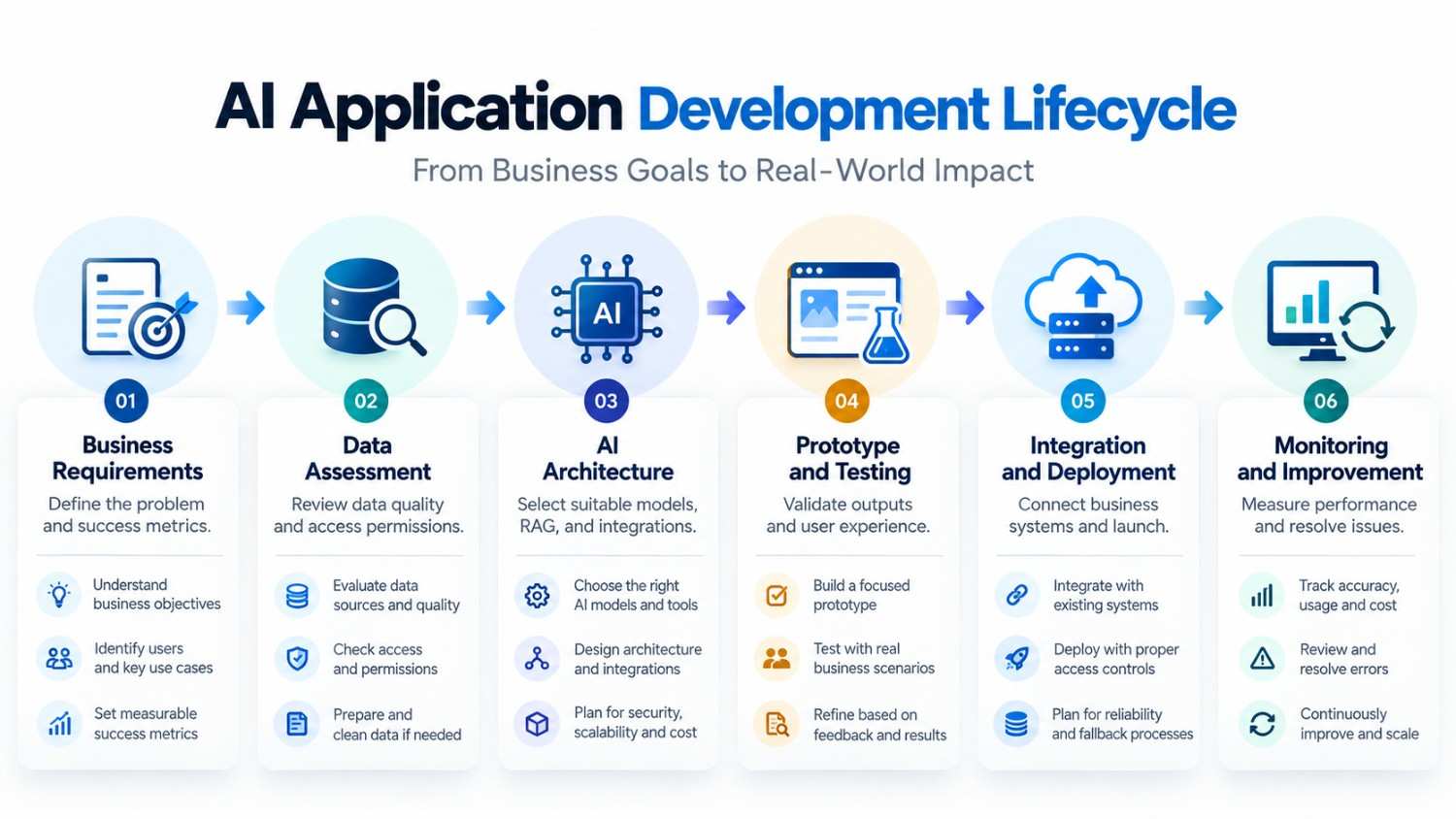
A practical development process may be broken up into six stages.
Step 1: Outline the business needs
First determine the target audience, the issue at hand, what info the application will require, and what the output will be.
For instance in the case of an invoice processing application which may have to extract certain fields out of the invoice, identify which info is missing, and send for review any which raise questions by defining requirements early we make it easier to determine if the finished product does what is intended.
Step 2: Check if data is ready
Review the issue of data quality, access, and permissions which the application in question will use.
If we find that documents are out of date, inconsistent, or incomplete the development team has to address those issues first. Data preparation is a large component of the project.
Step 3: Select the appropriate technology
Then we may use an existing AI model, retrieval augmented generation, machine learning, conventional workflow automation or a mix of these.
The choice of the model should follow the requirements. In some cases which are simple classification tasks we may not see the same type of architecture used as in an application that has to retrieve info, reason through multiple steps, and interface with other business systems.
Step 4: Develop and test a prototype
A prototype is used by the team to test the main idea out before going into full scale implementation.
Test out with real world examples that include incomplete input, ambiguous requests, incorrect info, and situations which the system asks for clarification or passes to a human.
Step 5: Integrate and deploy
Integrate the application with relevant business systems which also includes putting in place proper authentication, access controls, logging, and error handling.
Deployment planning also includes how we handle situations in which an API is down, the AI’s response is poor quality or that in which a needed data source is not available.
Step 6: Monitor and improve
Post launch tracks the application’s performance in terms of accuracy, reliability, usage, response times, and operating costs. Also review what users are saying and look into errors which may be reported instead of assuming the system will continue to perform without any input.
Security, Data Integrity, and Localisation Issue
An AI application’s value is a function of the data it has access to and the policies which govern its use. Also at the start of a project security and data governance issues should be addressed.
Businesses looking at AI in Indonesia should note which of the following issues is of import.
- Access permissions: Employees should have access only to information which they are authorized to see.
- Data protection: Identify where data is processed and stored, who has access to it, and how long it is.
- Output evaluation: Test out with a set of representative examples and develop a report on which results are incorrect or misleading.
- Human oversight: Decide what tasks will be automated and which will need employee approval.
- Fallback procedures: When out of information, the system is unsure, or a service is down we have a safe option.
- Language and localisation: Test out the Indonesian language features, local terminology, date and currency representations, and mixed language communication when relevant.
Indonesia’s Personal Data Protection Law, Law No. 27 of 2022, is an important reference when evaluating applications that process personal data. Businesses should assess the law’s applicability to their activities and obtain appropriate legal advice where necessary.
The NIST AI Risk Management Framework provides additional guidance on identifying and managing AI-related risks.
These frameworks can help organisations think through risk and governance, but using them does not automatically make an application secure or legally compliant.
What Determines AI App Development Costs in Indonesia?
The cost of developing an AI application depends on what the business needs it to do. A focused internal assistant and a complex application involving several systems, different user roles, and approval workflows can require very different levels of effort.
| Cost factor | Why it affects the budget |
| Application complexity | More features and complicated workflows generally require more development and testing |
| Data preparation | Documents or databases may need cleaning, structuring, or indexing |
| AI model usage | Model choice and the volume of requests affect recurring costs |
| System integration | Connecting to existing software can add implementation effort |
| Security and testing | Access controls, evaluation, monitoring, and failure handling require resources |
| Maintenance | Infrastructure, troubleshooting, and improvements create ongoing expenses |
How should businesses plan their budget?
Start with a very basic version of the application. This is a good way to determine the core requirements out which the solution will evolve, to identify what dependencies are present and to see if the put forth solution really works.
Ask that development partner to break out initial implementation costs from ongoing expenses which include model use, infrastructure, third party services and maintenance.
Also it is a good idea to put a value on the business before you go all in with a larger rollout. For instance a company may look at how much time staff put into document processing at present and then compare that with what we saw in a controlled pilot.
Avoid it which puts forth that all automated tasks will produce financial savings. What the business case must do is include implementation costs, human review, error correction, and the effort put into maintenance of the application.
Estimating a realistic budget also requires understanding the development stages, technical requirements, and ongoing expenses involved. Read our guide to AI app development costs and process in Indonesia for additional context when planning your project.
How to Choose an AI App Development Company Indonesia
Choosing a development partner requires more than comparing prices or reviewing a list of technologies. The provider should understand the business problem, explain its proposed approach, and be clear about the work required to deliver a dependable application.
Use this checklist when evaluating potential providers.
| Evaluation criterion | Questions worth asking |
| Business understanding | How will you translate our requirements into measurable outcomes? |
| Technical approach | Why is the proposed architecture suitable for this use case? |
| Data protection | How will access, storage, retention, and permissions be handled? |
| Integration | Can the solution work with our current CRM, ERP, databases, or APIs? |
| Testing | How will accuracy, reliability, and failure scenarios be evaluated? |
| Ownership | What happens to the source code, documentation, and other deliverables under the contract? |
| Pricing | What is included in the estimate, and which costs are recurring? |
| Post-launch support | Who will monitor the application and address issues after deployment? |
Ask the provider to walk through a realistic example rather than relying only on a presentation. A well-prepared proposal should explain the assumptions, limitations, dependencies, and acceptance criteria.
It is equally important to distinguish a successful demonstration from a production-ready application. A prototype may work well with a few selected examples but still require significant testing before it can handle real users and unpredictable inputs.
For businesses exploring AI agents and multi-step workflows, UAutomate AI’s guide to AI agent development provides additional context on how intelligent systems can interact with business processes.
AI Product Development in Indonesia vs Singapore
The right development partner is not necessarily located in the same country as the business. The decision should depend on the project’s requirements, the intended customers, the delivery model, and the provider’s relevant capabilities.
An AI Product Development Company Indonesia may be relevant to a business developing a reusable product for Indonesian customers. An AI App Development Company Singapore may be considered by organisations seeking a partner for Singapore-focused requirements or regional operations.
Similarly, an AI Product Development Company Singapore may be relevant when the objective is to build and maintain a product for a wider customer base.
These terms describe different business contexts; they do not automatically indicate differences in quality, cost, or technical expertise.
Before making a decision, compare the following:
- Market requirements: Does the provider understand the needs of your intended users?
- Language and localisation: Can the solution support the languages and terminology used in the target market?
- Data handling: Are the proposed data-processing arrangements suitable for your requirements?
- Communication: Can the teams collaborate effectively throughout development?
- Ownership and support: Are deliverables, maintenance responsibilities, and handover arrangements clearly defined?
- Total cost: Have development, integration, infrastructure, and ongoing support been considered?
For additional context, read this AI product development in Singapore.
How UAutomate AI Can Support Your AI Application Initiative
UAutomate AI’s published website covers AI development and automation capabilities, including AI agents, knowledge assistants, document-related workflows, and integration-oriented solutions. These areas may be relevant to businesses looking to connect AI with existing operations rather than introduce another disconnected tool.
For example, a business might explore an internal knowledge assistant to help employees find information in approved documents, or investigate AI-supported document processing to reduce repetitive data entry and review work.
The appropriate approach depends on the requirements. Before recommending a solution, the business problem, available data, existing systems, security expectations, and desired outcomes should be understood.
UAutomate AI’s AI development provides a starting point for reviewing its published solution areas. Businesses should confirm the exact scope, delivery arrangements, technical requirements, and ongoing support available for their proposed project directly with the team.
AI Application Readiness Checklist
Before requesting a proposal, prepare a short brief covering the information below. You do not need to have every technical decision finalised; the purpose is to make the first discussion more focused.
| Checklist item | What to prepare |
| Business problem | A clear explanation of the challenge |
| Intended users | Employees, customers, partners, or other user groups |
| Current workflow | The steps followed today and where delays occur |
| Available data | Documents, databases, APIs, and other approved sources |
| Required integrations | CRM, ERP, accounting, or other business systems |
| Success metrics | Baseline measurements and expected outcomes |
| Risk boundaries | Which tasks AI may perform and which require human approval |
| Budget and timeline | Project constraints and priorities |
| Ownership and support | Expectations for documentation, handover, and maintenance |
For instance, a company planning an AI document assistant should identify which documents the application can access, who will use it, what kinds of questions it should answer, and how employees will verify its responses.
This level of preparation helps a development partner assess feasibility and identify potential challenges before the project moves into implementation.
Frequently Asked Questions
1. What does an AI app development company in Indonesia do?
An AI app development company helps businesses plan, build, integrate, test, and maintain applications that use artificial intelligence. Depending on the requirements, these applications may support document processing, knowledge retrieval, customer support, analytics, or workflow automation.
2. How much does AI app development cost in Indonesia?
The cost depends on application complexity, data preparation, AI model usage, system integrations, security requirements, and ongoing maintenance. Businesses should request a scoped estimate that distinguishes initial development from recurring operating costs.
3. How long does it take to develop an AI application?
The timeline depends on the requirements, data readiness, integrations, testing, and deployment constraints. A focused prototype usually involves less work than a production application with several integrations and more demanding reliability requirements. A realistic timeline should be based on a defined scope.
4. Can AI applications integrate with existing business software?
Yes, provided the existing systems offer suitable APIs, connectors, or other integration methods. The feasibility depends on the software architecture, permissions, data formats, and security requirements. These dependencies should be assessed early.
5. How can businesses protect data used by AI applications?
Businesses should establish access controls, minimise unnecessary data collection, review provider data-handling terms, and define retention policies. Applications processing personal or confidential information also need appropriate security testing and compliance review.
6. What is the difference between AI app development and AI product development?
AI app development focuses on creating an application with AI capabilities. AI product development generally covers the broader lifecycle of creating, validating, launching, and improving a product for an intended customer base.
Build AI Around a Clear Business Objective
Choosing an AI App Development Company Indonesia is an important step, but the process should begin with a clear understanding of the business problem. The right application depends on suitable data, an appropriate technical approach, reliable integrations, and measurable success criteria.
Businesses should evaluate development partners carefully, validate their assumptions through a focused first release, and plan for monitoring and maintenance after launch. This makes it easier to determine whether AI is delivering practical value and where further investment may be justified.
Planning an AI-powered business application? Contact UAutomate AI to discuss your requirements, explore relevant AI capabilities, and identify a practical next step for your project.