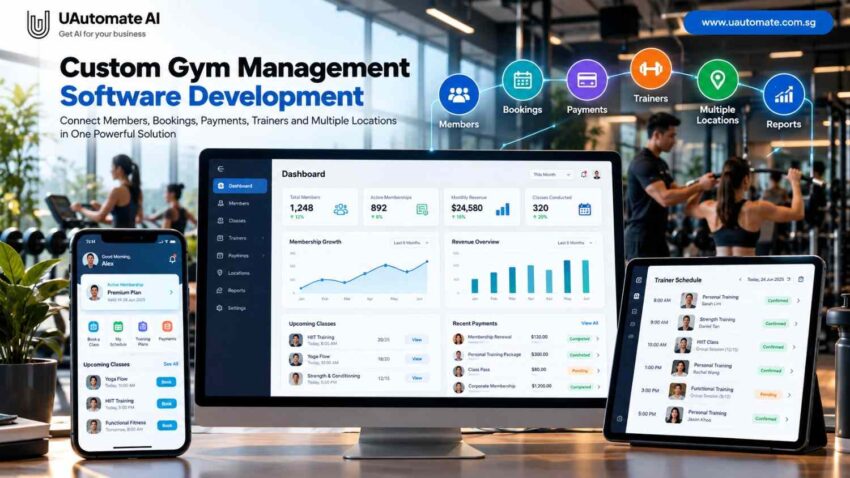
Assume a gym owner that has three locations. We have class bookings going through one platform, membership payments via another, and our trainers using spreadsheets for their schedules. While each system works fine on its own they are separate which means to get the full business view is a challenge.
This issue is seen in fitness businesses which as they grow their operations become more complex and by that time usual software may not have the flexibility required to run all aspects of the business.
Custom gym management software development offers an alternative: building a solution around the way your fitness business actually works. But when is custom development worth the investment, and when can existing software do the job?
Let us look at this guide which covers basic elements and practical aspects which will aid you in making the right decision.
The Real Problem: Your Gym Is Growing, but Your Software Is Not
A gym may begin by offering basic memberships and a booking system. As the business grows we see them add in personal training programs, corporate memberships, new locations and specialized services.
The original software may not support these changes.
Staff may run separate spreadsheets for trainer commissions, use diverse applications for customer communication and prepare reports for management by hand.
The result is more administrative work and less visibility into daily operations.
| Business development | New requirement | Possible limitation |
| Opening new branches | Centralised management | Limited branch reporting |
| Introducing new packages | Flexible membership rules | Restricted configurations |
| Hiring more trainers | Advanced scheduling | Limited staff management |
| Expanding services | Connected booking systems | Disconnected applications |
| Building a premium brand | Branded member experience | Limited customisation |
When these problems become regular, it is worth examining whether your current software needs additional integrations, customisation or a completely different approach.
Seven Signs That Fitness Business May Need Custom Software
Business size alone does not determine whether custom software is necessary. Your operational requirements matter more.
1 Membership Structure Is Becoming Complicated
In many gyms you don’t see a simple monthly subscription.
Some which are in business for this do annual members’ cards, family options, corporate packages, personal training menus and class specific subscriptions.
Managing these programs becomes complex when present software does not support different price rules, member freezings, extensions and renewal terms.
As we can design a system that is custom to your membership policies. It will track which trainings still have to go, set renewal terms and alert staff when a member requires attention.
2 When Managing Multiple Gym Locations
Managing several branches requires more coordination than running a single gym.
Each location may have different trainers, class schedules, operating hours and membership packages. However, business owners still need a consolidated view of performance.
A centralised platform can help:
- Headquarters monitor membership and revenue across branches.
- Branch managers manage local schedules and attendance.
- Trainers access assigned sessions.
- Members check services at their preferred location.
- Management compares branch performance.
This is particularly useful for fitness chains that need centralised reporting alongside branch-level control.
3 When Team Uses Too Many Disconnected Applications
Consider, what is the total number of applications your staff use daily?
One does memberships, another does payments, we have a separate tool which stores customer info and we use another for marketing communication.
Problems occur which arise from poor information sharing.
For instance, a member’s information change in one system may not be reflected in the other records.
With the right plan, fitness software can tie in these applications via APIs and supported connections which in turn will reduce duplicate data entry and manual updates.
4 Booking Process Does Not Match Your Business Model
A typical booking system works for regular group classes. But in the case of specialist fitness businesses they also have other requirements.
These may include:
- Personal training based on trainer availability.
- Small-group sessions with limited capacity.
- Recurring bookings and waitlists.
- Equipment-specific reservations.
- Package-based booking restrictions.
- Different booking privileges for membership categories.
A custom booking process which includes these requirements and makes scheduling easier for employees and members.
5 Want a Better Branded Member Experience
Your gym’s brand should be the same at every step of the member’s journey.
However when we see customers using other applications for bookings, payments and communication, we see that it breaks down.
A brand named fitness application can put these together under your business identity.
Based on what is required it may include class bookings, member details, payment history, trainer communication and personal notifications.
Businesses looking at connected fitness applications can also discuss their needs with UAutomate AI.
6 Cannot Access the Reports Your Business Needs
Basic gym software reports total memberships and monthly revenue but in terms of what the management is looking for they also need more in depth information.
For example:
- Which branches have the highest renewal rates?
- Which classes have low attendance?
- Which trainers have the highest session utilisation?
- How many members have not visited recently?
- Which membership packages generate the most revenue?
A custom reporting dashboard which brings together relevant info for owners to make decisions without the use of multiple spreadsheets.
7 Repetitive Administrative Work Is Increasing
Gym staff take care of a number of routine tasks which include membership follow ups, payment reminders, booking queries and attendance reports.
When done manually these tasks take up more of the employees’ time which in turn leaves them with less to put into member engagement.
A custom system can perform certain business functions through business rules, notifications and integration.
You can also explore UAutomate AI’s guide to business process automation in Singapore for more information.
Custom Gym Software vs Ready-Made Platforms: Which Should You Choose?
Custom software is not automatically better than an existing gym management platform.
Ready-made solutions provide established features and faster implementation. They are often suitable for businesses with standard requirements.
Custom development becomes relevant when existing platforms cannot support important workflows or integrate effectively with other systems.
| Evaluation factor | Ready-made software | Custom software |
| Implementation | Generally faster | Requires development |
| Features | Predefined | Requirement-based |
| Workflows | Limited to available configurations | Greater flexibility |
| Branding | Depends on vendor | Greater control |
| Integrations | Depends on supported connections | Designed around requirements |
| Scalability | Depends on vendor architecture | Planned around business needs |
| Maintenance | Primarily vendor-managed | Requires an agreed support arrangement |
| Investment | Usually subscription-based | Development and ongoing costs |
If you are still evaluating whether custom development is the right approach for your business, explore our guide to custom software development in Singapore.
Which Option Makes Sense for Your Business?
| Business situation | Suggested approach |
| Small gym with standard memberships | Ready-made software |
| Boutique studio with basic bookings | Ready-made software |
| Growing gym with integration gaps | Existing software plus custom integrations |
| Multi-location fitness chain | Custom or hybrid solution |
| Business launching a differentiated fitness product | Custom platform |
A hybrid solution is also worth considering.
You could retain your existing payment or membership platform while developing a custom dashboard, integration layer or branded application.
This provides additional flexibility without rebuilding features that already work.
What Should a Custom Fitness Management System Include?
The features should reflect how your business operates rather than simply increasing the number of modules.
A useful starting point is to divide the system into four areas.
A. Administration and Business Management
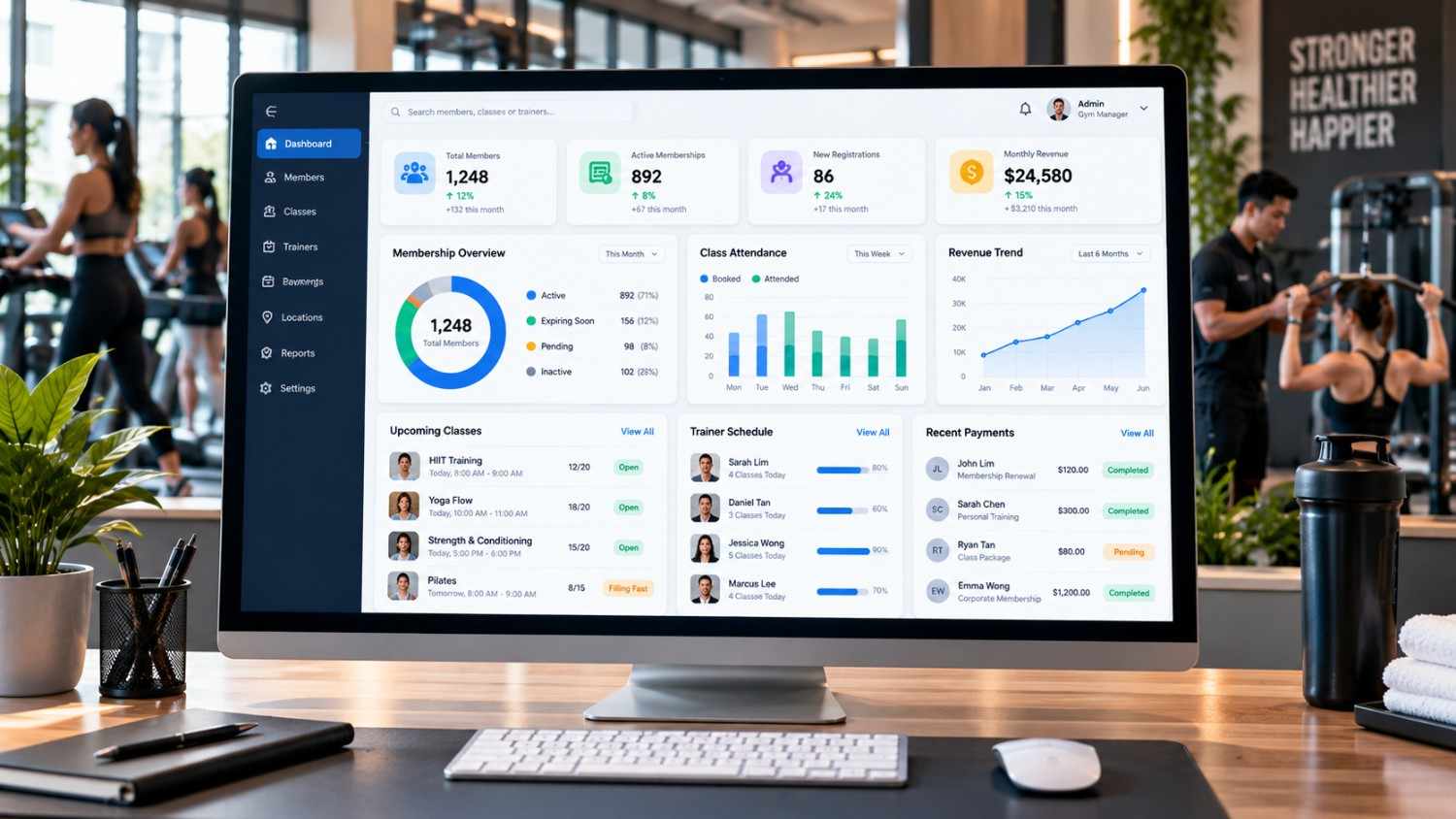
The administrative dashboard may include:
- Member registration and profile management.
- Membership creation and renewals.
- Payment records.
- Class scheduling.
- Trainer assignments.
- Branch management.
- Business reports.
B. Member-Facing Application
A member application can make everyday activities easier through:
- Account registration and login.
- Membership information.
- Class booking and cancellation.
- Personal training reservations.
- Payment history.
- Renewal notifications.
- Fitness progress information.
C. Trainer and Staff Interface
Trainers and employees may need access to:
- Daily schedules.
- Assigned training sessions.
- Member information based on permissions.
- Attendance records.
- Session completion updates.
- Availability management.
D. Reporting and Business Intelligence
A reporting system can bring information from different modules together.
For example, gym owners could monitor membership growth, revenue by branch, class utilisation, trainer workload and renewal performance.
How the components connect
| Component | Main responsibility |
| Central management platform | Coordinates gym operations |
| Admin dashboard | Manages members, payments and reports |
| Member application | Supports bookings and memberships |
| Trainer portal | Manages schedules and sessions |
| Analytics dashboard | Displays business performance |
| External integrations | Connects payments, CRM and accounting |
The system should also establish which platform is responsible for each type of information. For example, a payment provider may manage transaction status while the gym platform maintains membership records.
Why Fitness Software Integrations Matter More Than Adding More Features
A gym can use several powerful applications and still experience operational difficulties if those applications work independently.
Integration allows different systems to exchange relevant information.
| Integration | Business application |
| Payment gateway | Payment confirmation and renewals |
| CRM | Member records and follow-ups |
| Accounting software | Financial reconciliation |
| Access control | Authorised gym entry |
| Communication tools | Member reminders and updates |
| Analytics platform | Operational reporting |
Example: An Automated Membership Renewal Process
A connected system can handle a typical renewal through five steps:
- Identify upcoming renewals: Check membership expiry dates.
- Notify members: Send reminders through an approved communication channel.
- Process payment: Connect with the selected payment provider.
- Verify the transaction: Confirm payment status before updating membership.
- Update records: Display the new renewal status on the management dashboard.
This is an illustrative workflow. Its implementation depends on available APIs, payment provider capabilities and membership policies.
Good integration planning should also account for failed payments, duplicate notifications and situations requiring manual intervention.
Custom Gym App Development: When Does a Branded Application Make Sense?
A mobile application can become an important part of the member experience, particularly for businesses that depend on frequent customer interactions.
However, developing an app simply to appear in app stores is not a strong business reason.
Consider whether your members would genuinely benefit from features such as:
- Class and personal training bookings.
- Membership and subscription management.
- Payment history.
- Trainer communication.
- Progress tracking.
- Personalised notifications.
| Member activity | Possible app functionality |
| Joining the gym | Registration and membership selection |
| Booking a class | Availability and reservations |
| Managing payments | Payment history and renewals |
| Training with a coach | Session schedules |
| Tracking activity | Progress information |
| Staying connected | Notifications and announcements |
For businesses researching gym app development Singapore, the main consideration should be how the application connects with the operational platform behind it.
An app that operates independently of membership, booking and payment systems may create another disconnected tool rather than solving existing problems.
What Does Custom Gym Software Development Actually Involve?
Successful development begins with understanding how the fitness business operates.
The engineering team should first identify the users, workflows and business outcomes the system needs to support.
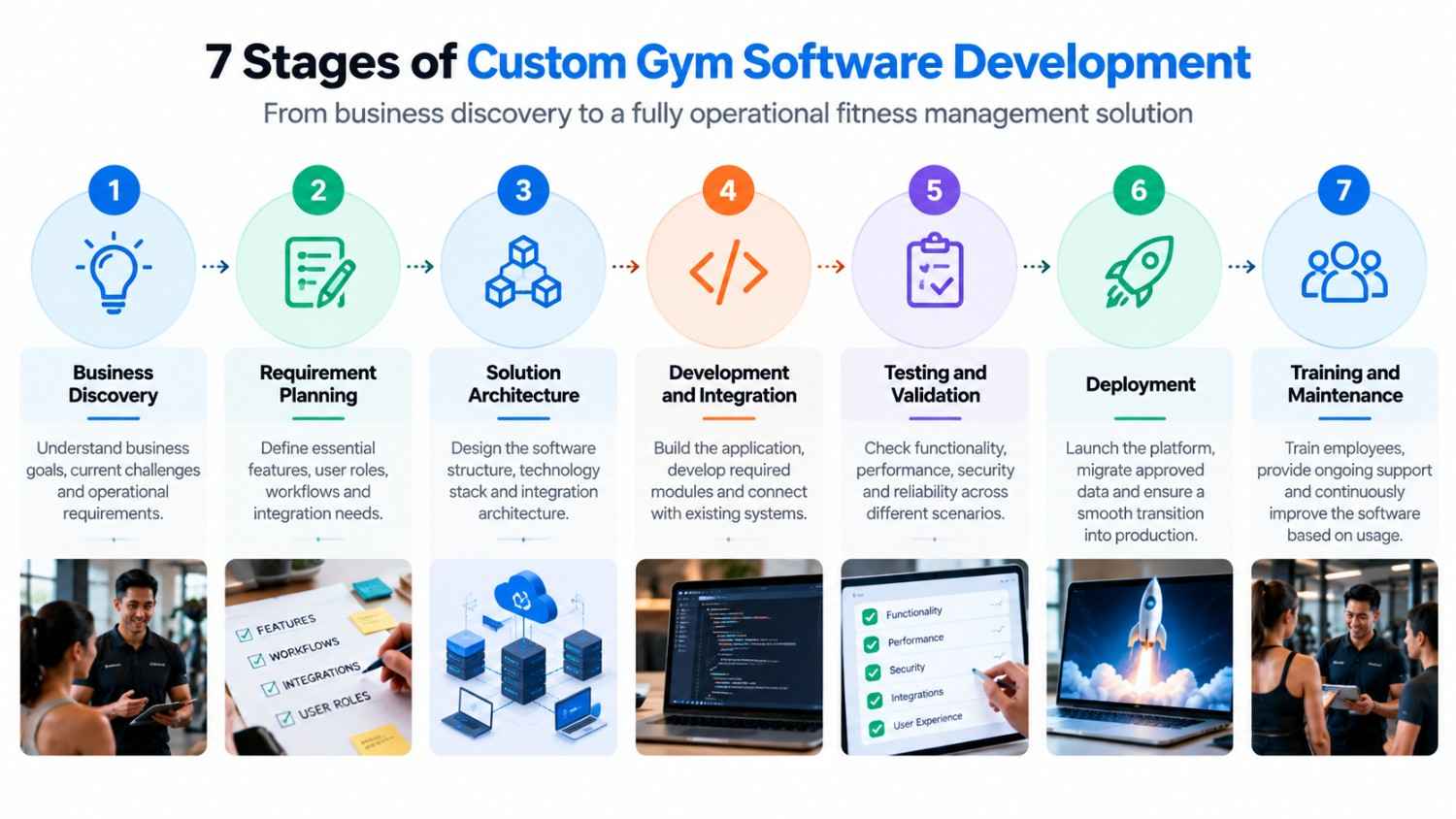
A typical development project involves seven stages.
Stage 1: Business Discovery
Understand the current operating model, identify users and document existing challenges.
Stage 2: Requirement Planning
Map important activities such as member registration, payments, bookings and renewals. Separate essential features from optional enhancements.
Stage 3: Solution Architecture
Decide how the platform will be structured, which existing systems will remain and how information will move between components.
Stage 4: Development and Integration
Build the required interfaces, backend services and databases. Connect relevant CRM, payment and communication systems.
For businesses planning to introduce intelligent features into their fitness applications, our guide to AI product development in Singapore
Stage 5: Testing and Validation
Test regular operations as well as failed transactions, cancelled bookings, membership freezes and duplicate records.
Stage 6: Deployment and Data Migration
Prepare the production environment, migrate approved records and validate the information before launch.
Stage 7: Training and Maintenance
Train employees, monitor performance, resolve issues and plan improvements based on actual usage.
Clear project requirements and acceptance criteria should be established before development begins.
How Much Does Custom Gym Management Software Development Cost?
There is no single price for every fitness software project.
The investment depends on the number of modules, workflow complexity, integrations, application platforms and maintenance requirements.
| Cost factor | Why it matters |
| Number of features | Additional modules require more development and testing |
| Mobile applications | iOS and Android introduce additional design requirements |
| Integrations | Third-party connections require technical work |
| Data migration | Existing records may need cleaning and validation |
| User permissions | Different roles need appropriate access |
| Reporting | Advanced dashboards require data modelling |
| Security | Authentication and data protection need attention |
| Maintenance | Updates and compatibility require ongoing work |
How Can Fitness Businesses Manage Development Costs?
One practical approach is to begin with a minimum viable product (MVP).
For example, a growing gym chain could initially prioritise:
- Centralised membership records.
- Branch-level management.
- Trainer scheduling.
- Essential payment integrations.
- Basic reporting.
Once these features work reliably, the business can introduce branded applications, automated retention workflows and advanced analytics.
This phased approach helps control the initial scope and allows the business to evaluate the solution before expanding it.
Security and Data Protection Should Be Part of the Development Plan
Gym management platforms may handle member contact details, attendance history, payment-related information and personal fitness data.
For businesses operating in Singapore, the Personal Data Protection Commission (PDPC) provides guidance on the Personal Data Protection Act (PDPA).
A development project should consider:
- Role-based access controls.
- Secure authentication.
- Appropriate data encryption.
- Controlled access to member records.
- Data retention and deletion policies.
- Backup and recovery procedures.
- Audit logs.
- Secure API connections.
When connecting payment, CRM or communication platforms, API security is particularly important.
The OWASP API Security Project provides guidance on common API vulnerabilities.
For Singapore-based operators, privacy requirements should be reviewed according to the actual information being collected and processed.
How UAutomate AI Can Support Tailored Fitness Technology Requirements
Selecting a development partner is beyond just finding a company which can build out an application. We need a team that has knowledge of business workflows, integrations and the people who will use the final product.
UAutomate AI is a Singapore-based technology company offering AI application engineering, custom software development, workflow automation and system integration capabilities.
Its website also presents AI fitness applications as a solution area, including branded iOS and Android applications.
Here are some relevant areas to explore.
Custom Applications and Business Dashboards
Through its custom AI software development services, UAutomate AI describes building business applications, operational tools and dashboards around specific requirements.
For fitness businesses a possible project is that of a custom management interface, member portal or integrated application.
Workflow Automation
Fitness companies which daily attend to member inquiries, notifications, records and internal coordination.
UAutomate AI’s workflow automation capabilities can be relevant when exploring ways to streamline these activities through business rules, APIs and automated processes.
Integration With Existing Systems
Wear out and replace every component is not always required.
We at UAutomate AI report we have put together an array of integration solutions for CRM, ERP, databases, APIs and cloud services. This is relevant for a fitness business which may want to connect to their present tools as an alternative to redeveloping their full tech platform.
AI-Powered Business Intelligence
Booked tickets, attendance and membership actions report valuable operational info.
A well thought out analytics solution can bring together relevant data which in turn will see management make better informed decisions.
Knowledge Systems and Team Support
Businesses that have many branches require uniform access to operations policies and procedures.
UAutomate AI’s AI knowledge assistants and RAG systems are relevant when exploring searchable internal knowledge systems for authorised employees.
Training and Adoption
A new platform’s value is only in how well it is adopted by the staff.
UAutomate AI also offers AI training services, which can support discussions around employee onboarding and adoption.
These are broader engineering capabilities, not a claim that every gym management module is already available as a standard product. Specific fitness functionality should be confirmed during project discussions.
Before Requesting a Development Proposal: What Should Gym Owners Prepare?
A clear project brief helps a development partner understand your business and provide a more realistic proposal.
Before approaching a development company, consider these six questions.
| Question | Information to prepare |
| What type of fitness business do you operate? | Single gym, fitness chain or boutique studio |
| What problems are you experiencing? | Manual administration, disconnected tools or reporting limitations |
| Who needs access? | Owners, managers, trainers and members |
| Which systems must connect? | Payment providers, CRM and accounting |
| What should the first version include? | Essential features and workflows |
| What does success look like? | Reduced manual work or improved reporting |
It is also helpful to prepare examples of membership rules, booking scenarios, existing software and reports you would like to access.
This allows the development team to determine whether you need custom software or whether existing tools can be configured to meet your requirements.
Frequently Asked Questions About Custom Gym Software
1. What Is Custom Gym Management Software Development?
It is the process of designing and building software around a fitness business’s specific requirements. It can include memberships, scheduling, payments, trainer management, reporting, integrations and branded applications.
2. Does Every Gym Need Custom Management Software?
No. Small gyms with standard booking and membership requirements may find ready-made platforms sufficient. Custom development is more relevant when existing solutions cannot support important workflows or integrations.
3. How Long Does It Take to Develop Custom Gym Software?
The timeline depends on project scope, feature complexity, integrations and testing requirements. A focused dashboard generally requires less development work than a complete multi-location platform.
4. Can Custom Gym Software Integrate With Existing Payment Gateways and CRM Systems?
Yes, provided the relevant platforms offer suitable APIs or supported integration methods. Authentication, data formats, permissions and error handling must be assessed before development.
5. What Is the Difference Between Gym Software Development and Gym App Development?
Gym software development covers the wider operational platform, including administration, memberships, payments and reporting. Gym app development focuses on the mobile experience for members or trainers. Both can operate as parts of one connected system.
6. Can a Custom Gym Management System Support Multiple Locations?
Yes. It can support centralized management, branch-specific permissions, individual schedules and consolidated reporting, depending on the business requirements.
7. Is Custom Gym Software More Expensive Than Ready-Made Software?
Custom development generally requires a higher initial investment. However, the comparison should also consider subscription fees, integration expenses, customisation charges, maintenance and long-term operational value.
8. How Do I Choose a Gym App Development Company in Singapore?
Evaluate its software engineering capabilities, integration experience, development process, security practices and ongoing support arrangements. Ask about requirement gathering, testing, deployment and maintenance before selecting a partner.
Build Software Around the Way Your Fitness Business Operates
Your fitness business does not require custom software just because it has many members or is in multiple locations. What it does need is a tailored solution which improves on what is present which in turn will improve efficiency, visibility, customer experience or growth.
Custom gym management software development can address these challenges through connected applications, specialised workflows, business integrations and reporting systems designed around actual requirements.
For some businesses, this may mean developing a complete management platform. For others, a custom dashboard, branded mobile application or integration layer may be enough.
The best starting point is to identify what is not working and define what a successful solution should achieve.
If you are looking to design a custom digital solution for your fitness business reach out to UAutomate AI to go over your needs and we will put together a project specific proposal.