A member messages on WhatsApp to book a class, another asks about their renewal, whilst the reception team are updating payments in Excel and trainers are checking their schedules via individual messages. This is a common scenario for many gym owners.
Initially, it may seem like an easy and cheap option to use various systems, as the number of your members increases it can become very difficult to keep track of bookings, payments, attendance and memberships.
This is where Gym software in Singapore businesses can benefit from becomes relevant. Instead of switching between multiple applications, gym owners can bring essential activities into a connected digital environment.
The issue with using WhatsApp, spreadsheets and standalone fitness apps is they often aren’t integrated and therefore staff need to manually update information. As your fitness business grows you should aim to reduce any unnecessary work.
For growing fitness businesses, the focus should be on reducing this unnecessary effort and creating a more organised way to manage operations.
1. Why traditional gym management methods stop working as businesses grow
Most gyms don’t start with complicated software requirements. Initially, the owner might manage membership details in Excel, confirm bookings through WhatsApp and ask trainers to maintain their own schedules.
This approach works when there are relatively few members. However, as membership numbers increase and more trainers join, the same processes create additional administrative work.
Consider a gym that manages 50 members using spreadsheets and WhatsApp. When its membership grows to 300 or 500 people, maintaining everything manually becomes much harder.
WhatsApp becomes the booking and customer support system
WhatsApp makes communication convenient. Members can ask about class timings, check membership plans, request bookings and contact trainers.
However, conversations are not the same as organised business records.
For example, when a member requests a place in a weekend fitness class, an employee must check availability, confirm the reservation and update the attendance record. If the message gets buried among other conversations, the booking might be missed.
WhatsApp Business offers useful features such as quick replies, labels and automated greetings. However, these features do not independently replace a complete gym management system.
Spreadsheets become difficult to maintain
Spreadsheets are useful for storing information, but problems arise when several employees maintain different versions of the same file.
Gyms commonly use spreadsheets to track:
- Member names and contact information.
- Membership start and expiry dates.
- Payment status and outstanding balances.
- Class attendance.
- Trainer schedules.
- Membership renewals.
For instance, a trainer might record attendance in one file while reception updates another. The owner then has to combine the information to understand the actual business position.
Separate fitness apps create additional complexity
Some gyms use one application for bookings, another for payments and a third for membership management.
Although each application may work well individually, employees still need to move between platforms to complete routine tasks.
The business becomes digitally active without having a genuinely connected operating system.
2. What disconnected gym operations actually look like
Here is how different gym activities are commonly managed when there is no central system.
| Business activity | Traditional approach | Operational challenge |
| Class bookings | WhatsApp messages | Manual confirmation and missed requests |
| Membership tracking | Excel spreadsheets | Outdated or duplicate records |
| Payment monitoring | Bank statements and separate records | Difficult reconciliation |
| Attendance | Paper registers or sheets | Delayed reporting |
| Trainer scheduling | Individual calendars | Scheduling conflicts |
| Member communication | Multiple chat groups | Inconsistent information |
| Business reporting | Manually prepared reports | Limited visibility |
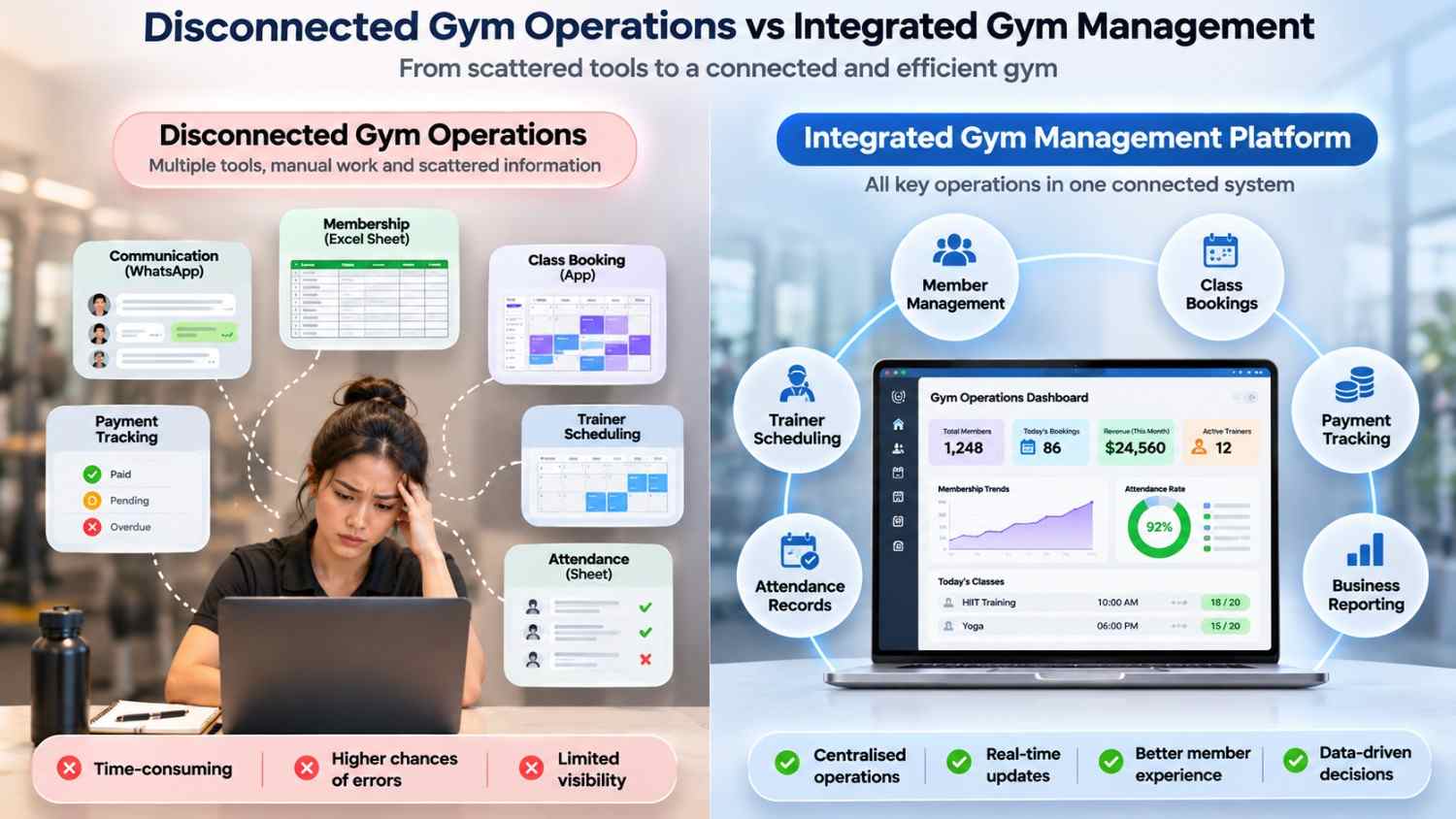
The real issue isn’t how many applications a gym uses. It’s whether those applications can share information.
For example, when a member books a class, the booking details should be accessible to the relevant trainer and reception team without requiring repeated manual updates.
3. Six operational problems caused by fragmented gym systems
Disconnected tools can cause issues throughout the gyms operations. Small issues that can add up.
3.1 Missed bookings and scheduling conflicts
If there is a manual booking process staff will constantly need to check messages, confirm availability and update the schedule.
There is a risk of duplication if two staff members are using separate systems.
Booking processes can be connected so that there is one central schedule, bookings can be recorded and availability shown.
3.2 Membership renewals become difficult to track
Membership renewals are an important part of ensuring steady income.
If you are keeping track of expiry dates in a spreadsheet staff will have to keep checking and know who to contact.
Membership systems can be connected so that expiry dates can be organised and reminders can be sent out depending on your set rules.
3.3 Payment reconciliation takes additional time
Payments can come through multiple sources and membership records are being updated separately.
This can make it difficult to know what payments have been made, what is outstanding and what needs attention.
Payment connections can help to connect payment records with relevant membership information depending on your chosen payment gateway and accounting systems.
3.4 Trainers lack a shared view of schedules
Trainers need accurate information on what sessions they have been allocated, when classes are and changes to the schedule.
If everyone has their own calendars managers will need to inform people individually which can cause confusion when sessions change.
Centralised scheduling means everyone has one place to go.
3.5 Member experiences become inconsistent
Imagine a member comes into reception to ask about their expired membership.
One person will check WhatsApp, another will look at the spreadsheet and another will look through old payments.
Centralised member records mean authorised staff can find relevant information more easily.
3.6 Owners struggle to understand business performance
Gym Owners will want to know more than just how many memberships they have.
Maybe they want to know how many people are attending, how many bookings they are getting, how many renewals they are getting, how much they are collecting in payments and how they are using their trainers.
Having a connected reporting system will show operational KPIs.
By introducing business process automation in Singapore, businesses can reduce repetitive administrative tasks, improve workflow coordination and make everyday operations easier to manage.
4. What changes when gym operations become connected?
An integrated gym management system creates a shared environment where different business activities work together.
Instead of maintaining separate records for every task, the business uses connected workflows that allow information to move between different functions.
Example: A connected member journey
| Step | Activity | What happens |
| 1 | Member registration | A member profile is created. |
| 2 | Membership selection | The appropriate membership plan is assigned. |
| 3 | Payment | Payment is recorded through the connected payment process. |
| 4 | Booking access | The member receives access to relevant booking options. |
| 5 | Class reservation | The selected session is added to the schedule. |
| 6 | Trainer coordination | The trainer can view the updated session schedule. |
| 7 | Attendance | Participation is recorded after the class. |
| 8 | Business reporting | Management reviews relevant membership and attendance information. |
This example shows how information can move between different business functions without employees repeatedly entering the same details.
What does an integrated environment connect?
| System component | Main responsibility | Operational value |
| Member management | Stores member profiles and membership details | Centralised records |
| Booking management | Handles class reservations and availability | Organised scheduling |
| Payment integration | Connects transaction records | Easier payment tracking |
| Attendance management | Records participation | Better visibility |
| Trainer management | Organises trainer assignments | Improved coordination |
| Communication workflows | Supports member notifications | Consistent communication |
| Reporting dashboard | Consolidates operational information | Better decisions |

A personal training studio may prioritise individual client sessions and trainer calendars. A multi-location gym may need centralised memberships, branch-level reporting and shared customer records.
The right combination of features depends on the business model.
5. What should an all-in-one gym software solution include?
When comparing all-in-one gym software, it is easy to get distracted by the number of features a provider advertises.
However, having more features doesn’t automatically make a system useful. What matters is whether it supports the activities employees handle every day.
Businesses with specific operational requirements can also explore custom software development in Singapore to understand how software can be designed around their workflows, integrations and long-term requirements.
Centralised member management
A member profile should provide a clear view of relevant information, including:
- Contact details.
- Membership type and validity.
- Payment history.
- Booking records.
- Attendance information.
- Communication history.
This reduces the need to search through multiple files whenever an employee needs to check a member’s details.
Online booking and scheduling
Members should have a convenient way to check available sessions and make reservations.
Depending on the gym’s requirements, the system may support class capacity, trainer availability, cancellations and waitlists.
Membership and payment management
The system should make it easier to monitor membership status and payment activity.
Where supported, payment gateway integrations can connect transactions to member records. Gym owners should check compatibility with their preferred payment providers and accounting workflows.
Trainer and staff coordination
A central scheduling environment helps managers assign trainers, organise sessions and communicate changes.
Role-based access is also important. Trainers may need access to their schedules without requiring access to every business record.
Member-facing mobile applications
A branded mobile application can make it easier for members to interact with the gym.
Depending on the solution, it may allow members to:
- View membership details.
- Book fitness classes.
- Check upcoming sessions.
- Receive notifications.
- Access account information.
Reporting and analytics
A useful reporting environment should help owners understand what is happening across their business.
Examples include membership activity, attendance trends, booking utilisation, payment status and trainer workload.
The objective is to make business information easier to understand and act upon.
6. How to transition from spreadsheets and WhatsApp without disrupting operations
Moving away from familiar tools can feel like a major task, particularly for gyms that have used the same administrative processes for years.
A planned transition allows employees to adapt while reducing the risk of losing important information.
Stage 1: Audit existing tools
Identify every application, spreadsheet and manual process currently used for bookings, payments, attendance and membership records.
Stage 2: Identify essential requirements
Separate essential requirements from optional features. A small studio may prioritise booking management, while a larger gym may need multi-location reporting.
Stage 3: Plan data migration and integrations
Review existing member records, remove duplicate entries and identify which applications need to connect with the new system.
Before deciding whether to connect existing applications or build a new solution, businesses should understand the difference between AI integration and custom AI development.
Stage 4: Test workflows and train employees
Test common activities such as registrations, bookings, cancellations, renewals and payment updates. Train employees before moving all operations.
Stage 5: Monitor and improve
Review employee feedback and operational performance. Identify processes that still require unnecessary manual work and improve them.
Five-stage implementation summary
| Stage | Main activity | Expected output |
| 01 | Existing process audit | Tool and workflow inventory |
| 02 | Requirement planning | Prioritised feature list |
| 03 | Integration and migration | Connected information environment |
| 04 | Testing and training | Staff-ready workflows |
| 05 | Deployment and optimisation | Improved daily operations |
A phased approach is particularly useful for gyms that cannot afford to interrupt their regular classes and membership activities.
7. Why Singapore fitness businesses should take digital integration seriously
Digitalisation is becoming an important part of how businesses in Singapore manage their operations.
According to IMDA’s Singapore Digital Economy Report 2025, 95.1% of Singapore SMEs had adopted at least one digital area in 2024.
This doesn’t mean every gym needs an expensive enterprise platform. It does show why businesses should regularly evaluate whether their technology supports their operational requirements.
For fitness businesses, digital integration can reduce repetitive administration, improve access to information and create more consistent member experiences.
Data protection is another important consideration. Gym management systems may store personal details, contact information and payment-related records. Businesses should understand how their chosen software handles data storage, access permissions and security.
Singapore’s Personal Data Protection Act (PDPA) establishes obligations for organisations handling personal data. Gym owners can refer to the Personal Data Protection Commission for official guidance.
Other useful resources include:
8. How UAutomate AI can help build connected business workflows
Choosing software is not simply about purchasing another application. It is about finding a technology solution that fits the way a business operates.
UAutomate AI works on designing and deploying production-grade AI systems, custom applications, conversational AI and workflow automation.
Its website also discusses a fitness and coaching centre use case involving membership policies across multiple gym locations. The example demonstrates how an AI knowledge assistant can help employees retrieve consistent operational information from internal documentation.
For gym businesses dealing with disconnected systems, UAutomate AI’s engineering capabilities offer several areas worth exploring.
Custom AI and software integration
Many businesses already use booking platforms, CRM systems, databases or payment services they don’t necessarily want to replace.
A custom integration project can assess whether these tools can exchange information through APIs and connected workflows.
Explore UAutomate AI’s AI and software capabilities.
AI-powered customer communication
Gym employees answer similar questions throughout the day. Members may ask about membership plans, operating hours, bookings and available classes.
UAutomate AI develops AI chatbots that can connect with business systems and support customer enquiries, lead qualification and workflow automation.
Explore AI chatbot development by UAutomate AI.
Centralised business knowledge
For gyms operating across multiple branches, keeping employees updated about membership policies and internal procedures can be challenging.
UAutomate AI’s AI knowledge assistant and RAG solutions provide an approach to retrieving information from internal documents and business knowledge repositories.
Automated workflows and intelligent agents
Connected workflows can coordinate activities across different platforms.
Depending on the required integrations, automation can support lead qualification, customer follow-ups, customer service and internal processes.
Explore UAutomate AI’s multi-agent system development.
Voice-based customer interactions
Gyms receiving regular telephone enquiries can explore AI voice solutions for appointment scheduling, lead qualification and customer support.
Learn more about voice bot development.
The exact features, integrations, deployment requirements and costs depend on the project scope. Gym owners should discuss their requirements with UAutomate AI rather than assume every capability is available as a ready-made gym management module.
9. Is your gym ready to move beyond disconnected tools?
Although you may not need to replace all of your apps straight away, there are some indications that you may need to upgrade your systems.
Consider the following situations:
- Employees regularly search WhatsApp conversations for booking information.
- Membership details are maintained in multiple spreadsheets.
- Payment records require manual reconciliation.
- Trainers receive schedule changes through individual messages.
- Members frequently contact reception for information.
- Membership renewals depend entirely on manual reminders.
- Management struggles to prepare accurate operational reports.
- Opening another gym location would increase administrative complexity.
If several of these situations sound familiar, it may be worth evaluating an integrated solution.
Before choosing a provider, ask about integration capabilities, data migration, security, reporting, ongoing maintenance and scalability.
A useful system should simplify existing processes rather than introduce another layer of administration.
Frequently Asked Questions
1. What is gym software, and why do fitness businesses need it?
Gym software is a digital system designed to organise activities such as member management, class bookings, attendance, payments and trainer scheduling. It helps fitness businesses reduce manual administration and maintain organised operational records.
2. Can gym software replace WhatsApp for bookings?
Gym software can replace manual WhatsApp-based booking management by providing structured reservation workflows. However, WhatsApp can continue to serve as a communication channel, particularly when integrated with other business systems.
3. Can I manage gym memberships and payments through one system?
Yes, depending on the software and available integrations. A suitable system can connect membership records with payment information, helping employees monitor active subscriptions, renewals and outstanding payments.
4. What is the difference between gym management software and fitness studio software?
Gym management software generally supports broader operations, including memberships, attendance, trainers and payments. Fitness studio software may focus more on class schedules, instructor availability, session packages and reservations.
5. Is all-in-one gym software suitable for small fitness studios?
Yes. Small studios can benefit from centralised bookings, membership records and payment tracking. However, they should choose a solution based on their actual requirements rather than paying for unnecessary features.
6. Can existing spreadsheets and member records be transferred to new gym software?
In many cases, records can be migrated if the new system supports the required formats and data structures. Before migration, businesses should check for duplicate records, outdated information and missing fields.
7. How much does gym software cost in Singapore?
Pricing varies according to the number of members, locations, users, features, integrations and support requirements. Custom-built solutions may also involve development and maintenance costs. Gym owners should request a proposal based on their business model.
8. How can gym software improve daily business operations?
It can centralise important information, reduce repetitive data entry, improve scheduling visibility and make operational reporting easier. Results depend on how effectively the software integrates with existing business processes.
Stop managing separate tools. Start connecting your gym operations.
Although it can be beneficial to use WhatsApp, spreadsheets and standalone fitness apps, keeping data across multiple platforms can be challenging as your business grows.
Choosing the right gym software in Singapore will allow you to take advantage of having an integrated system for your gym memberships, bookings, payments, trainers and communications.
If your team is spending too much time on managing these systems, then it’s time to reconsider your technology setup.
UAutomate AI can help your business look into custom software, AI integration and automation solutions that can help your operations run smoother.
Ready to explore a more connected way of running your fitness business?
Talk to UAutomate AI about your requirements to book a consultation. We can show you how integrated technology can make your processes easier and help you grow your business.