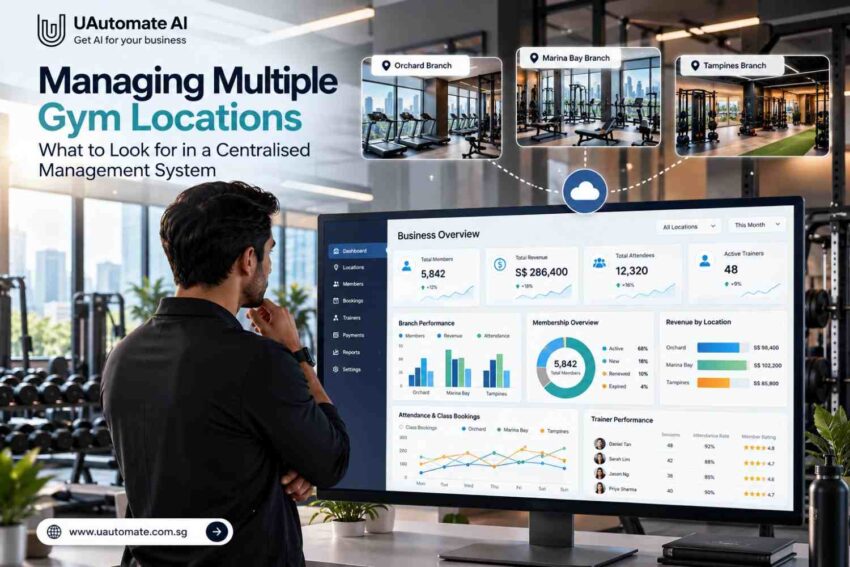
Opening up new gym locations is a great step for any fitness business. We see growth in terms of which members we can attract, what services we can offer and in bottom line terms of revenue. At the same time though we see new operational issues come up. Tracking memberships, payments, staff like trainers, attendance and customer info across many branches becomes very complex very fast.
This is where gym management software for multiple locations becomes valuable. Instead of separate management of each branch, gym owners have at hand a central system which gives better access into business activities.
Also at issue is what platforms truly have what it takes beyond support for multiple locations. Member management, staff access issues, financial reporting, integrations, scalability and member experience all play a role.
This guide details what to look for from gym operators’ perspective in a centralised management system. We also discuss how connected fitness technology supports growth of your business.
Why Managing Multiple Gym Locations Requires a Different Approach
Managing a single gym is also a fairly simple task. The owner or manager may handle memberships, staff, payments and daily operations without having to coordinate many teams.
As more branches open up, that is when we see an increase in responsibility. Each location brings in new staff, members, transactions and operational issues.
For instance consider a fitness chain that runs four gym locations. Each branch has their own membership records, trainers, class schedules and payment info.
If present reports are separate, the head office has to put together information from various teams which they have which report the business performance.
Three common challenges emerge.
1. Fragmented Business Information
A branch manager may keep membership info in spread sheets, also in other locations we use separate billing software. We also have different systems for attendance records.
Bringing all pieces together for monthly reports is time consuming which in turn increases the chance of errors.
A linked system which brings together important business records in one place which in turn makes info easy to access and manage.
2. Limited Visibility Into Branch Performance
Having the total revenue of a gym chain is a start but it doesn’t tell us how each location is doing.
Owners also need to understand:
- Which branch attracts the most new members?
- Where are membership renewals declining?
- Which location has the greatest amount outstanding?
- Are some branches experiencing lower attendance?
- Are trainers being utilised effectively?
Without a consolidated report which includes all the relevant information from each branch, we see that these questions require more coordination.
3. Inconsistent Member Experiences
Members report to see the same high level of service each time they go to the gym.
However we see that independent branches have developed different booking procedures, membership processes and communication practices.
A large scale platform which is used by all may put in place standard practices which in turn allow local areas to keep their specific procedures.
What Should a Centralised Gym Management System Actually Control?
A right platform which should integrate the main elements of a fitness business as opposed to looking at each function in isolation.
When comparing multi-location gym software, consider the following capabilities.
- Centralised Membership Management Across All Branches
In many gyms the primary element which is very important is the membership info.
When a business has multiple branches, they may have issues with separate member records which in turn causes confusion for instance when customers are to visit a different branch.
A centralised membership system should support:
- Member registration and profiles.
- Membership plan creation.
- Renewal and expiry tracking.
- Membership upgrades and cancellations.
- Payment history.
- Member activity records.
- Cross-branch access, where applicable.
- Duplicate member identification.
Example: A member registers at your Tampines branch but wants to attend a class at your Jurong location.
With separate systems, employees may need to verify membership information manually. A connected platform can make the relevant records available to authorised staff, helping them check whether the membership includes access to that location.
Different membership arrangements may also need to be supported.
| Membership type | Access arrangement |
| Single-location | One assigned branch |
| Multi-branch | Selected locations |
| Premium | All eligible branches |
| Corporate | Access based on company agreement |
This flexibility helps businesses manage different membership categories without creating confusion for employees or customers.
2. Branch-Wise Staff and Trainer Management
As a gym chain expands, managing employees across locations becomes another important responsibility.
The head office needs an overview of the workforce, while branch managers need access to information about their respective teams.
Look for features such as:
- Employee profiles and records.
- Trainer assignments.
- Branch-specific staff allocation.
- Role-based access permissions.
- Shift and schedule management.
- Staff attendance records.
- Trainer performance tracking.
- Commission calculations, where required.
For example, a company with four branches and 20 trainers may need different access levels for owners, branch managers and trainers.
Role-based permissions allow employees to access information relevant to their responsibilities without giving everyone unrestricted access to the entire business.
This is an important feature when evaluating a gym chain management system.
3. Centralised Billing and Revenue Management
Managing payments across several branches can become difficult when every location follows a different billing process.
A centralised financial system should help owners understand revenue, collections and outstanding payments.
Depending on the platform, useful capabilities include:
- Membership payment tracking.
- Recurring billing.
- Invoice and receipt management.
- Outstanding payment identification.
- Refund records.
- Branch-wise revenue reports.
- Payment reconciliation.
- Expense tracking.
Consider a gym chain operating three locations.
| Financial metric | Branch A | Branch B | Branch C |
| Membership revenue | S$32,000 | S$25,000 | S$29,000 |
| Outstanding dues | S$2,000 | S$3,500 | S$1,500 |
| Retail revenue | S$4,000 | S$3,000 | S$5,000 |
These figures are illustrative.
Instead of collecting separate financial reports from every branch, management can compare individual locations alongside the overall business.
It is also important to distinguish between collected payments, invoices issued and recognised revenue. These represent different financial activities and should be reported accurately.
4. Centralised Attendance and Check-In Monitoring
Attendance records provide useful information about how members use gym facilities.
A connected platform should ideally support compatible check-in methods such as:
- QR code scanning.
- Mobile application check-ins.
- Membership cards.
- Barcode scanners.
- Biometric devices, where supported.
- Integrated access-control systems.
This information can help management identify peak visiting hours, popular classes, inactive members and locations with lower utilisation.
For example, if a member who previously visited four times a week suddenly stops attending, the relevant team can follow up and understand whether the member needs assistance.
Attendance data can therefore support both operational planning and membership retention activities.
5. Centralised Gym Reporting and Analytics
For a growing gym chain, reporting should provide more than a monthly revenue figure.
Business owners need to understand what is happening across the organisation and where individual branches may need attention.
A useful reporting system should provide two levels of visibility.
Organisation-level reporting
- Total active memberships.
- Overall revenue.
- New registrations.
- Membership cancellations.
- Total attendance.
- Renewal rates.
- Outstanding payments.
Branch-level reporting
- Location-wise revenue.
- New memberships.
- Membership renewals.
- Member attendance.
- Trainer utilisation.
- Class bookings.
- Payment collections.
- Membership inactivity.
For example, if overall revenue declines during a particular month, management should be able to identify which location contributed most to the change.
This is where centralised gym reporting becomes valuable. It turns information collected across different branches into insights that management can use.
The Difference Between Centralised Control and Branch-Level Flexibility
Centralising gym operations does not mean every location needs to follow exactly the same rules.
Different branches may serve different customer groups. A premium fitness studio might focus on personal training, while another location offers general gym memberships.
The management platform should provide shared oversight without restricting local operations unnecessarily.
| Management area | Centralised control | Branch-level flexibility |
| Memberships | Shared member visibility | Location-specific plans |
| Staff | Organisation-wide oversight | Local staff assignments |
| Payments | Consolidated reporting | Branch collections |
| Scheduling | Overall schedule visibility | Individual class timings |
| Reporting | Combined performance | Individual branch analysis |
| Inventory | Overall stock visibility | Location-specific stock |
A company-owned gym chain may prefer centralised control over most activities. A franchise network may need separate permissions and financial reporting for independently operated branches.
Before selecting software, decide which processes should be standardised and which should remain under local management.
What to Evaluate Before Investing in Multi-Branch Fitness Software
Not every platform advertising multiple-location support will meet the requirements of a growing gym business.
Before making a purchasing decision, consider these six areas.
1. Scalability as Your Business Expands
The software should accommodate future growth without requiring a complete system change whenever another branch opens.
Ask the provider:
- Can new locations be added easily?
- Can each branch have separate settings?
- Can reporting accommodate additional branches?
- Can user permissions be managed centrally?
- Can the platform handle increasing membership volumes?
Consider your expected growth over the next three to five years, not just your current requirements.
Gym businesses planning to expand across multiple branches may also benefit from understanding how custom software development in Singapore can support business growth.
2. Integration With Existing Business Systems
Fitness businesses often use separate tools for payments, accounting, customer communication, websites and access control.
Replacing every application may not be necessary.
Check whether the platform can connect with existing technology through APIs, supported connectors or custom development.
Potential integrations include:
- Payment gateways.
- Accounting software.
- CRM platforms.
- Email and messaging tools.
- Gym access-control devices.
- Websites.
- Member mobile applications.
Confirm which integrations are already supported and which would require additional development.
Businesses planning to connect different applications can also explore custom software development in Singapore to understand how tailored software can support their operational requirements.
3. Data Security and Access Management
A gym chain handles personal information such as member names, contact details and membership records.
For businesses operating in Singapore, the Personal Data Protection Act (PDPA) establishes requirements concerning the collection, use and disclosure of personal data.
When evaluating a system, consider:
- Role-based access control.
- Secure authentication.
- Data encryption.
- Access and activity logs.
- Regular backups.
- Data retention policies.
- Secure integrations.
- Data recovery procedures.
The Personal Data Protection Commission Singapore provides guidance for organisations handling personal information.
Businesses should also review the Cyber Security Agency of Singapore’s cloud security guidance when assessing cloud-based platforms.
Security should be considered from the beginning rather than added just before implementation.
4. User-Friendly Dashboards
A platform may offer advanced features, but employees will struggle to use them if the interface is complicated.
Different users should have access to information relevant to their roles.
For example:
- Owners need an overview of business performance.
- Regional managers need branch comparisons.
- Branch managers need daily operational information.
- Trainers need schedules and client details.
- Reception employees need registration and check-in functions.
During a software demonstration, ask the provider to show how these different users interact with the platform.
5. Data Migration and Implementation Support
Moving to a new management system involves more than creating employee accounts.
Existing membership records, payment information and attendance history may need to be transferred.
Before selecting a provider, ask about data import, duplicate identification, record validation, employee training, testing and post-implementation support.
A phased rollout can make the transition easier. For example, a gym chain could introduce the platform at one branch first, resolve any issues and then expand to the remaining locations.
6. Reporting Accuracy and Customisation
Every gym chain has different business priorities.
A boutique studio may focus on class attendance and trainer productivity, while a large membership-based gym may prioritise recurring revenue and renewals.
Check whether reports can be filtered by branch, date range, membership category, trainer, revenue type and customer status.
Also confirm how each metric is calculated. Membership growth and active membership figures should have clearly defined reporting rules.
How a Centralised System Helps Gym Chains Make Better Decisions
When owners begin to use business info to solve day to day issues that run the company the true value of connected management software is seen.
Here are four practical examples.
Scenario 1: Identifying Underperforming Branches
A gym owner reports that they see an increase in members, at the same time revenue is very much the same.
Branch by branch it is reported that in one of our locations we see a drop in renewals which at the same time has new enrollments.
Management should look into what issues are at the root of the problem with regards to pricing, customer service or membership cancellations instead of implementing wide scale changes which may be unnecessary.
Scenario 2: Improving Trainer Utilisation
In some locations we see that trainers are underutilized, in others we have issues with peak hour demand.
Access to reports of staff assignments and schedule info can help management identify which resources are under or over utilized.
Scenario 3: Reducing Membership Churn
Some members leave before they cancel their memberships.
A large scale database of enrolled customers may notice when a member is coming up for renewal or notice that attendance is dropping.
The business can also put forth relevant follow up actions like personalized communication, renewal reminders or membership reviews.
Scenario 4: Standardising Customer Communication
When different groups handle communication separately members may receive which is out of date info on bookings, renewals and services.
Connected communication systems may include standard routine messages which at the same time allow for personal attention.
To understand how connected workflows can reduce repetitive administrative activities, read UAutomate AI’s guide to business process automation in Singapore.
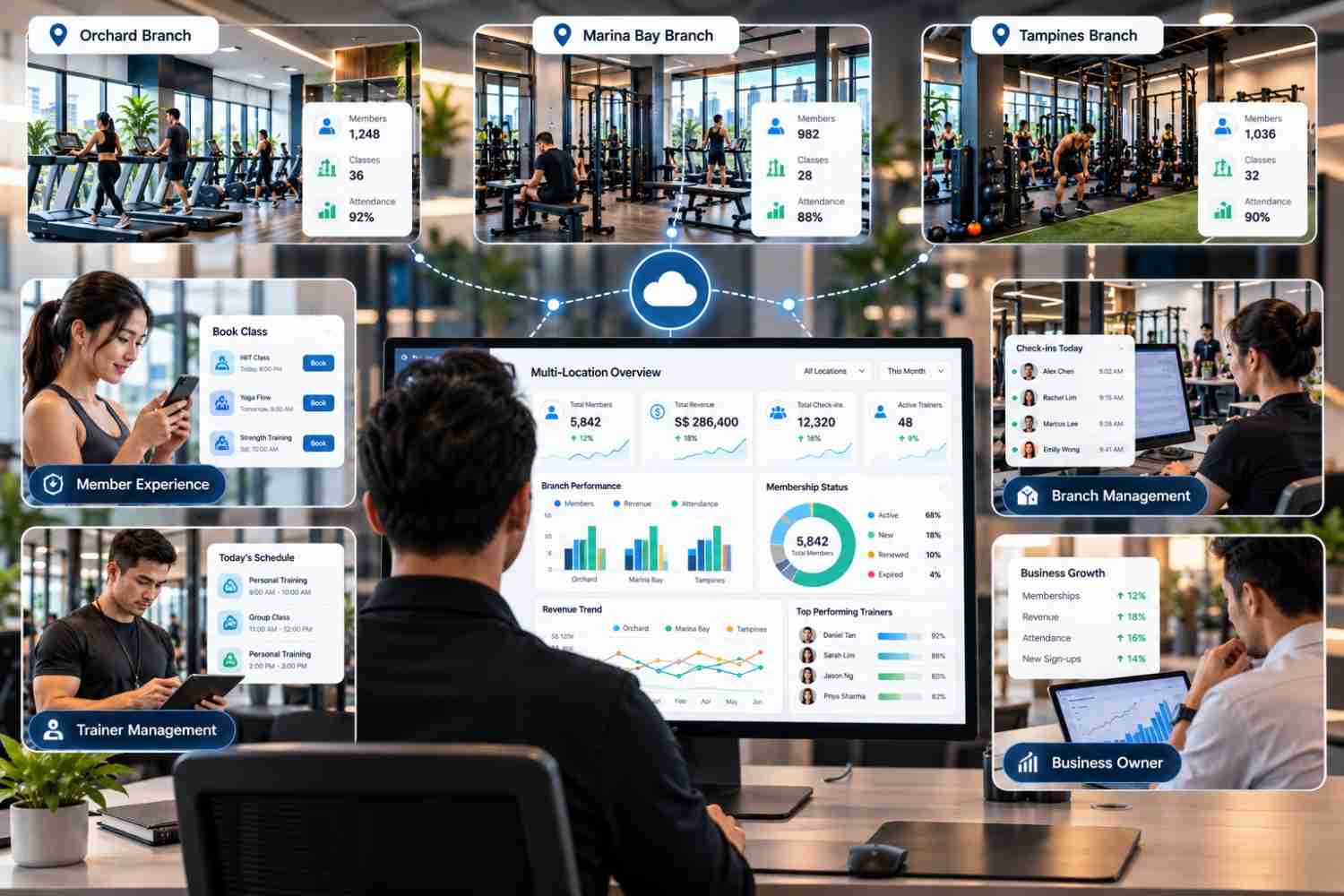
What Should a Gym Chain’s Central Dashboard Look Like?
When comparing platforms, do not rely only on feature lists. Ask the provider to demonstrate how information appears in an actual management dashboard.
A useful dashboard should bring together the performance indicators that gym owners and managers need to review regularly.
| Dashboard section | Information to display |
| Membership overview | Active, new, expiring and cancelled memberships |
| Financial overview | Revenue, collections and outstanding dues |
| Branch performance | Location-wise comparisons |
| Attendance analytics | Daily visits and attendance patterns |
| Staff overview | Trainer allocation and utilisation |
| Class management | Bookings, capacity and attendance |
| Retention indicators | Inactive members and renewal patterns |
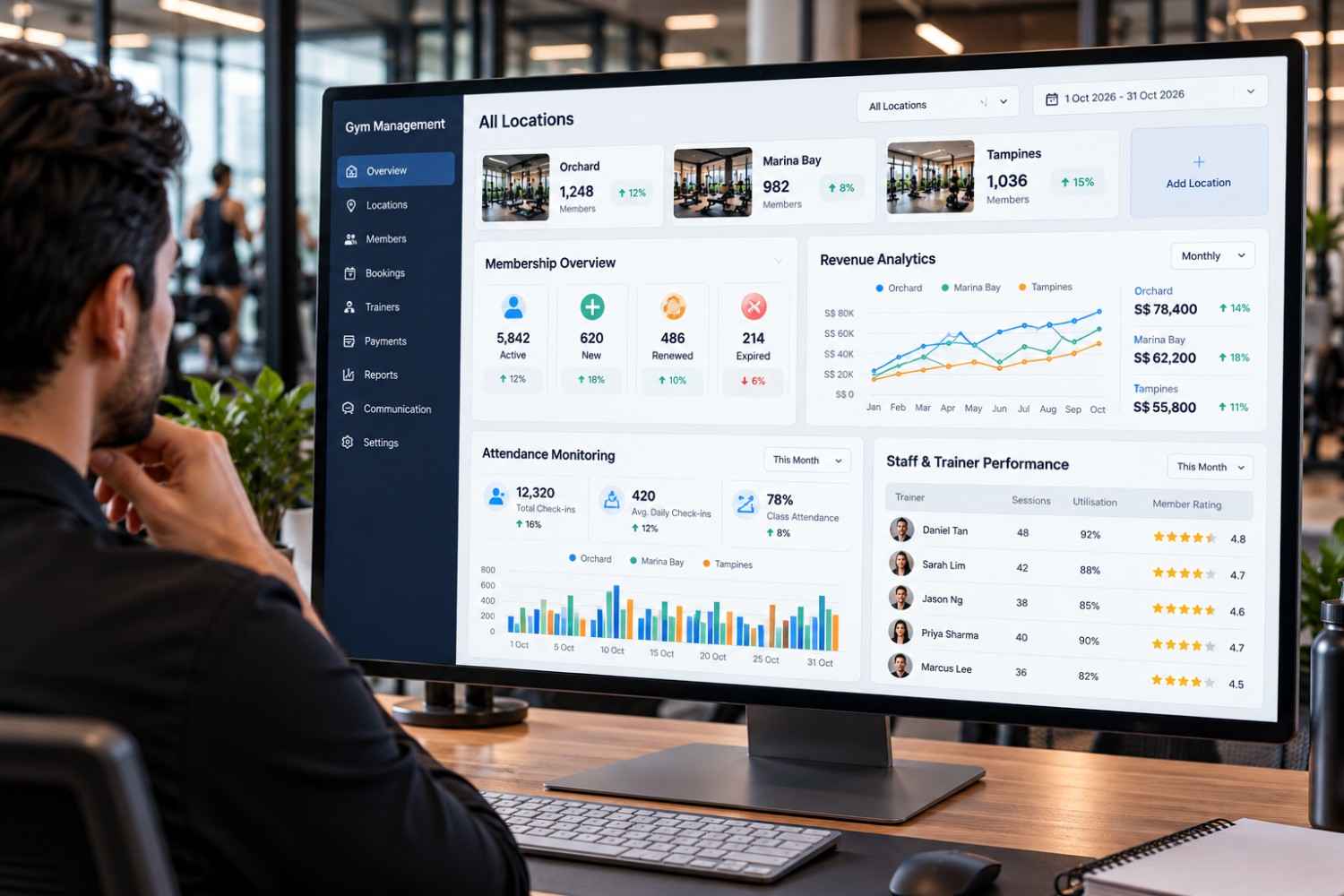
The dashboard should also allow authorised users to filter information by location and reporting period.
For example, an owner might start with the combined performance of all branches and then select one location to review its membership growth, revenue and attendance.
How UAutomate AI Can Support Connected Fitness Business Operations
As a fitness business expands, its technology requirements may move beyond basic membership and billing management.
Gym operators may start looking for branded mobile applications, connected business systems, performance analytics and more efficient ways to manage information across locations.
This is where UAutomate AI’s work in fitness applications and custom software engineering becomes relevant.
UAutomate AI presents AI fitness apps as one of its industry capabilities, offering branded iOS and Android applications with a connected fitness operating system. Its broader engineering capabilities also include custom AI solutions, predictive analytics, intelligent automation and business-system integration.
1. Connected Fitness Applications
A branded fitness application can give members a consistent digital experience across different locations.
Depending on project requirements, an application can include:
- Member profiles.
- Fitness progress tracking.
- Class and session information.
- Membership-related information.
- Customer engagement.
- Notifications and communication.
For example, members with multi-location access may need to find eligible classes or services at different branches.
Explore UAutomate AI’s fitness application offering to understand its connected fitness capabilities.
Businesses planning to develop their own branded fitness platforms can also explore the process of iOS and Android AI app development for Singapore startups to understand the key considerations involved in building mobile applications.
2. Performance Intelligence and Predictive Analytics
Gym operators may want to understand member activity, engagement patterns and changes in operational performance.
AI-based solutions can be explored for:
- Analysing attendance patterns.
- Understanding membership renewal trends.
- Identifying potential retention risks.
- Reviewing trainer performance indicators.
- Supporting revenue analysis.
For example, a business may want to identify members whose attendance has declined and prioritise appropriate follow-up activities.
The effectiveness of these applications depends on data quality, suitable integrations and the way the solution is designed.
Features such as predictive analytics, automated notifications and personalized recommendations can make fitness applications more useful, and businesses can explore AI-powered app features to consider in 2026.
3. Custom Software and System Integration
A gym chain may already use separate systems for accounting, payments, customer management and access control. Replacing every application may be unnecessary.
UAutomate AI’s custom AI software development capabilities are relevant to businesses looking for technology designed around their existing workflows.
Potential project areas include:
- Connecting existing business applications.
- Developing branded fitness applications.
- Designing management dashboards.
- Integrating operational data sources.
- Building automated workflows.
- Developing business-specific analytics.
The final solution should be based on the existing systems, integration requirements and business objectives.
A Practical Checklist Before Choosing Your System
Before committing to a provider, compare potential platforms against your actual business requirements.
| Evaluation area | Questions to ask |
| Multi-location access | Can all branches be managed through one platform? |
| Memberships | Can members access eligible locations? |
| Staff management | Can permissions be assigned by role and branch? |
| Financial management | Can revenue be reviewed by location? |
| Reporting | Are consolidated and branch-level reports available? |
| Attendance | Does the platform support existing check-in methods? |
| Integrations | Can it connect with current business systems? |
| Scalability | Can additional branches be accommodated? |
| Security | Are access controls and backups addressed? |
| Implementation | Is migration and staff training available? |
| Customisation | Can business-specific workflows be supported? |
| Support | What assistance is available after deployment? |
Rank these requirements according to their importance.
For example, cross-branch membership access may be essential for a premium gym chain, while branch-level financial reporting could be the biggest priority for a franchise operator.
This makes the selection process more practical and helps management focus on features that can genuinely improve everyday operations.
Frequently Asked Questions
1. What is gym management software for multiple locations?
It is a management platform designed to help fitness businesses oversee several gym branches through a connected system. Depending on its capabilities, it can support membership records, staff management, payments, attendance, scheduling and consolidated reporting.
2. Can members use their membership at different gym branches?
Yes, provided the platform supports cross-location access. Businesses can define which membership plans allow access to one branch, selected branches or all eligible locations.
3. What is the difference between single-location and multi-location gym software?
Single-location software primarily manages one gym. Multi-location software adds capabilities for overseeing several branches, including consolidated reporting, location-specific permissions and shared member records.
4. How does centralised gym reporting help gym owners?
It allows owners to compare revenue, memberships, attendance and other operational indicators across locations. This helps identify performance differences and investigate problems.
5. Can a gym chain manage staff permissions separately for each branch?
Yes, if the platform supports role-based and branch-level access controls. Owners, regional managers, trainers and reception employees can receive different permissions according to their responsibilities.
6. Can existing gym software be integrated with a centralised management system?
Potentially, through APIs, supported connectors or custom development. Compatibility depends on the existing applications and their technical capabilities.
7. What should gym owners consider when switching to multi-branch software?
Important considerations include data migration, membership records, payment history, staff permissions, integrations, security, employee training and ongoing technical support.
8. How can AI improve multi-location gym management?
AI can help analyse member engagement, identify potential retention risks, review coach performance and generate revenue-related insights. Its usefulness depends on data quality and the business objectives being addressed.
Build a More Connected Fitness Business With UAutomate AI
Managing multiple gym locations is more than just running separate branch accounts and then combining them for monthly reviews. As a growing fitness business we need better access to info on memberships, staff, revenue, attendance and branch performance.
Choosing the right gym management software for multiple locations starts with understanding your operational challenges, identifying disconnected processes and deciding which information should be available centrally.
For fitness businesses exploring connected applications, AI-powered solutions and custom technology development, UAutomate AI can help assess the requirements and identify a suitable development approach.
Looking to improve how your fitness business operates across multiple locations?
Contact UAutomate AI to discuss your business requirements, explore its fitness technology capabilities and arrange a consultation with the team.