
Every time a digital product succeeds it is because a problem which is worth solving was identified. A business may need to improve daily operations, better the customer experience or to integrate systems which do not play well together. What follows that idea is not just code. It is a clear picture of what the business wants, thoughtful design and the right technical solution.
For companies exploring custom software development in Singapore, the goal is to build software around their actual requirements rather than adjust every process to fit an existing tool.
A startup may require an initial minimal viable product to test out an idea, whereas a big organization might want to go for automation of repetitive tasks, or to integrate separate applications.
This guide takes you through the journey from that initial concept to a live software solution, we cover product discovery, design, development, integrations, security and delivery. Also we look at what businesses should consider when it comes to choice of development partner and how UAutomate AI’s features play into AI enabled software solutions.
When Does a Business Need Software Built Around Its Operations?
In the early stages a business may use Spreadsheets, pre-made applications and manual processes which work fine. As the business grows though managing info across many different tools becomes an issue.
Signs your current systems are limiting growth
When we have employees input customer info into a spreadsheet, they then copy it over to a CRM and out go manual follow up emails. This is a time consuming task which also seeks to increase error rate.
Other warning signs include:
- Teams repeatedly enter the same information into different systems.
- Existing software failing to support important business workflows.
- Managers are having issues with access to current information.
- Manual approvals delaying routine tasks.
- As businesses grow, workarounds become more complex.
These issues don’t always call for a brand new application. At times improving an existing platform or linking present tools is enough.
Custom software versus ready-made platforms
| Factor | Ready-made software | Custom software |
| Initial implementation | Often quicker | Requires planning and development |
| Functionality | Based on existing features | Designed around defined requirements |
| Integrations | Depends on available connectors | Can accommodate specific integration needs |
| Initial investment | Often lower | Depends on scope and complexity |
| Maintenance | Usually vendor-managed at the platform level | Requires an agreed support plan |
The right choice depends on the problem. Custom development makes more sense when existing solutions cannot support essential workflows or when specialised functionality is important to the business.
Start With Product Discovery, Not Development
Before we go into which technologies to use or development timelines we first must determine what the software is to achieve.
Define users, goals and measurable outcomes
Identify the end users of the application and the issues they present. Talk to related staff, watch present procedures and see where time or info is going out.
For instance instead of asking for any old AI solution a company may look to reduce manual data entry and improve the tracking of customer issues.
That better defined objective which in turn allows the development team to put forth an appropriate solution and determine what success will look like.
Map workflows and prioritise features
Not all features will be included in the first release. Essential functionality is what we will prioritize in order to manage the initial stage’s scope.
In the case of a customer operations platform the first version may include user login, customer records, task assignment and status tracking. As for advanced analytics or AI assisted classification we will introduce that once the core workflow has been proven out.
A way to organize requirements is to put them into categories of essential, important, optional or for a future release.
A practical example
A service company that has its customers reach out via website, email and messaging they in turn have our staff classify each inquiry which we then put into the proper team.
Discovery may also present that we are dealing with fragmented info instead of a software deficit. Centralized applications can put all of the pieces in one place, track ownership and report status. Also we may add automation which in turn will reduce ongoing repetitive work.
This approach is focused at resolving real business issues.
When planning your application, consider which features will genuinely help users. Our guide to AI-powered app features explores capabilities businesses can consider when developing a useful digital product.
Turn Requirements Into a Usable Product With UI/UX Design
An app may have all the right features and yet still leave users frustrated if the interface is tough to use. What we see in the user interface design is how the product presents itself to the user, in contrast the focus of user experience design is how well we guide the user through tasks.
Design around real user journeys
Designers should create maps of typical user paths before finalizing screens. In a service oriented application this may include the action of receiving a request, going over its details, assigning which team is responsible and reporting back on completion.
Wireframe and interactive prototypes which we present to stakeholders before development begins allow us to catch out early stages of any confusion. We identify issues that could cause rework which is better done before than after the fact.
Accessibility is key. The W3C Web Content Accessibility Guidelines present information on how to make digital products more accessible to users with various abilities.
Before development, make sure that users are able to perform key tasks with ease, see and understand error messages, use the interface on various devices and access info related to their roles.
If your idea involves building an AI-powered product, our guide to AI product development in Singapore explains the key considerations involved in turning an early concept into a working solution.
Choose the Right Solution: Web, Mobile or Enterprise Software
The best platform depends on how people will use the product, which systems it needs to connect with and what the business wants to achieve.
| Solution | Typical applications | Key consideration |
| Web application | Customer portals, dashboards and booking systems | Browser compatibility and access controls |
| Mobile application | Field services and on-the-go customer experiences | Device features and offline requirements |
| Enterprise software | Cross-department workflows and reporting | Permissions, integrations and governance |
| SaaS product | Subscription-based software for multiple customers | Customer separation, onboarding and maintenance |
| AI-enabled application | Document processing, intelligent search and workflow assistance | Data quality, evaluation and human oversight |
Web applications for business workflows
Web apps are a good choice for when employees and customers require access via a browser. They also serve to centralize data, support in the approval process and in the sharing of info across departments.
For instance a distributor may use a web application for order tracking, to check in on inventory and to attend to customers’ requests.
Mobile app development Singapore businesses may need
Mobile app development is a must when it comes to access services while on the go, at a job site or which take advantage of smart phone features.
A field service application which will have technicians see their assignments, take photos, and report when a job is done. But also it isn’t always that a mobile app is a must. For when mostly what the users require is a simple which they can get to at any time, a responsive web app will do.
The decision must take into account user behaviour, performance requirements, device capabilities and maintenance costs.
Custom enterprise software for complex operations
Custom enterprise solutions in Singapore which often what organizations look to do is connect between departments, data and present business systems.
For instance a business platform may integrate customer data, inventory info and operational reports. We aim to improve info consistency and make workflows easier to manage which is different from just building a larger app.
For organisations planning more complex digital initiatives, our guide to enterprise AI development in Singapore discusses how AI can support business operations and connected workflows.
Custom Software Engineering: Architecture, APIs and Integrations
A good base is to be had which supports present application needs without at the same time making it hard to change in the future.
Choose architecture based on actual needs
A small internal application works well with a simple modular design. For large scale platforms which have independent components that scale well we can take an open system approach.
Microservices provide flexibility but also present additional deployment and monitoring issues. Architecture choices should be based on business requirements, expected use and team skills instead of technology trends.
Connect existing business systems
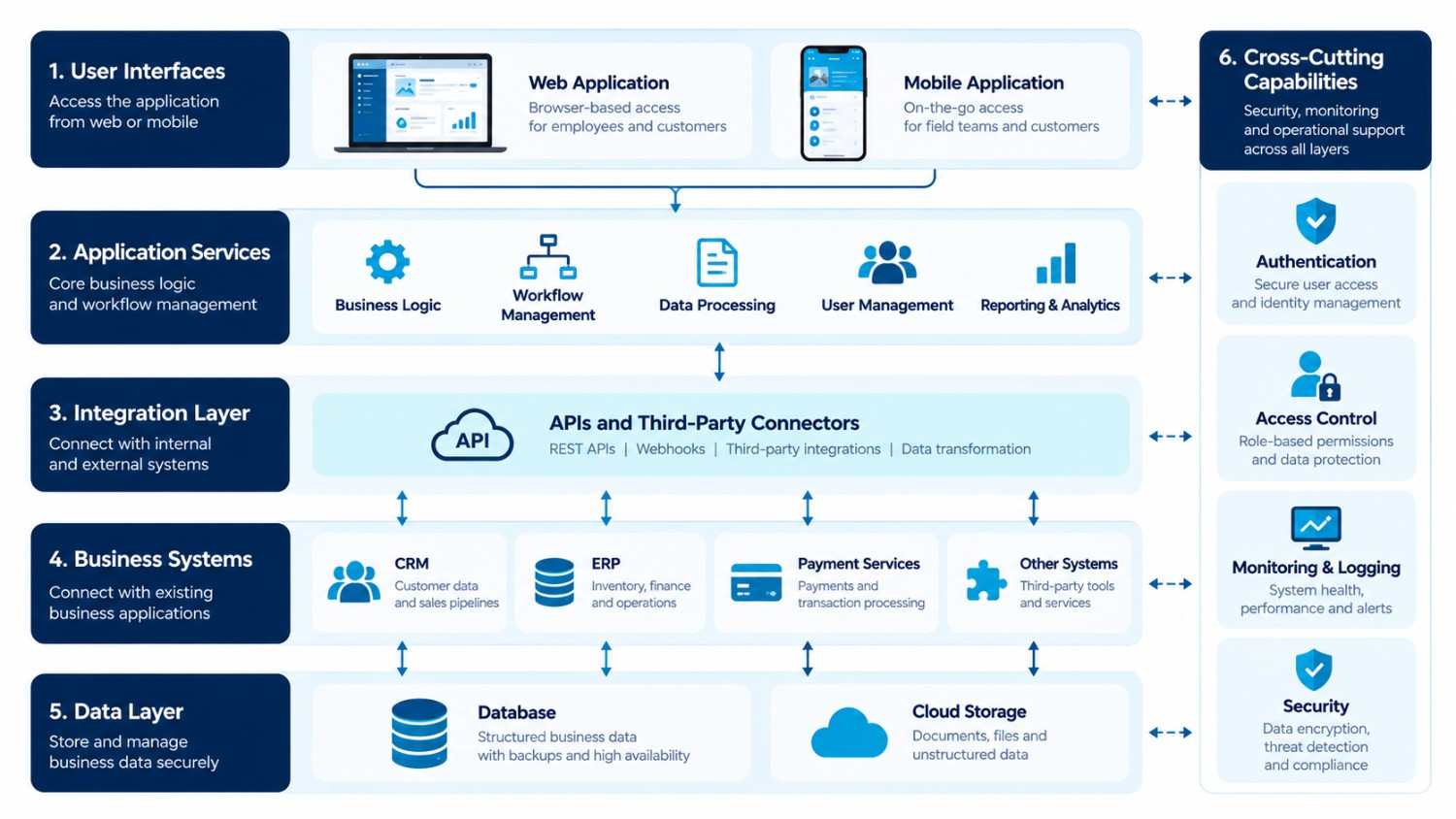
Many of our applications interface with CRM platforms, ERP systems, payment providers and databases.
Application programs interface (APIs) which is what we use for these connections, also in addition for reliable integration we require authentication, data mapping, error handling and monitoring.
For instance in which a customer inquiry turns into a sale, we see a system which creates a CRM record and alerts the relevant employee. Also it will handle duplicate inputs and transient service failures.
Learn more on AI integration vs custom AI development which is to see how different approaches solve business requirements.
Where AI and automation fit
AI brings value to applications which are charged with processing documents, classifying requests, searching internal info or supporting natural language interactions.
Potential for use in processing of invoices, responding to questions which are put forth in approved business docs and directing enquiries to the right team.
However, that which is put out by AI may not be accurate. For sensitive processes we may require validation rules, audit trails and human approval. Businesses should look at the accuracy and reliability of AI before they use it for big decisions.
UAutomate AI’s published capabilities include AI product and platform engineering, conversational AI, document processing and workflow orchestration. If your goal is to reduce repetitive work, our article on AI automation in Singapore explores how businesses can use automation to improve everyday operations.
Build security and data protection into the architecture
Security should be considered from the beginning, not added just before launch. Common measures include access controls, secure authentication, encryption where appropriate, protected credentials, backups and regular software updates.
Singapore businesses handling personal data should review their obligations under the Personal Data Protection Act (PDPA). The Personal Data Protection Commission provides guidance on organisational data protection responsibilities.
The OWASP Top 10 is another useful resource for understanding common web application security risks. Actual safeguards should be selected according to the application’s data, architecture and risk profile.
From First Build to Launch: How Software Delivery Works
Software development works best when the team and business stakeholders share a clear understanding of what needs to be delivered and how progress will be evaluated.
The software development journey
| Stage | Main activities | Expected outcome |
| Discovery | Define users, requirements and goals | Agreed project scope |
| UI/UX design | Develop wireframes and prototypes | Validated user journeys |
| Architecture | Plan components, data and integrations | Technical implementation plan |
| Development | Build and review features in iterations | Working software increments |
| Testing | Check functionality, integrations and security | Validated release candidate |
| Deployment | Release the application and onboard users | Production-ready solution |
| Maintenance | Monitor, fix and improve the product | Continued reliability and improvement |
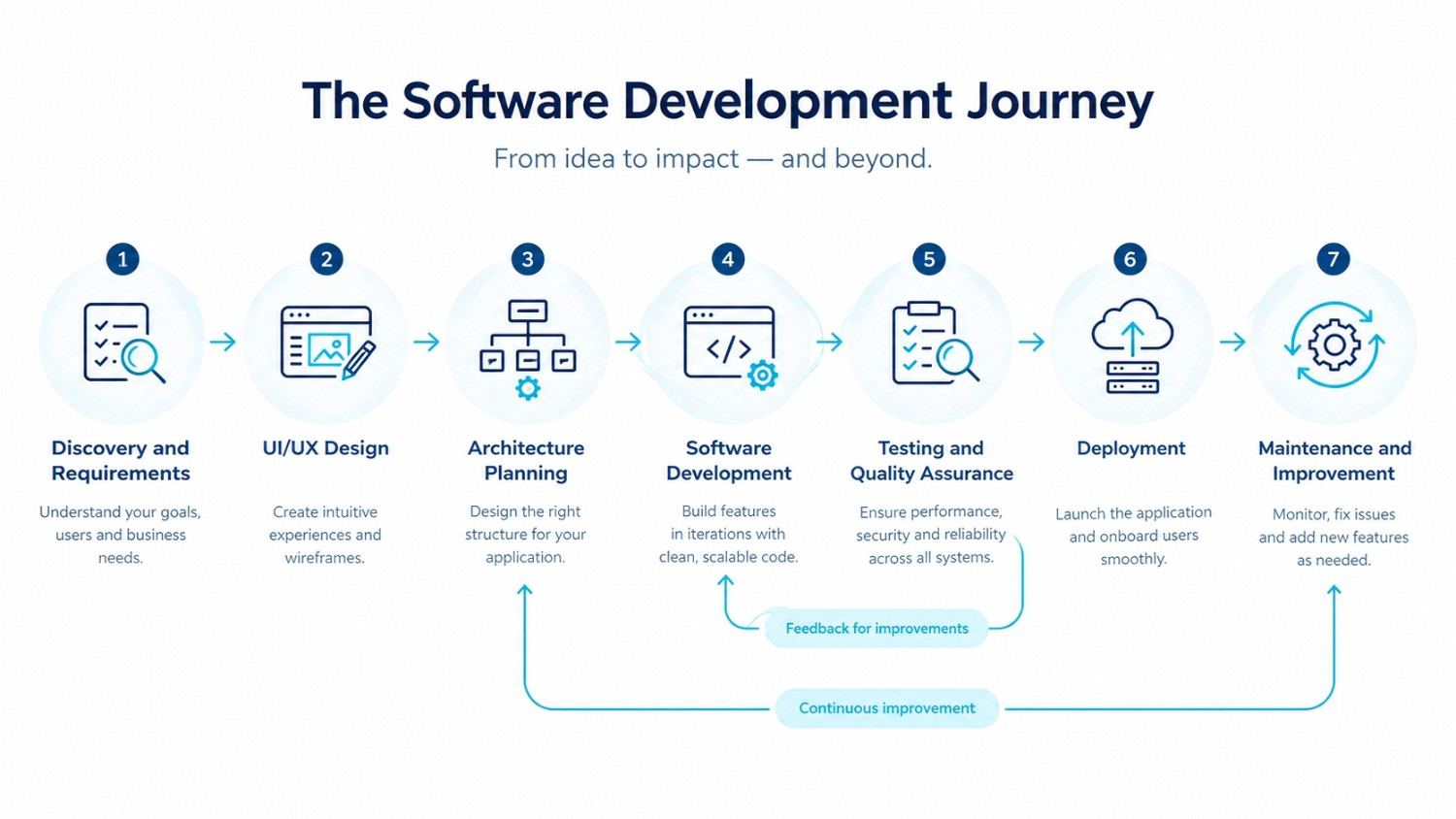
The stages may overlap, particularly when an Agile approach is used. Feedback from testing can also lead to changes in design or requirements.
Agile development and project visibility
Agile development divides work into smaller increments, allowing stakeholders to review progress and provide feedback throughout the project.
Teams should agree on milestones, responsibilities, acceptance criteria and how changes will be handled. Regular demonstrations and documented decisions help prevent misunderstandings.
Testing and post-launch support
Testing should cover functionality, integrations, performance and relevant security risks. User acceptance testing helps confirm that the software supports actual business workflows before release.
After deployment, teams need a plan for monitoring, bug fixes, security updates, backups and future enhancements. These responsibilities should be clarified before handover.
What Influences Custom Software Development Cost and Timeline?
There is no single price or timeline that applies to every project. The effort depends on what needs to be built and the conditions in which the software must operate.
| Factor | Why it affects the project |
| Feature scope | More workflows require additional development and testing |
| Design complexity | Custom interfaces need design and validation |
| Integrations | External systems introduce dependencies and testing needs |
| Security requirements | Sensitive data and complex permissions require additional controls |
| Platform choice | Web, iOS and Android requirements affect scope |
| Data migration | Existing information may need cleaning and validation |
| Ongoing support | Hosting, monitoring and updates create continuing costs |
A discovery phase helps clarify requirements, identify dependencies and create a more realistic estimate. Building an MVP can reduce the initial scope, provided essential security and quality requirements remain in place.
For AI-enabled applications, budget planning should also account for model usage, data preparation, evaluation and any external services required.
How to Choose a Custom Software Development Partner in Singapore
Selecting a development partner is to find a team that has expertise in the business issue at hand and also in the tech solutions which will solve it.
Before committing, ask:
- Discovery: How do we get the team on board with our processes and features?
- Engineering: Can we go over what the put forth architecture is and the integration choices?
- Security: How do we handle data access, testing and updates?
- Delivery: Are presentational elements of project progress and acceptance criteria defined?
- Ownership: Which parties have control over the source code, data and technical documentation?
- Support: What support is there post launch?
Review available project examples if they are present, also compare proposals based on deliverables, maintain value in the long term and not just by price.
Where UAutomate AI may fit
UAutomate AI reports capabilities into the areas of AI product and platform engineering, conversational AI, document processing, retrieval augmented generation (RAG) and workflow orchestration.
These features apply to businesses which are creating applications for intelligent document processing, internal knowledge search, conversational interfaces or connected workflows.
The right strategy is project dependent. Before we proceed, clarify the put forth scope, deliverables, technical aspects, ownership and post launch support.
Visit UAutomate AI to review its published capabilities and assess whether they align with your business requirements.
Frequently Asked Questions
1. How much does custom software development cost in Singapore?
Costs depend on features, integrations, security requirements, platform choices and ongoing support. A discovery phase helps establish the scope and produce a more meaningful estimate. Compare proposals by deliverables and long-term operating costs rather than initial price alone.
2. How long does it take to develop custom business software?
The timeline depends on complexity, scope, integrations and stakeholder availability. A limited MVP generally requires less work than a multi-system enterprise platform. Ask providers for a milestone-based plan that includes testing and deployment.
3. Is custom software better than off-the-shelf software?
Neither is always better. Ready-made software works well when its features meet your requirements. Custom development may be appropriate when essential workflows need specialised functionality or the software is central to your business offering.
4. What is the difference between web application development and mobile app development?
Web applications run through browsers, while mobile applications are designed for smartphones and tablets. The choice depends on how users access the service, whether device-specific features are necessary and how the application will be maintained.
5. How do you make custom enterprise software secure and scalable?
Use appropriate architecture, access controls, secure authentication, testing and monitoring. Scalability also requires attention to performance, database design and integration limits. Ongoing maintenance is essential because security and reliability depend on implementation and operational practices.
6. How do I choose a custom software development company in Singapore?
Look for a partner that understands your business goals, explains technical trade-offs and offers a clear delivery plan. Assess relevant experience, security practices, integration capabilities, ownership terms and post-launch support.
Build Your Next Business Solution With UAutomate AI
A successful software project starts with a defined problem which we then work to solve, not a large list of features. We put in the time to get to know our users, we choose the right architecture and we plan for continuous improvement which in turn transforms that initial idea into a solid business solution.
When it comes to the evaluation of custom software development in Singapore for a business application, AI enabled product, or integrated workflow start by identifying what you want to achieve, present systems, and operational issues.
Reach out to UAutomate AI with your project needs. We can also go over what technical path would work best for you.