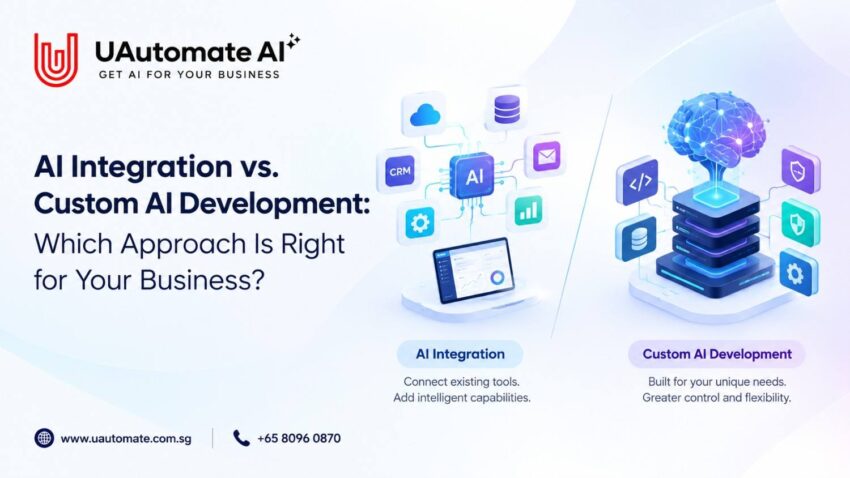
Businesses considering AI usually face one key question: should at what point do they integrate AI into what they already use, or do a custom build for their specific requirements? This plays into cost, efficiency, scale, and long term differentiation. For businesses that are looking at an AI Product Development Company in Indonesia this is a key issue to sort out early.
AI integration brings in smart features to present systems. In custom AI development a business has more input on how a solution uses data and implements special workflows. Which is the better option is not a given; what works best depends on the issue at hand, the infrastructure, data, budget and also long term goals.
This guide looks at both options, reports on which works best and presents a practical approach to which to choose one that is tied to business results.
What Is AI Integration and How Does It Work?
AI integration brings in present AI models, services, or tools into the business which is already using certain software and workflows. Instead of building out a full application from scratch the business adds in AI features to what they currently have.
For instance an online store may include an AI assistant to answer product questions. Also a recruitment agency may use AI to sum up resumes in its applicant tracking system and a service business may automatically sort in coming customer inquiries.
We aim to improve present processes without overhauling which may be functioning fine.
Common applications of AI integration
Common uses include:
- Customer support: Integrate AI chatbots with websites, help desks, or messaging platforms.
- Document processing: Extract, determine the main points of, and put into categories business documents.
- Sales and marketing: Support at lead qualification, customer communication and content workflows.
- Internal operations: Integrate AI tools with knowledge bases, reporting systems and productivity applications.
- Business analytics: AI used to analyze info which supports staff decision making.
Integration can use APIs, software connectors, automation platforms or custom middleware. Also it’s a fact that which elements come into play is a function of the types of systems you have, data quality, security requirements, and degree of customization.
Businesses that want to implement AI into their system without a full scale replacement of current software may look at AI Solution Development as a good place to start.
What Is Custom AI Development?
Custom development of AI products which is to say you design an AI powered application, product, or system to fit in with a business’ specific needs. We may use present commercial models, open source tech, custom application logic, retrieval systems, and special machine learning elements.
Training from scratch is not always the solution. Usually what we see is the use of an existing model which we then put to work with custom software, business data, security measures and integrations.
Consider a business that is looking for an in house assistant which uses the company’s policies, technical docs, and operational records. Generic chatbots may give out wide ranging responses which do not use approved info or which respect employee permissions. We can design a custom solution to that.
When custom development becomes useful
Custom AI development may make sense when a business needs:
- Features that existing products cannot provide.
- AI experiences built into a proprietary application.
- Access to specialized business knowledge and internal documents.
- Complex processes that include many systems or decisions.
- Greater control of which users can do what, how the system functions, and performance.
- A unique AI product which supports a different business model.
For example, RAG development supports AI systems that retrieve relevant information from approved knowledge sources before generating an answer. The right architecture depends on the data, accuracy needs, and security requirements.
AI App Development is also worth exploring when an application needs to fit a specific customer journey or workflow.
AI Integration vs. Custom AI Development: Key Differences
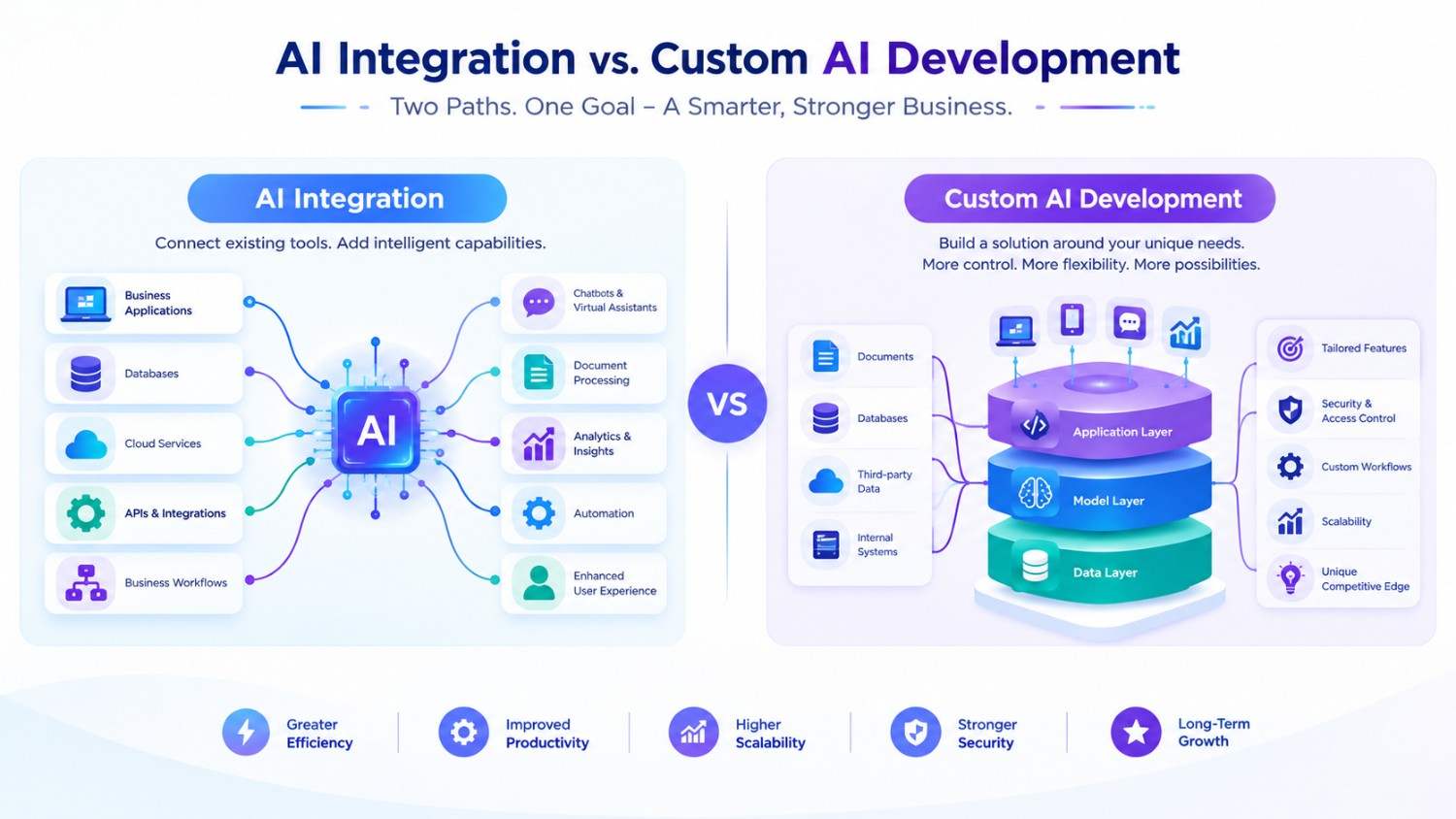
The difference is not simply buying versus building. Integration can involve substantial engineering, and custom development can still reuse existing models. The key question is how much of the solution is already available and how much must be tailored to the business.
| Decision factor | AI integration | Custom AI development |
| Initial investment | Often lower for straightforward use cases | Often higher when substantial design and engineering are required |
| Implementation time | Potentially shorter when systems are compatible | Depends on scope, data preparation, testing, and architecture |
| Customization | Limited by the capabilities of selected tools and connectors | Can be designed around specific requirements |
| Existing infrastructure | Extends current systems | May extend existing systems or introduce new components |
| Data requirements | Depends on the connected service and its access model | Can be designed around defined data sources and permissions |
| Maintenance | Shared between service providers and the internal team | Requires ongoing responsibility for custom components |
| Scalability | Depends on vendor limits, architecture, and usage costs | Depends on architecture, infrastructure, and engineering quality |
| Differentiation | Useful for common business capabilities | Useful when specialized workflows or product features matter |
| Vendor dependency | May be significant when tied to a single platform | Depends on model choices, architecture, and portability |
| Best fit | Standard capabilities and improvements to existing workflows | Specialized requirements and differentiated products |
Cost and implementation time
Existing AI services may lower initial development time which is true if they play into what we are already using. Also, we see that API fees, licenses, data prep, security evaluations, and continuous maintenance add up.
For complex custom projects we see that more planning and engineering is required. We put in the investment which pays off when the result is of great value to us.
Compare lifetime cost, rather than initial price outlay. Include implementation, infrastructure, model use, monitoring, support, updates and staff training.
Customization and control
Integration works out great when a present service does what you require. On the other hand you have to trade that for limited control over the vendor’s road map, model behavior, or platform constraints.
Custom development provides a greater flexibility in terms of application logic, user experience, integrations and evaluation. It does not automatically translate to better accuracy, greater security, or full data ownership which in turn depends on the architecture, contracts and controls.
Scalability and maintenance
Both these approaches scale but in different ways. Integrated services may ease infrastructure management for you at the cost of tied in third party pricing, availability and usage issues. Custom systems present more architecture options but require ongoing monitoring, testing, maintenance and clear ownership.
We look at which options perform better instead of assuming one is just faster or cheaper.
When Should a Business Choose AI Integration?
AI implementation is a good solution when present systems are performing well and the business wants to add a certain feature without overhauling its full operation.
Improving existing software
A company can use AI for sales calls summation, drafting follow ups, or sorting in coming leads in its CRM. If the platform or some compatible service is a go to for these tasks, integration may be the better choice than to build a separate application.
Automating repetitive customer interactions
Businesses that regularly answer questions about appointments, pricing, services, or order status may benefit from an assistant connected to reliable, approved information.
Depending on the use case, chatbot development or WhatsApp bot development may support customer communication. Make sure the assistant uses reliable information and passes complex cases to a person when needed.
Testing an idea before making a larger investment
Integration can also test whether an idea is worth expanding. A business could try an AI-assisted workflow with a small team, track response times and workload, then use the results to decide on the next investment.
Integration is not always quick, though. Legacy systems, incompatible data, and strict security requirements can complicate even a small project.
When Is Custom AI Development the Better Choice?
Custom development is worth considering when existing tools cannot meet important functional, data, or operational needs.
Building an AI-powered product
A business launching a subscription AI platform, industry-specific app, or distinctive customer experience may need more than standard integrations can offer.
A custom product can bring user accounts, permissions, workflows, AI features, analytics, and business rules together in one application. When considering an AI Product Development Company Singapore, look for a partner able to turn those requirements into an architecture that can be maintained over time.
Working with proprietary information
Companies may want AI to search contracts, procedures, product documents, manuals, or other private sources. The solution must account for permissions, document updates, source references, access restrictions, and the impact of incorrect answers.
A custom retrieval system may help when existing tools fall short. It still needs access controls, testing, and governance.
Managing complex workflows
Some processes span several systems and decision points. A service request, for instance, may involve collecting details, checking records, routing the case, drafting a response, and getting approval.
A custom application can coordinate these steps using defined business rules. If several specialized agents are genuinely needed, consider multi-agent systems development. Use this approach only when the benefits outweigh the extra coordination, testing, and operational complexity.
Real-World Business Scenarios: Which Approach Fits?
These examples are of what we have put forth as representative scenarios which in turn present how the right approach is to be determined by the issue at hand; they are to that effect not reports of specific client projects.
Scenario 1: A service business which improves response to customers.
A clinic, salon, or home service provider reports that they get many questions regarding our hours, what we do, the prices we charge, and with making appointments.
Potential approach: AI implementation.
A site assistant or messaging bot may field routine questions with pre-determined info and we direct customers to the right booking channel for that which they are asking. For more complex issues we pass them to the staff.
Custom development will be required in cases of special booking logic, multiple system integration issues, or a unique customer experience which current tools do not support.
Scenario 2: A company needs answers from internal documents
An organization encourages its employees to ask questions on policies, product specifications, and operating procedures.
Potential approach: A personalized knowledge assistant which may use RAG.
The system is able to access relevant passages from approved documents and put together responses which are based on that material. In terms of design we focused on document permissions, citations, update frequency, and also did tests for unsupported answers.
Scenario 3: A company is set to release a new AI product.
A company is set to roll out a new AI based application to its’ customers which will include special features, subscriptions, user dashboards and also tailored workflows.
Potential approach: Tailor made AI solutions.
The company will still support present AI models and third party services but the application itself has to be designed around the product’s business model and user experience.
The takeaway: Choose what works best, not what is most advanced.
How to Decide: A Practical AI Investment Framework
Before choosing a route, assess the project against the same set of business and technical questions.
| Question to ask | If the answer is yes | What to investigate |
| Does an existing tool already solve most of the problem? | Start by evaluating integration | Compatibility, licensing, security, and limitations |
| Is the workflow unique to your business? | Consider custom components | Business rules and customization requirements |
| Does the system need access to private internal knowledge? | Assess a controlled data-connected solution | Permissions, retrieval quality, data handling, and auditability |
| Must the AI work across several applications? | Assess integration complexity | APIs, data synchronization, identity management, and failure handling |
| Is the AI itself part of your product’s competitive advantage? | Consider custom product development | User experience, differentiation, and long-term product ownership |
| Are the requirements still uncertain? | Start with a limited pilot where feasible | Clear success metrics, representative testing, and a defined review point |
Evaluate the full cost of ownership
Compare setup costs versus ongoing costs, including costs of development, subscriptions, model usage, infrastructure, security reviews, support, and monitoring, and future upgrades.
Model costs on a realistic usage basis, because costs based on pilotage and low-volume usage are misleading.
Define success before development begins
In what you will use to determine the success of the change, think of response speed, percentage of tasks completed, hours saved, cost per request, customer satisfaction, and error rate that require human intervention. Before we implement the change measure the present performance baseline and the performance after the change to see and draw what that tells us in terms of results.
Also note that a very expensive and complex solution which looks great may in fact not be what the business requires which in the end may cause the solution to be a failure.
Plan for risk and governance
AI can return incorrect answers, expose information through weak access controls, or behave differently as conditions change. Test realistic inputs, edge cases, unauthorized access, failures, and handoffs to human staff.
The NIST AI Risk Management Framework offers voluntary guidance for managing risks throughout AI design, development, deployment, and use. It encourages teams to identify and address risks from the start, not just before launch.
The OECD AI Principles also provide guidance on trustworthy AI, helping organizations consider responsible development, transparency, and potential risks when planning AI solutions.
Can Businesses Combine AI Integration and Custom Development?
Yes. A hybrid model which puts to use present AI resources and also includes custom elements that have proven value.
For example a company may integrate a present language model into its support platform, add a retrieval feature for internal docs, and put in place logic for permissions and sensitive info escalation.
This way we avoid rebuilding every component which also doesn’t stretch a generic tool beyond what it is meant to do.
A practical implementation plan may consist of three phases:.
Phase 1 — Validate: Select an in depth use case, set the base metrics, and put forth the simplest which is adequate.
Phase 2 — Extend: Address gaps that were brought to light in the pilot with more integrations, better data preparation, or custom components.
Phase 3 — Operationalize: Introduce monitoring, access controls, evaluation, documentation, support procedures, and ongoing reviews prior to expansion.
These are guidelines for the planning process, not a definitive timeline. With complexity, regulation, and operational risk we may see additional stages.
How UAutomate AI Can Support Your AI Development Strategy
UAutomate AI offers services across AI product and app development, AI solutions, RAG, multi-agent systems, chatbots, voice bots, and WhatsApp bots.
These services support businesses at different stages of AI adoption, from connecting AI to existing software to creating tailored applications, knowledge assistants, or more complex workflows.
For example, a business comparing AI App Development Company Indonesia options should review the proposed scope, integrations, security measures, maintenance responsibilities, and success metrics. These criteria also apply when comparing providers in Singapore and other markets.
Start with the business problem, map the relevant data and systems, set success criteria, and then compare realistic options instead of choosing a technology first.
Frequently Asked Questions
1. What is the difference between AI integration and custom AI development?
AI integration adds existing AI capabilities to software or workflows a business already uses. Custom AI development creates a system around specific requirements, often while reusing existing models and services.
2. Is AI integration cheaper than custom AI development?
Integration may need less upfront engineering when systems are compatible and the use case is simple. Licensing, usage fees, maintenance, and vendor limits still affect the total cost. Custom development costs more initially in many cases, but specialized functionality may justify the investment.
3. How long does it take to integrate AI into existing software?
There is no standard timeline. Connecting compatible systems may be quick, while legacy software, multiple databases, sensitive data, and extensive testing can extend delivery. Assess scope, dependencies, and acceptance criteria before setting an estimate.
4. When should a business build a custom AI solution?
Consider custom development when existing tools cannot support specialized workflows, proprietary data, required functionality, access controls, or product differentiation. Make sure the business case also accounts for maintenance.
5. Can custom AI development use existing AI models?
Yes. Many custom applications use models through APIs or hosted services, alongside custom logic, retrieval, integrations, and security controls. Training or fine-tuning is only needed when the use case and evaluation results support it.
6. Is AI integration secure for businesses handling sensitive data?
It can be secure when designed carefully, but the result depends on the provider, data flows, permissions, contract terms, retention settings, and implementation. Check how data is processed and stored, test access rules, and involve security or compliance teams before launch.
7. Can businesses combine AI integration with custom AI development?
Yes. A hybrid strategy connects existing AI services to current systems and uses custom development for specific needs. Keep each component purposeful, and test, monitor, and maintain the full solution.
Choose the Right AI for Your Business
AI integration and also custom AI development play into different areas. Integration of which you have proven tools into your present workflow; custom development is for that which is very specific, greater architectural control, or to set your product apart. A hybrid approach which puts them together.
Before you commit, determine the outcome, go over your data and infrastructure, do a total ownership cost analysis, and put in place measurable success criteria. For businesses looking at an AI Product Development Company in Indonesia which solution you choose should fit your needs and be maintained responsibility as your needs change.
Ready for the best AI solutions for your business? Go to UAutomate AI to check out our AI development services and tell us your needs.