
How Much Should You Budget for Gym Software in Singapore?
Running a gym is not just about putting out equipment and running fitness classes. Also owners have to run the membership program, schedule trainers, collect payments, track attendance, and follow up on renewals. As the business grows these tasks can become very time consuming to do manually.
Understanding gym management software pricing helps you choose a system that fits your budget without paying for features you do not need.
In Singapore, what you pay for software is at the discretion of the company you use, the size of the team, included features, and the level of support. For basic plans we see that small studios may fit into those, but for full scale operations which require in depth solutions and custom built features expect to see a higher price tag.
The monthly fee is just a piece of the picture. Setup, integrations, payment processing and additional services may also seem to add to the total cost.
This guide goes over the basic price structures, hidden costs, and what gym owners should look at before they ask for a software proposal.
What Is the Typical Cost of Gym Management Software in Singapore?
There is no standard price for every gym. A personal training studio with 50 clients has different requirements from a fitness centre with multiple branches and hundreds of members.
The following figures are illustrative budgeting ranges, not official market averages or guaranteed quotations.
| Software category | Indicative monthly budget | Suitable for |
| Basic membership and attendance software | S$0–S$50 | Independent trainers and small studios |
| Standard gym management software | S$50–S$150 | Small and growing gyms |
| Advanced fitness management platforms | S$150–S$500+ | Established gyms |
| Multi-location or enterprise solutions | S$500+ or custom quotation | Larger fitness businesses |
| Custom-built fitness software | Quotation required | Businesses with specialised needs |
Actual prices vary by provider, features, member limits, and billing conditions.
What do these price ranges mean for your gym?
A basic subscription may cover membership records, attendance, and scheduling. Advanced plans may include automated reminders, payment integrations, and detailed reporting.
Custom development works differently. The price depends on the functionality, integrations, testing, and maintenance agreed with the development team.
Start with your operational requirements rather than choosing the cheapest plan automatically.
Five Pricing Models You Should Understand Before Buying
Providers calculate their charges differently. Understanding the pricing structure helps you estimate future expenses.
| Pricing model | How it works | What to check |
| Per-member pricing | Based on membership volume | Member limits and upgrade fees |
| Per-location pricing | Charges for each branch | Centralised reporting costs |
| Feature-based pricing | Different plans include different features | Essential features requiring upgrades |
| Usage-based pricing | Depends on messages or transactions | Additional usage charges |
| Custom development | Based on project requirements | Maintenance and ownership terms |
Per-member pricing
This model we see to include all elements of a subscription in membership volume. Also it is a fact that which members are counted by the providers as active paying, trial or in inactive state varies.
What happens if you go over the plan limit.
Per-location pricing
A plan which works for one studio may not be economical at scale. Report on the presence of multiple branches, shared member records, and centralised reporting.
Feature-based pricing
Basic plans include memberships and scheduling, for in depth analytics, marketing tools, or custom branding you will have to upgrade.
Identify essential features before comparing tiers.
Usage-based pricing
Messaging, payment processing and integration may be at an extra cost. A low monthly fee may not be so attractive as usage goes up.
Custom development
Custom developed software is a solution for when off the shelf options do not support business processes.
Our custom AI software development services are for businesses looking to create tailored applications and integrations. The investment we require is based out of the agreed scope.
What Determines Gym Software Subscription Costs?
Two gyms can receive different quotations because their operating requirements are different.
Membership size and business structure
A small studio may use basic membership tracking, at a multi branch gym you may find that out of more in depth reports, various staff permissions, and shared customer information is required.
The price effect is based on the provider’s model.
Booking, scheduling, and attendance
Check out what your gym could use. Do they need personal training sessions, group classes, wait lists, recurring bookings, cancellation policies, or digital check in systems? More complex processes may require a higher plan.
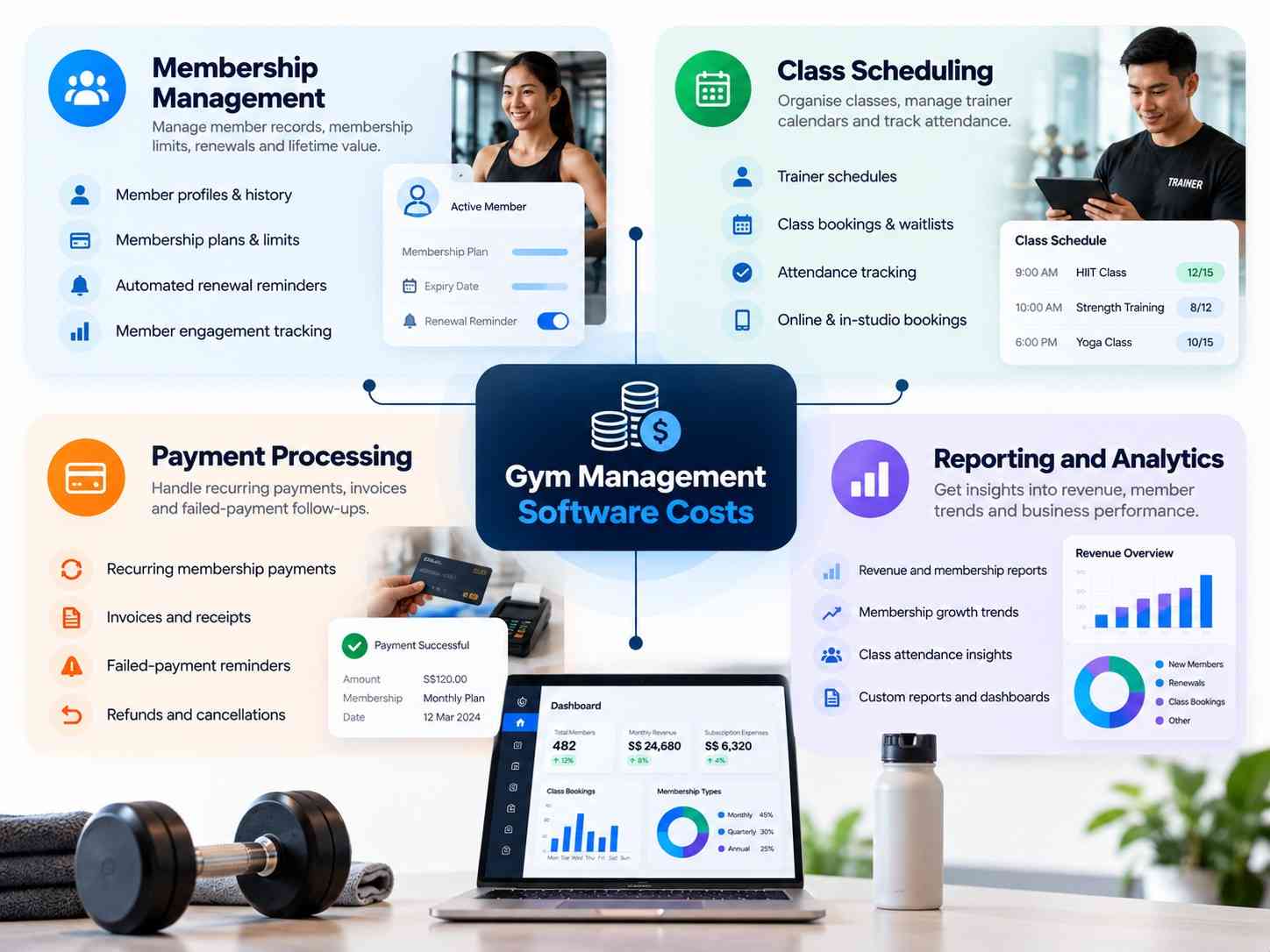
Payment and membership billing
Payment functionality may include:
- Membership invoices and payment records.
- Recurring payment collection.
- Failed-payment reminders.
- Membership freezes and cancellations.
- Refund tracking and renewal notifications.
Confirm which features are included and whether payment gateway charges are separate.
Integrations and automation
Your health club may be using accounting software, a CRM, WhatsApp, or a payment gateway. Integration of these tools will reduce duplicate work but may come at a higher fee.
Explore UAutomate’s AI based workflow automation solutions which is a great way to look into automating repetitive tasks across supported systems.
Reporting and business intelligence
Basic reports present membership numbers and attendance. In advanced reports owners can see trends in revenue, member engagement, and renewals.
Choose what reporting features your team uses instead of paying for what you don’t need.
The Hidden Costs That Can Increase Your Final Budget
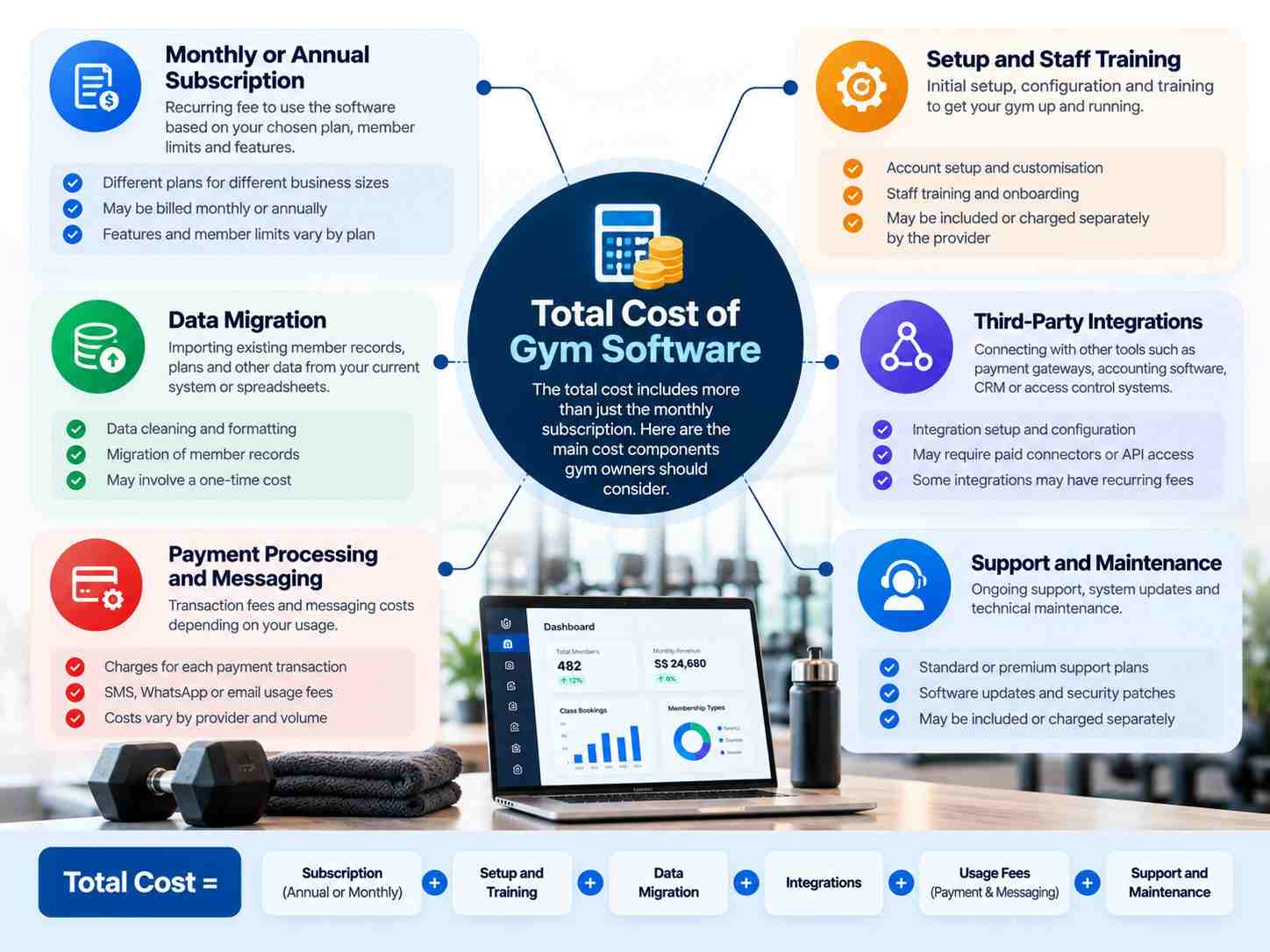
The subscription is only one part of the total investment. Ask providers to explain all initial and recurring charges.
| Cost component | Why it matters | Question to ask |
| Setup and onboarding | Initial configuration and training | Is onboarding included? |
| Data migration | Existing records may need cleaning | Is migration chargeable? |
| Payment processing | Transaction charges increase with usage | What fees apply? |
| Messaging | SMS and other services may have limits | What are the overage rates? |
| Integrations | Third-party connections may cost extra | Are fees recurring? |
| Hardware | Scanners and turnstiles may be separate | What is included? |
| Premium support | Faster assistance may cost more | What support is included? |
| Contract changes | Upgrades may increase costs | How are changes priced? |
Don’t overlook implementation costs
Suppose a subscription costs S$99 per month. Your gym may also need data migration, payment configuration, and staff training.
These expenses can make the first-year cost significantly higher than the advertised subscription.
For custom development, distinguish the initial build from ongoing hosting, maintenance, and future enhancements.
Check the tax treatment
Ask whether the quotation includes GST. Singapore’s prevailing GST rate is 9%, although its application depends on the supplier and transaction.
Consult the Inland Revenue Authority of Singapore’s GST guidance when reviewing a proposal.
Review contract terms carefully
Compare annual and monthly billing, renewal conditions, cancellation terms, data export options, and minimum commitments. The lowest advertised monthly price may not offer the best long-term value.
Calculate the Real First-Year Cost: A Worked Example
Consider a hypothetical fitness studio purchasing subscription-based software. These figures are illustrative, not an actual vendor quotation.
| Expense | Illustrative amount |
| Monthly subscription | S$99 |
| Annual subscription | S$1,188 |
| Initial setup and training | S$300 |
| Integration configuration | S$240 |
| Messaging allowance | S$180 |
| Estimated first-year total | S$1,908 |
This estimate excludes applicable GST, payment processing, hardware, and other unlisted expenses.
If setup and integration costs do not recur, the second-year cost may be lower, assuming other charges remain unchanged.
What if your gym has 300 members?
Member count alone cannot determine the price. Check whether the provider charges per member, per location, or by feature tier.
If a plan has a 200-member limit, you may need to upgrade as membership grows. Ask vendors to explain pricing at 100, 200, 300, and 500 members.
Use this simple formula
First-year software cost =
Annual subscription + setup and migration + integrations + usage charges + hardware + training + applicable taxes.
For a longer-term comparison, calculate three-year costs, including expected upgrades, membership growth, and additional branches.
Subscription Software vs Custom Fitness Software: Which Is More Economical?
The decision is not simply between cheap and expensive software. It is about choosing a solution that suits your requirements.
| Consideration | Subscription software | Custom-built software |
| Initial investment | Usually lower | Depends on project scope |
| Time to launch | Often shorter | Requires development and testing |
| Available features | Defined by provider | Defined by agreed requirements |
| Business-specific workflows | Limited to supported options | Can be tailored |
| Integrations | Depends on available connectors | Can be scoped for required systems |
| Maintenance | Follows provider’s service model | Agreed with development partner |
| Ownership | Governed by contract | Depends on licensing and ownership terms |
| Best fit | Standard requirements | Specialised workflows |
When subscription software makes sense
For most small gyms out there a pre-existing subscription platform is what you’ll use to get started. They handle memberships, scheduling, attendance, and reporting which you don’t have to develop from scratch.
Test out your processes before going all in. Check that the system does what it is supposed to with your cancellation policies, membership freezers and booking rules.
When custom software deserves consideration
Custom solutions may be a good option to pursue when off the shelf products do not support key requirements like branded member apps, integrated branch reporting, or specialized automation.
Projects include design, development, integrations, testing, and ongoing support.
Read UAutomate AI’s guide to AI product development in Singapore which covers what to think about as you design your unique solution.
A practical decision rule
If present software fits what you need, compare subscription options first. If key processes still require manual work arounds, look at integration or custom solutions.
Custom development should address a business issue which is measurable, not for the purpose of adding complexity.
How to Decide Whether the Software Will Deliver a Return
Software should be evaluated by what it does for your business, not by the number of features it has.
For instance automated systems may cut down on the time staff spend in updating spreadsheets, checking for expired members, and sending out renewal notices. The degree of benefit is a function of what tasks are eliminated and how well the staff use the system.
Measure the current situation first
Record a few baseline figures:
- Staff hours spent on administration.
- Missed or overdue membership renewals.
- Average response time for enquiries.
- Booking errors and missed reminders.
- Membership renewal rate.
- Avoidable operational costs, where measurable.
Compare these figures after implementation.
Illustrative ROI calculation
Suppose automation saves 10 staff hours per month and the estimated labour cost is S$20 per hour. The time saved represents $200 in monthly labour value.
With a S$99 monthly subscription, the estimated value exceeds the subscription cost by S$101.
This is an illustration, not a guaranteed saving. It excludes implementation expenses and assumes the saved time creates measurable value.
Use the right success metrics
| Business objective | Metric to monitor |
| Reduce administration | Staff hours spent on repetitive tasks |
| Improve renewals | Membership renewal rate |
| Reduce missed appointments | Booking no-show rate |
| Improve enquiries | Average response time |
| Improve reporting | Time required to prepare reports |
| Support growth | Cost of adding members or branches |
For more advanced analysis, explore UAutomate AI’s AI knowledge assistants and business data solutions, depending on your data and requirements.
What to Look for in Gym Software Singapore Providers
Price is not the only issue. A low cost option that doesn’t fit in with your workflows will end up creating more work for staff.
Essential operational requirements
Look out for membership info, expiration dates, class schedules, attendance management, payment history, renewal processes, staff access, reporting, and data export.
Requirements for a growing gym
Based on your business needs which may include that you have a multi branch management structure, we also see that you may require automated reminders, online booking, a branded member app, accounting integrations, and advanced reporting.
A personal trainer may go by appointment, in group class settings the focus may be on space and wait lists.
Choose what you implement based on your present operations.
Security and data protection
Gyms have access to name, contact, attendance and payment info.
Ask on issues of authentication, access permissions, backups, data retention, incident response, and data export.
Singapore’s Personal Data Protection Commission issues guidance on the Personal Data Protection Act (PDPA). Get to know your responsibilities which include the collection, use, and disclosure of personal data.
In the case of AI systems ask which data is processed and what is shared with third parties.
Support and reliability
Confirm support timings, escalation processes, and service levels. During outages at peak times bookings and check ins are disrupted which in turn negates the value of a low priced subscription.
How UAutomate AI Can Support a Tailored Fitness Technology Strategy
In all cases not every gym should have their own software platform. Also some businesses grow to a point where they require reporting, automation or integration which basic tools do not offer.
UAutomate AI is a Singapore-based AI development and automation company offering custom software, applications, workflow automation, and related technology services.
At the start we should look at the gym’s business needs, instead of a pre-selected tech package.
Gym Unnati: A fitness performance use case
UAutomate AI’s company portfolio identifies Gym Unnati as an AI-powered gym performance system focused on areas such as member progress, coach performance, retention risks, and revenue insights.
This shows how fitness tech can be used for business decisions which go beyond basic member management. Confirm present features, integrations, and commercial availability directly with UAutomate AI.
Tailoring the solution to your business model
| Business requirement | Possible solution direction |
| Repeated manual data entry | Workflow automation |
| Difficulty comparing branch performance | Reporting dashboard |
| Member data spread across systems | Data integration |
| Missing business-specific functionality | Custom application |
| Difficulty searching internal policies | AI knowledge assistant |
These are potential approaches, not guarantees that every feature is available out of the box.
Explore UAutomate AI’s custom AI software development service and AI app development guide.
What happens during a discovery discussion?
Start with UAutomate AI’s contact and consultation page to discuss your requirements.
A useful discovery conversation should clarify your workflows, business goals, existing systems, and technical needs before defining the proposed scope and cost.
Request a written proposal covering deliverables, integrations, timelines, ongoing support, ownership, and recurring expenses.
A Practical Buying Framework for Gym Owners
Follow these steps to compare options before making a decision.
Step 1: Document your current workflow
List how your team handles enquiries, memberships, bookings, payments, renewals, and reporting. Identify repetitive tasks.
Step 2: Separate essential features from optional ones
Prioritise what your gym needs immediately. Consider advanced analytics or AI features only when they solve a clear problem.
Step 3: Request comparable quotations
Give each provider the same details about member numbers, branches, staff accounts, payment methods, integrations, and support requirements.
Step 4: Calculate the full cost
Compare subscriptions, setup, migration, training, payment processing, messaging, and upgrades. Separate custom development from recurring expenses.
Step 5: Test real scenarios
Ask vendors to demonstrate a membership renewal, failed payment, cancelled class, frozen membership, and management report.
Step 6: Review the agreement
Check billing schedules, cancellation terms, data ownership, export options, support commitments, and renewal conditions.
Step 7: Define success before implementation
Set measurable goals for administrative workload, booking errors, renewal performance, and staff adoption.
A clear implementation plan is more valuable than purchasing features without knowing how your team will use them.
Frequently Asked Questions About Gym Management Software Pricing
1. How much does gym management software cost per month in Singapore?
Publicly listed subscriptions can start below S50monthly,whilestandardplansmaycostS50–S$150. Advanced platforms can cost several hundred dollars monthly. Enterprise and custom-built solutions require individual quotations.
2. What affects the gym management system the most?
Membership volume, branches, features, integrations, payment processing, and implementation support are major factors. Custom projects also require budgeting for development, testing, and maintenance.
3. Is there free gym management software available?
Some providers offer free plans or trials. Check member limits, branding restrictions, support, data export, transaction fees, and upgrade costs before choosing one.
4. Are gym software subscription costs tax-inclusive in Singapore?
Not always. Ask for a written breakdown of the subscription, applicable GST, transaction charges, and recurring fees. Refer to IRAS guidance for the relevant tax treatment.
5. What is the difference between fitness studio software pricing and gym software pricing?
Fitness studios may prioritise class schedules, instructor availability, and packages. Larger gyms may require recurring billing, access control, multi-branch management, and consolidated reporting. The best comparison depends on your operating model.
6. Should a small gym invest in custom software?
Usually, a small gym should assess established subscription platforms first. Custom development is worth considering when existing products and integrations cannot support important business requirements.
7. How can I reduce the total cost of gym software?
Choose essential features, compare full annual costs, and check payment and messaging fees. Test the software before signing a long contract and confirm migration charges and upgrade conditions.
Choose Software That Fits Your Gym’s Future
Choosing software is beyond which company has the lowest monthly rate. What you need is a solution that fits into your process, makes things easier for your team, and also scales as your business does.
When looking at gym management software pricing see to it that you look at setup charges, integrations, payment fees, support, data protection and the value of time saved.
A subscription model works for simple membership and booking issues. As for gyms with in depth reporting or automation issues they may do better to look at a custom solution.
Ready to dive into which tech will be best for your fitness business? Reach out to UAutomate AI to go over your needs and get a custom proposal. Tell us your work flows, what features you require, which integrations you need and your growth plans which in turn will help us to define the right scope and budget.