
From a Business Idea to an AI-Powered Application
Turning a business concept into a workable application is beyond just picking the right tech. You have to know your audience, determine the issue you are to solve, and which features will add value. For companies looking at AI app development in Singapore the first step is defining the app’s purpose.
AI powered solutions for business which may include organizing info, answering customer queries, and reducing repetitive tasks. But also it is important to note that putting in AI isn’t a sure fire thing for success. What we see is that the solution has to be reliable, easy to use, and relevant to the business at hand.
For instance a business may want to implement an AI assistant for customer service. Before we get into development they have to determine what questions the AI will be able to answer, what info the AI may access and also at what point human intervention is required.
This guide goes over the key choices you make in building out an AI powered business application which ranges from validating an idea to planning an MVP, determining costs and selecting a development partner.
1. Start With the Business Problem, Not the AI Feature
It’s easy to start out an AI project with chatbots, AI agents, or language models in mind. But a better approach is to focus on the business problem you want to solve.
In any given week a company may receive hundreds of customer queries. At first the company may think about implementing a chatbot. But what may in fact be the issue is that staff are spending too much time on the search for product info or routing issues.
Identifying the root cause is what will lead to the best solution.
Identify the user and what they want
Before we get into technical requirements, ask yourself these three questions:.
- Who will use the application: What type of entities do you customers, staff, management, or business associates?
- What problem should it solve?
- How will you measure success?
For instance a company may put forth that which they require thus:.
Our support team is spending too much time in the search of internal documents to answer routine questions. We need an app which will help employees find out relevant info and put together accurate responses.
This sets the stage for the development team.
Translate the problem into measurable objectives
| Business challenge | Potential AI capability | Possible success metric |
| Repeated customer enquiries | AI-assisted question answering | Resolution time and answer quality |
| Difficulty finding information | Semantic search and retrieval | Time required to locate information |
| Manual document processing | Information extraction | Processing time and error rate |
| Inconsistent recommendations | Recommendation system | Relevance and user engagement |
| Repetitive administrative tasks | Workflow automation | Manual steps and exception rate |
These are potential metrics, not guaranteed results. Establish a baseline before development and compare performance after implementation.
The principle is straightforward: define the problem first, decide what improvement looks like, and then determine whether AI is the right solution.
2. Which AI Business Application Should You Develop?
Which is the right application for a given case depends on the users, business goals, available data, and also the consequences of an incorrect result.
Common AI application opportunities
| Application type | What it does | Example |
| Customer-facing AI assistant | Answers questions using approved information | Website FAQ assistant |
| Internal knowledge application | Helps employees search documents | Company policy assistant |
| Document intelligence application | Extracts information from files | Invoice review tool |
| Recommendation application | Suggests relevant options | Product discovery assistant |
| Workflow automation application | Supports repetitive processes | Enquiry classification tool |
| Predictive application | Estimates outcomes using historical data | Demand forecasting dashboard |
In many cases AI is not required for business problems. Also at times we see that regular software does the job; in some other cases AI may enhance an existing process.
Match the technology to the requirement
Traditional software does a good job when you have set rules and defined inputs. In terms of seeing through to the patterns in data that aren’t immediately obvious we have machine learning. Also we have large language models which do a great job at summarization, natural language interaction and info extraction.
RAG has an application which is able to pull out relevant info from approved sources before it generates a response. Its reliability is dependent on retrieval quality, source freshness, access permissions, and model behavior.
Choose technology according to the business requirement rather than selecting the most complex architecture available.
3. Validate the Idea Before Investing in Full Development
An idea may look good at first but that doesn’t mean it is what the customers want. Validation is what companies use to check their assumptions before they put in a large development budget.
Step 1: Engage with potential users
Ask future customers about what they do now in regards to the issue, what causes the delays, and which steps in their process need improvement. Questions that get at what they actually do are better than just asking if they like your idea.
Step 2: Evaluate technical viability
Identify what information the application requires, which is the source of that info, and if it is to be used for the intended purpose. Also look at integration issues, data quality, and what may happen as a result of poor quality AI output.
Step 3: Choose the right validation method
| Method | Purpose | Limitation |
| Clickable prototype | Tests navigation and user experience | Does not prove AI reliability |
| Technical proof of concept | Tests a technical assumption | Does not establish commercial viability |
| Minimum viable product (MVP) | Tests a usable core product with real users | Does not guarantee long-term success |
| Pilot deployment | Evaluates the application in a controlled setting | Results may differ across users and environments |
For instance a company that is developing an AI knowledge assistant may first see how it does in retrieving relevant answers from a small set of documents.
Step 4: Define what we will consider to be successful
Before development starts, decide on what performance will be measured. Which metrics to use will depend on the application but may include answer quality, task completion time, processing accuracy, adoption, or how often human intervention is required.
A prototype is used to put a design forward which may or may not be the final product, while an MVP is what we use to see if that which we are designing actually has value.
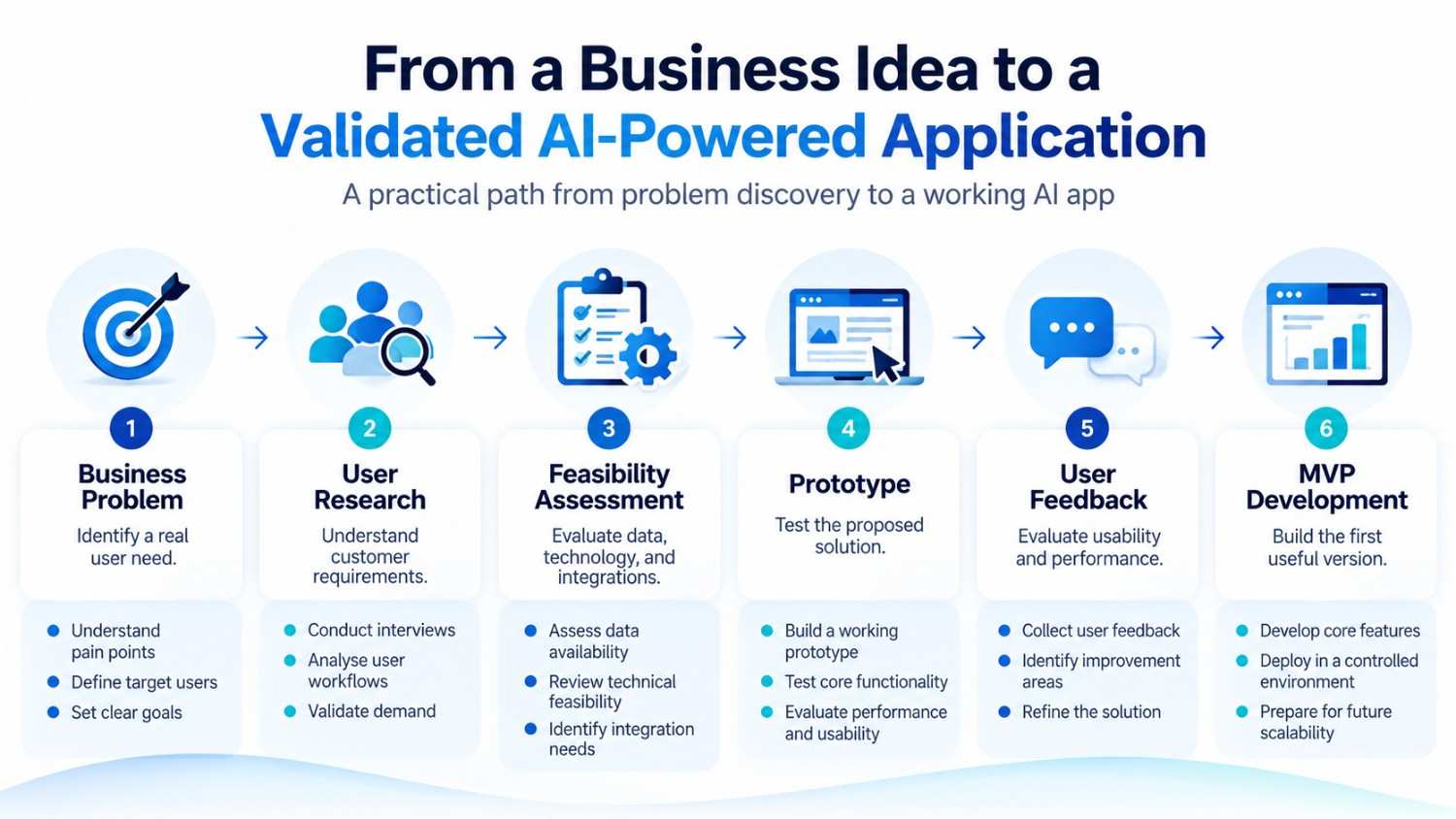
4. Decide What the First Version Needs to Include
Trying to build every possible feature in the first release can increase complexity and make it difficult to determine what users actually need. Start with the smallest version that can perform the main task properly.
Prioritize features
| Priority | Typical features | Purpose |
| Must have | Core user journey, essential AI function, error handling | Delivers the main value |
| Important for launch | Access permissions, monitoring, testing, feedback | Supports reliability |
| Later phase | Advanced personalization, additional integrations | Expands functionality after validation |
| Avoid initially | Features without a clear user need | Reduces unnecessary complexity |
Right priorities are based on the use case. For which type of application that deals with private information we see that strong access controls and audit logs from the first release are a must.
Plan data and integrations
Before developing what data the application will handle, which users will access it, how it will be updated, and which external systems we will integrate.
Also determine how we handle it when an integration breaks down or the AI is unable to give a reliable response.
Design for errors
AI systems produce faulty and incomplete results at times. Which is why it is up to the designers of applications to include features that present to users what level of certainty there is in the info presented and also to put in easy access to human help.
For example an AI assistant should report out when it doesn’t find enough support for a response instead of making up an answer. Also a document processing application should identify uncertain fields for review.
Businesses can explore UAutomate AI’s AI chatbot solutions when conversational automation fits their requirements.
5. Build From Scratch, Integrate AI, or Start With an Existing Platform?
Not every business needs a completely new application. Integrating AI into existing software may be sufficient, while specialized workflows may justify custom development.
| Approach | Best suited for | Main consideration |
| Custom AI application | Specialized workflows and unique requirements | Greater engineering effort |
| AI integration into existing software | Businesses with established systems | Integration compatibility |
| Prototype or existing platform | Early-stage validation | Possible limitations in control and customization |
Consider integration when using present software that fulfills most requirements.
Think about custom development when off the shelf tools don’t support your needs.
Start with a prototype when demand or technical feasibility remains uncertain.
AI Software Development Singapore projects may go down any of those paths. Which is the best option is which one that meets the business needs, budget, and long term goals.
For mobile applications, see UAutomate AI’s iOS and Android AI app development guide.
6. What Influences AI App Development Cost and Timeline in Singapore?
Development costs and timelines depend on the application’s scope, complexity, integrations, data requirements, and testing needs.
Understand the main cost drivers
| Cost factor | Why it matters |
| Product scope | More features increase design and development effort |
| Data preparation | Information may need cleaning, structuring, or indexing |
| AI architecture | Model selection and evaluation affect complexity |
| Integrations | External systems require connectivity and error handling |
| Security and testing | Sensitive workflows need appropriate controls |
| Operating costs | Hosting, model usage, monitoring, and maintenance continue after launch |
Separate out initial development costs from those that recur. AI services, infrastructure, support and improvements which go into the product are elements of total cost of ownership.
Request a clearly scoped estimate
Ask that potential vendors present on deliverables, testing, deployment, documentation, support, exclusions, and recurring fees. We see value in comparing proposals on these details which is to say that comparing just the top line prices is not enough.
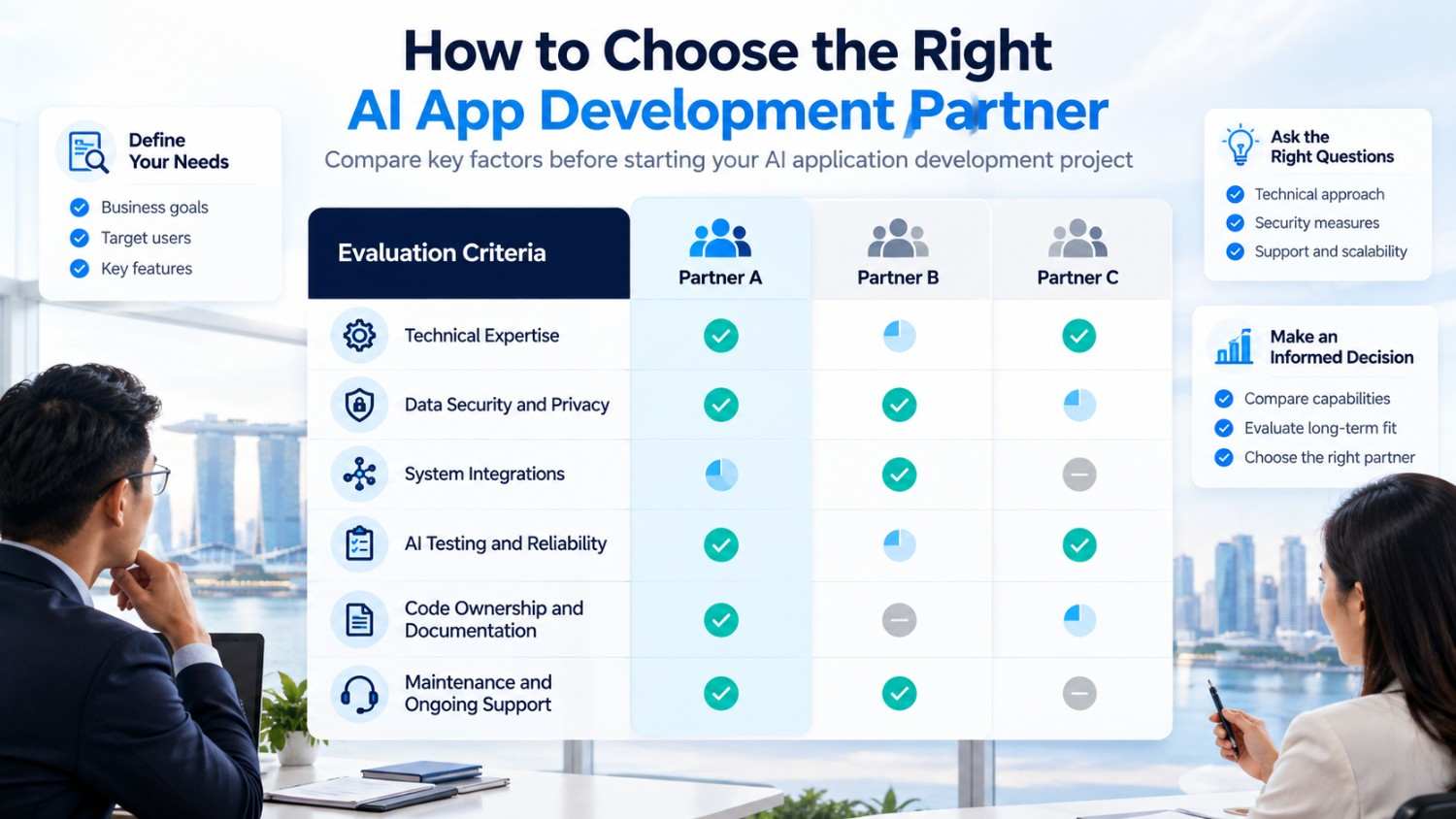
7. How to Choose the Right AI App Development Partner
A development partner must know your business goals, present technical choices in a clear way, and put in place the testing and maintenance frameworks.
Choosing the right development partner involves more than comparing prices or reviewing a company’s portfolio. You also need to evaluate its technical expertise, experience with production-ready AI applications, security practices, integration capabilities, and ongoing support. To make this decision easier, read our detailed guide on how to choose an AI development company in Singapore, which explains the key evaluation criteria, questions to ask potential vendors, and common red flags to watch out for.
In the evaluation of AI Product Development in Singapore which companies may do is use a structured checklist.
Questions to ask potential partners
| Evaluation area | Questions to ask |
| Discovery and planning | How will requirements and priorities be established? |
| AI expertise | Why is the proposed architecture appropriate? |
| Data and integrations | How will data access and permissions be managed? |
| Testing | How will AI output quality be measured? |
| Security | How will sensitive information be protected? |
| Ownership | Who owns the code and documentation? |
| Support | What maintenance is included after launch? |
| Pricing | What assumptions and recurring costs apply? |
Look for evidence, not promises
Request that potential partners share out their development processes and how they test AI outputs. Also ask them to talk about relevant experience which they can share without going into detail of client confidentiality.
Be aware that we don’t always see perfect results. AI performance is a factor of your use case, data, model, and environment.
A solid proposal will include what will be built, how success will be measured, which risks are left, and how the application will be supported.
8. Make Reliability, Privacy, and Human Oversight Part of the Design
Privacy and reliability must be integrated into the plan from the start.
In Singapore companies should look at what data protection requirements apply to them which includes the Personal Data Protection Act if relevant. What companies must do depends on the type of info they process and what role the company plays.
Practices such as reducing what data is collected which isn’t necessary, using access controls, looking at third party services, and documenting how we handle sensitive info are put into use.
Consult the Personal Data Protection Commission Singapore, explore IMDA’s AI resources.
Choose appropriate human controls
| Application behaviour | Control to consider |
| Answering routine questions | Source checks and escalation |
| Drafting communications | Human review before sending, where appropriate |
| Updating customer records | Permission controls and validation |
| Performing consequential actions | Explicit authorization and stronger safeguards |
The appropriate level of oversight depends on the consequences of an error. AI should be used where it adds value, with safeguards suited to the task.
9. Measure Whether Your AI App Is Delivering Business Value
Launching the application is only the beginning. Businesses need to evaluate whether it solves the original problem and continues to perform as expected.
| Objective | Metric | Measurement method |
| Reduce repetitive work | Time spent per task | Compare before and after |
| Improve answer quality | Correctness against a reviewed test set | Evaluate representative responses |
| Improve user experience | Task completion and feedback | Review usage and user research |
| Reduce errors | Error and exception rates | Compare equivalent workflows |
| Control costs | Cost per completed task | Include operating expenses |
High use of a product does not mean success of an AI application. Users may put in a great deal of interaction with a system without that system putting out accurate results or helping them to achieve their goals.
Use a practical improvement process
- Establish a baseline: Record current performance.
- Launch a controlled version: Begin with a specific group.
- Collect evidence: Review reports, issues, task fulfillment, and charges.
- Address weaknesses: Improve what is most important to you.
- Measure again: Determine if the changes did what was intended.
This approach is for business to make informed decisions on improvements and future investment.
10. How UAutomate AI Can Help Turn Your Idea Into an Application
Selecting a development partner begins with identifying the business issue at hand and the result which the application is to produce.
Our AI’s published materials cover AI product development, RAG development, and AI chatbot solutions. We have put together these resources for businesses to try out various AI powered applications.
Depending upon what you need the most out of your project we may go with a custom application solution, AI integration into present software systems, or a small scale prototype to determine feasibility which we will use to grow the project.
Before jumping into development, define your target audience, what data you have to work with, which systems this will integrate with, what results you are looking to achieve, security parameters, and also what is needed for ongoing support. These elements help set a realistic project scope.
You can also learn more about UAutomate AI and review its published capabilities before contacting the team.
Frequently Asked Questions About AI App Development in Singapore
1. How much does it cost to develop an AI app in Singapore?
Costs depend on scope, complexity, integrations, data readiness, security, and testing. Hosting, AI model usage, monitoring, and maintenance also contribute to ongoing expenses. Request an estimate based on your requirements that separates development costs from recurring operating costs.
2. How long does it take to build an AI-powered business app?
The timeline depends on technical complexity, integrations, data availability, and testing requirements. A prototype and a production-ready application have different objectives. Define the essential features and acceptance criteria before agreeing on a delivery schedule.
3. How do I turn my business idea into an AI app?
Identify a specific user problem, validate demand, assess feasibility, and select a suitable AI approach. Define the MVP and success metrics, then build and test the smallest useful version before expanding features based on evidence.
4. Do I need a large dataset to build an AI application?
Not always. Some applications use existing AI models with approved documents, APIs, or structured business information. Other applications, particularly those requiring domain-specific predictions, may need substantial historical data. Requirements depend on the use case and data quality.
5. Should I build a custom AI app or integrate AI into existing software?
Integration may be suitable when current software already meets most requirements. Custom development may be appropriate for specialized workflows or greater control. A prototype can help assess feasibility before committing to either approach.
6. How do I choose an AI app development company in Singapore?
Evaluate technical experience, discovery methods, data and integration planning, testing, security, ownership, and post-launch support. Compare proposals by deliverables and assumptions rather than price alone, and ask how the team will measure success.
7. How can businesses protect customer data in AI applications?
Use data minimization, appropriate access controls, secure integrations, and clear data-handling procedures. Review third-party services and applicable obligations, including the PDPA where relevant. Test access restrictions and establish suitable human oversight before deployment.
Turn Your Business Idea Into a Practical Next Step
A useful AI application starts with a clear problem, a realistic development plan, and measurable objectives. Validating your idea and defining the first version carefully can help you make better development decisions.
If you’re evaluating an AI App Development Company Singapore businesses can work with, begin by identifying the problem, the intended users, and the outcome you want to achieve. Contact UAutomate AI to discuss your application idea and explore an approach that fits your requirements.