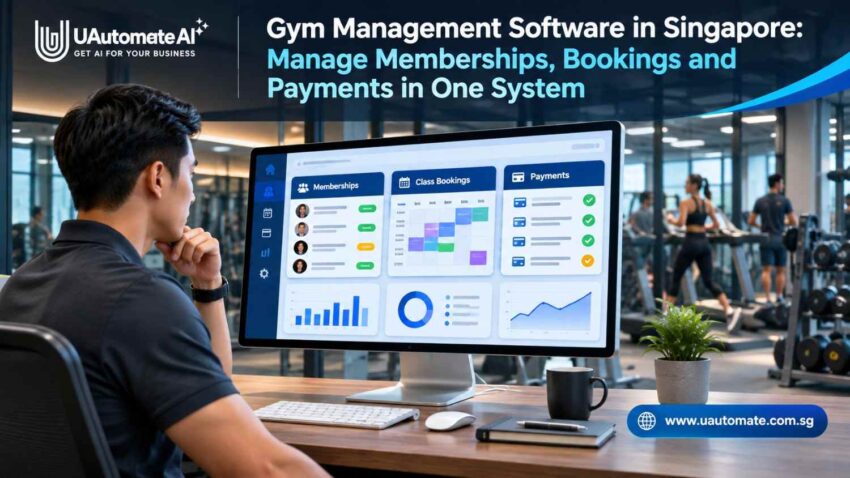
Running a gym is a juggling act. From boarding new members to scheduling trainers and collecting payments, each task requires accurate information and smooth coordination.
For gym owners exploring gym management software in Singapore, the challenge is often not the absence of technology but the difficulty of managing multiple disconnected tools.
For instance we see that members’ details are put in spreadsheets, trainers use WhatsApp for coordination of appointments and also that payment records are kept separate. Although these tools serve separate purposes well enough, in practice what we have is that which creates unnecessary admin work in transition between them.
Membership information becomes difficult to maintain
As the membership base grows, we see that manual update of customer info, subscription plans and renewal dates is becoming a time issue. If a member upgrades a package or puts a subscription on hold our staff has to see that the changes are reflected correctly.
Without a central database, we see that out of date information causes confusion at check in and during membership renewal.
Manual bookings create scheduling problems
Gyms that provide group classes and personal training sessions must coordinate trainers, available spaces and customer bookings.
Managing all through messages results in double bookings, missed cancellations and delayed confirmations.
Payment tracking becomes disconnected
Membership fees, prepaid options and single class payments may have different billing structures.
When payment info is separate from membership information, admins must do manual verification of transactions and identify outstanding balances.
Staff coordination takes more time
Trainers require updated schedules, reception teams booking information, and managers an overview of daily activities. When we use different tools the accuracy of information goes down.
| Operational area | Common problem | Business impact |
| Memberships | Scattered customer records | Missed updates and renewals |
| Bookings | Manual scheduling | Booking conflicts |
| Payments | Separate transaction records | Difficult reconciliation |
| Staff | Limited schedule visibility | Coordination delays |
| Reporting | Disconnected information | Incomplete business insights |
The solution is to connect important operations rather than continue adding separate applications.
Read UAutomate AI’s guide on replacing spreadsheets, WhatsApp and disconnected fitness applications to understand this challenge further.
How One Gym Management System Connects Your Daily Operations
An integrated management system which includes membership info, bookings, payment records and staff activities.
Instead of repeating the same information over and over, employees can access the relevant records in a central system.
1. Membership management: Keep member information organised
A gym membership software system helps maintain customer profiles, membership plans, subscription details and attendance records.
Depending on the platform, useful features include:
- Digital member registration and onboarding.
- Membership plan creation and upgrades.
- Subscription validity and renewal tracking.
- Attendance history and session balances.
- Membership freezes and cancellations.
- Automated expiry notifications.
For instance when a member buys a ten session personal training package the system associates the package with their profile and updates the balance as they use the sessions.
This is made easier for staff to track usage and answer member queries.
2. Class and appointment bookings: Make scheduling easier
A gym booking software which allows members to see what sessions are available and reserve spots for the times that work best for them without having to call the reception for each appointment.
Useful capabilities include:
- Online class reservations.
- Trainer availability management.
- Booking confirmations and cancellations.
- Class capacity restrictions.
- Waitlists for fully booked sessions.
- Appointment rescheduling.
- Automated reminders.
In a fitness studio which runs group yoga classes we see that members have the option to reserve places online, also the system we use has a feature which is to close off bookings once we reach the set capacity.
This decreases manual coordination and we present a more convenient booking experience.
3. Payment management: Connect billing with memberships
Payment management is made easier when transactions are tied to the right member, subscription or service.
| Payment model | Example | Relevant functionality |
| Monthly subscription | Standard gym membership | Recurring billing |
| Prepaid package | Ten training sessions | Package balance tracking |
| Pay-per-class | Single yoga session | Individual payment records |
| Trial membership | Seven-day introductory offer | Trial validity tracking |
| Add-on purchase | Fitness workshop | Additional service billing |
Payment gateway integrations can connect transaction information with membership and booking records.
Gym owners should check whether their chosen platform supports their preferred payment provider, refunds, failed transactions and reconciliation requirements.
Explore UAutomate AI’s article on gym booking and payment software for more information.
4. Staff and trainer management: Improve daily coordination
Trainers have access to their assigned sessions, work hours and upcoming appointments.
A platform which is connected can help administrators with scheduling sessions, review of availability and notification of change.
For instance if a trainer is out of the picture the manager may identify which appointments are affected and sort out new schedules via the shared booking calendar.
Role based permissions are key. Trainers may only require access to the sessions assigned to them, managers on the other hand require a more in depth report on operations and finance.
5. Member communication: Keep customers informed
Members appreciate timely information about their bookings, payments and memberships.
Automated notifications can support:
- Booking confirmations.
- Upcoming session reminders.
- Membership expiry alerts.
- Renewal notifications.
- Payment status updates.
The goal is to reduce the back and forth while at the same time we put the right information in front of the customer at the right time.
How Memberships, Bookings and Payments Work Together
The real value of integrated software is seen in the full member journey.
At the start of someone’s time at a fitness studio. Registration, membership activation, payment, class sign up and attendance are related activities.
When these processes share info staff do not have to manage each step independently.
A practical example: From registration to renewal
| Stage | What happens | How the system helps |
| 1. Registration | Customer creates a profile | Member details are stored centrally |
| 2. Membership selection | Customer chooses a plan | Membership is linked to the profile |
| 3. Payment | Customer completes a transaction | Payment status is recorded |
| 4. Class booking | Member reserves a session | Availability and eligibility can be checked |
| 5. Attendance | Member attends the session | Attendance and package usage are updated |
| 6. Renewal | Membership approaches expiry | Reminders can be triggered |

What changes for the gym owner?
With disconnected applications an employee may have to go to different systems to do the following: confirm a payment, activate a membership, update the booking calendar and notify the trainer.
An integrated system which ties in these activities via configured workflows.
For instance once a payment is confirmed the associated membership can be activated if the system is configured for that to happen. The booking system at that point will apply the relevant membership rules.
This decreases duplicate data entry and we see that employees have a more consistent view of member info.
Also it allows owners to see membership activity, attendance patterns and payment status without going to various sources.
For businesses with specialised class schedules, explore fitness studio management software.
Essential Features to Look for Before Choosing Gym Software in Singapore
Not every fitness business requires the same functionality. An independent gym may prioritise membership renewals, while a multi-location fitness brand may need centralised reporting and advanced integrations.
The right gym software Singapore businesses choose should reflect their actual operating requirements.
1. Centralised member database
The platform should maintain organised member profiles, contact information, membership plans, attendance and transaction history.
2. Flexible membership management
Look for support for monthly subscriptions, prepaid packages, trial plans, upgrades and renewal tracking.
3. Online booking and scheduling
Check whether members can reserve sessions independently and whether the system supports trainer availability, cancellations, waitlists and capacity restrictions.
4. Payment and billing integration
Understand which payment gateways are supported and how the platform handles refunds, failed payments and recurring billing.
5. Automated notifications
Booking confirmations, payment updates and renewal reminders can reduce manual follow-ups.
6. Reporting and business analytics
A useful reporting dashboard should help managers understand membership activity, class attendance, payment records and other business indicators.
7. Mobile-friendly member experience
Members should be able to access membership details, upcoming bookings and important updates conveniently through their mobile devices.
8. Integration with existing business tools
Check whether the platform can connect with accounting software, payment gateways, communication applications and other tools already used by the gym.
A practical software evaluation checklist
| Feature | What to verify |
| Member database | Can staff access complete member records? |
| Membership plans | Can different packages be configured? |
| Booking system | Can members book and cancel sessions? |
| Payments | Does it support the required payment gateway? |
| Notifications | Can reminders be automated? |
| Reporting | Are useful operational reports available? |
| Mobile access | Is the member experience convenient? |
| Integrations | Can existing tools exchange information? |
A long feature list does not automatically make a platform suitable. Gym owners should test their actual workflows before selecting a solution.
Choosing the Right Solution for Your Type of Fitness Business
Different fitness businesses have different operational requirements. A system suitable for an independent gym may not provide everything needed by a multi-location fitness brand.
| Fitness business | Main requirements | Useful capabilities |
| Independent gym | Memberships and attendance | Member records, billing and check-ins |
| Boutique fitness studio | Group classes and limited capacity | Online booking and waitlists |
| Personal training business | Individual appointments | Trainer calendars and session tracking |
| Multi-location gym | Centralised management | Branch reporting and access permissions |
| Pilates studio | Instructor and equipment availability | Resource scheduling |
1. Independent gyms and fitness centres
Independent health clubs require solid membership management, payment tracking and attendance records.
A simple platform for these activities may work when the business has basic membership packages.
2. Boutique fitness studios
Boutique studios have a tendency to run with smaller class sizes and limited space. Also of import are the booking policies, trainer assignment and what happens with cancellations.
3. Personal training businesses
Personal trainers often present packages for a set number of sessions. Our software should include easy appointment scheduling, session tracking and balance monitoring.
4. Multi-location gym operators
Businesses with many branches require a unified view.
They may have centralised membership records, branch level reporting, shared membership access and separate permissions for managers and trainers.
The right setup is based on how the business runs its branches.
Off-the-Shelf Gym Software vs Custom Gym Operations Software
Gym owners also choose between using an existing platform or investing in software which is developed to suit their business needs.
Both of these approaches are valid. What it comes down to is operational complexity, budget, integration requirements and future plans.
| Evaluation factor | Off-the-shelf software | Custom software |
| Initial setup | Usually quicker | Requires planning and development |
| Initial investment | Often lower | Generally higher |
| Features | Predefined functionality | Designed around requirements |
| Integrations | Depends on provider | Can be developed for specific systems |
| Branding | Varies by provider | Greater customisation potential |
| Maintenance | Usually vendor-managed | Requires ongoing support |
| Flexibility | Subject to platform limitations | Greater control over functionality |
When ready-made software makes sense
Ready-made software is suitable for gyms with standard membership packages, straightforward scheduling and limited integration needs.
It can also be a practical starting point for new fitness businesses.
Before selecting a provider, review subscription charges, transaction fees, available integrations, data export options and customer support.
When custom software becomes worth considering
Custom gym operations software may be more appropriate when a business has specialised workflows or needs several applications to communicate.
For example, a growing fitness brand may want a branded mobile application connected to its membership database, booking platform, payment provider and accounting system.
Custom development provides flexibility, but gym owners should also consider implementation time, testing, maintenance and future upgrades.
UAutomate AI offers custom software engineering services for businesses exploring tailored applications and system integrations.
The objective should be to select a solution that meets current requirements without creating unnecessary complexity.
How UAutomate AI Helps Fitness Businesses Build Connected Management Systems
Each fitness business has their own approach to member and trainer management and daily operations.
A neighborhood gym may put in a basic membership platform, at the same time a premium fitness studio may benefit from a branded mobile app, automated communication and in depth reporting.
UAutomate AI is a software engineering company out of Singapore which provides digital solutions, application development and business automation services.
Its AI fitness app and gym management solutions focus on connecting member-facing experiences with business operations.

1. Software built around fitness business requirements
In the beginning we look at how the gym functions.
This includes the identification of membership structures, booking rules, payment workflows, staff responsibilities and present applications.
Once we have the requirements defined the appropriate features and integrations can be planned.
2. Connecting membership and booking processes
A connected fitness platform which includes member profiles, session reservations and attendance information.
For instance a member books in for a training session via the mobile app and the trainer sees the updated appointment in their schedule.
3. Branded fitness applications
Some fitness companies are looking for more than what a generic booking system has to offer.
A branded app which provides a digital platform for members to check in to their account, book into sessions and get updates.
Read UAutomate AI’s guide on launching a branded gym app without building one from scratch.
4. Integrating existing business tools
A fitness platform will interface with accounting systems, messaging services and payment providers.
UAutomate AI’s fitness solution which includes services like WhatsApp API, SMS, email, Xero and QuickBooks. Note that specific integration availability is to be confirmed against project requirements.
5. Supporting future business growth
As a gym grows it may add new branches, membership types and training programs.
A solid software architecture is one which can adapt to change when also at the design stage we put in the elements of scalability and maintenance.
Explore UAutomate AI’s portfolio and company background to learn more about its software development capabilities.
What Should Gym Owners Consider Before Investing in Software?
Choosing a management platform is a business decision not just a technology purchase. It should support day to day operations and also be easy to implement and maintain.
1. Understand the total cost
Costs may include that of subscriptions, implementation, data migration, integrations, payment processing, employee training and maintenance.
Custom development also requires investment in testing and future updates.
Get a detailed breakdown first.
2. Evaluate data security and privacy
Gyms may collect personal details, contact information, membership records and attendance data.
Businesses operating in Singapore should understand their responsibilities under the Personal Data Protection Act.
The Personal Data Protection Commission Singapore provides official guidance on personal data protection requirements.
Check how the proposed platform handles access permissions, data storage, backups and incident management.
3. Check payment gateway compatibility
Check that the put forth system supports the required payment methods and transaction processes.
The Monetary Authority of Singapore provides information about Singapore’s payment services regulatory framework.
Review provider fees, settlement arrangements, refunds and transaction reporting before selecting an integration.
4. Plan implementation and data migration
Transitioning from spreadsheets or present platforms requires planning.
Before migration membership records, package balances, booking histories and payment information should be verified.
A practical implementation strategy should include data validation, staff training and testing before the new platform becomes the primary operational system.
5. Consider long-term business value
Singapore’s digitalisation initiatives provide useful context for businesses investing in technology.
The IMDA website provides information on digital adoption and Singapore’s technology landscape.
For gym owners, the important question is whether the investment can improve measurable activities such as administrative workload, booking accuracy and payment reconciliation.
Frequently Asked Questions About Gym Management Software
1. What is gym management software?
Gym management software is a digital platform that helps fitness businesses manage memberships, bookings, payments, attendance and other operational activities.
Depending on the platform, it may also include trainer scheduling, automated notifications and business reporting.
2. How much does gym software cost in Singapore?
Pricing depends on the provider, number of members, required features, locations and implementation model.
Ready-made platforms generally use subscription-based pricing, while custom development involves a project investment and ongoing maintenance costs.
Gym owners should compare total costs rather than focusing only on monthly subscription charges.
3. Can gym management software handle memberships and payments together?
Yes. Integrated platforms can connect membership records with payment information.
For example, a successful transaction may trigger membership activation or renewal when the relevant workflow is configured.
The exact functionality depends on the payment gateway and software integration.
4. What is the difference between gym membership software and gym booking software?
Gym membership software focuses on member profiles, subscriptions, package validity and renewals.
Gym booking software manages class reservations, trainer availability, appointment schedules and cancellations.
An integrated solution can combine both functions, allowing booking eligibility to be connected with membership status.
5. Can gym members book classes online?
Yes. Platforms with online booking functionality allow members to view available sessions and reserve suitable time slots.
Depending on the system, members may also be able to cancel appointments, join waitlists and receive booking confirmations.
6. Is custom gym management software better than ready-made software?
The answer depends on business requirements.
Ready-made software is often suitable for gyms with standard operating processes. Custom development may be more appropriate when a business needs specialised workflows, extensive integrations or greater control over functionality.
7. How can gym software reduce administrative work?
Gym software can reduce repetitive tasks by connecting member records, bookings, payments and communication workflows.
Automated confirmations, renewal reminders and centralised records can reduce manual follow-ups and make daily administration easier.
Bring Your Gym Operations Together with UAutomate AI
Managing memberships, bookings and payments should not require switching between separate applications.
A platform which is connected can help fitness businesses to organize info, reduce repetitive admin tasks and also provide members with a better experience.
For gym owners looking for gym management software Singapore what you should do is to go for a solution that fits your particular business model, supports key workflows and which also as the business grows will scale with you.
UAutomate AI we put forward for our business customers solutions in connected software, automation and tailored fitness tech.
Ready to look at a better way to manage your fitness business?
Contact UAutomate AI to share your needs and we will present you with a right fit gym management solution.