
Fitness Business Growth Starts with Better Member Management
Running a successful fitness business is about more than just getting new members in the door and providing great training sessions. What also is very important is that gym owners and fitness studio operators pay attention to memberships, attendance, trainer coordination, payment processing and also have regular client communication. As the business grows these tasks can become very difficult and time consuming to handle manually.
This is what fitness business management software does. It brings together key business functions which in turn gives owners better access to daily operations and also makes it easier to manage the member experience.
In Singapore’s fitness industry which is diverse in terms of what customers are looking for in terms of which training programs, what schedules they prefer and what their health goals are we see that consistent engagement is key. A member which is given the right advice, easy booking options and which sees that the business is very much on top of communication is more likely to stick with the business.
Artificial intelligence is transforming the field of fitness management. We see that instead of using only manual reports, businesses may use AI assisted tools which in turn present a picture of the member’s activity and which also identify issues that need to be addressed.
The chance is to go beyond what we do in terms of membership management and to build a connected fitness business which has coaching, customer engagement and daily operations working as a team for long term growth.
The Real Cost of Managing a Fitness Business with Disconnected Tools
A growing fitness studio which is using one application for class bookings, spreadsheets for membership renewals, WhatsApp for client communication and a separate platform for workout plans.
Each tool does well on its own, but what we see is an increase in the amount of extra work when it comes to managing info across many platforms. Staff are putting in the same info more than once, they are checking in to different applications which in turn lengthens response time to clients and also are putting together reports which they have to do manually.
Also note that which details are important may be easily missed.
A trainer may not be aware of a member’s expiring membership. Admin may overlook a pattern of booking cancellations which in turn leaves the business owner to not know what services are performing the best in terms of revenue.
| Operational challenge | How it affects the business |
| Separate client databases | Incomplete or outdated member information |
| Manual renewal tracking | Missed renewal opportunities |
| Disconnected booking systems | Scheduling difficulties and confusion |
| Manual attendance monitoring | Delayed identification of inactive members |
| Separate coaching applications | Limited visibility into client progress |
| Manual business reporting | More administrative work for owners |
To understand how disconnected platforms affect daily operations, read our guide on gym software in Singapore.
The bigger problem is not the number of applications a business uses. It is the lack of connection between them.
Why traditional gym management is no longer enough
Traditional management systems tend to deal with issues like membership registration, attendance recording and payment collection.
Presently modern fitness businesses need to see into.
They also have to report on which members are active in a regular basis, which are part of the classes, which are making progress toward their goals and which are working with the trainers.
For instance a member may have 3 months left on their membership but may not have been to the gym in a few weeks. We see that membership status does not tell the whole story.
A holistic management approach which helps businesses to identify these issues and proactive before they grow into larger customer experience problems.
From Membership Administration to Intelligent Fitness Business Management
Fitness companies are slowly adopting integrated systems which combine daily operations with data driven decisions.
AI based gym management software which can analyse available information, recognize patterns and also put forth improvements for better business performance.
The difference between traditional and AI-supported management can be understood through practical examples.
| Traditional management | AI-supported management |
| Manually reviewing attendance sheets | Analysing attendance patterns |
| Sending identical reminders | Supporting personalised communication |
| Tracking renewals in spreadsheets | Centralised membership expiry tracking |
| Maintaining separate client records | Connected client information |
| Reacting after cancellation requests | Identifying potential engagement concerns earlier |
| Preparing reports manually | Data-supported business insights |
AI does not take the place of gym owners or personal trainers or the relationships which they develop with members. Instead it can do away with repetitive tasks and enable professionals to focus on issues which require personal care.
For instance when a member’s attendance starts to drop that is brought to staff attention. The trained professional will then reach out to the member, determine the cause and put forth a better schedule.
Value is in the mix of useful tech with real human interaction.
Five Ways AI Is Changing Fitness Business Management
1. Identifying Members Who May Be at Risk of Cancelling
Members do not always report when they start to lose interest in a fitness program. At times the first signs show in how they go about their day.
A person that used to attend 3 times a week may instead gradually reduce that. Also a member may not show to their classes as often as they are scheduled or may stop at all from working with their trainer.
AI enabled analysis which can put into perspective such changes by looking at attendance, booking and engagement data.
Once a potential issue is identified, the business can take practical steps:
- Send a personalized check-in message.
- Ask whether the member is experiencing scheduling difficulties.
- Suggest a more convenient class or training schedule.
- Arrange a conversation with the assigned coach.
- Review whether the current programme still suits the member’s goals.
For example a person that has stopped coming to evening sessions may have changed their work schedule. We may find it useful to offer a morning class instead of sending out the same generic reminders.
We aim to notice changes early and provide relevant support, not to assume that each inactive member is a definite cancellation.
2. Personalising Fitness and Nutrition Experiences
In each of the members that join a fitness business they do so with different goals. Some are out to improve their strength, others are into weight management, flexibility, endurance or general fitness.
A profile that is detailed and updated helps trainers to see these differences and put together appropriate programs.
AI based tools which the platform is able to support will include workout planning, meal guidance and progress monitoring.
For instance a beginner will have a different training schedule than a person who has been into exercise for several years. Having out fitness goals, training history and progress notes organized is to help coaches to change programs when requirements do.
Personalization still requires professional judgment in which health and nutrition issues are concerned.
3. Automating Communication and Member Engagement
Communication breaks down when trainers and administrators handle multiple clients manually.
As a business grows it can become hard to remember every booking confirmation, membership reminder and follow-up.
Fitness business systems which do the task of organizing those repetitive activities.
Common examples include:
- Class booking confirmations.
- Upcoming session reminders.
- Membership expiry notifications.
- Missed-session follow-ups.
- Progress milestone messages.
- Re-engagement campaigns.
For instance a member that is at their renewal date will get a timely notice of the available renewal options. Administrators then focus on members that require extra help.
Automation should not be a one size fits all approach which disregards the recipient. Communication should be relevant, timely and in the style which members prefer.
4. Improving Coach Productivity and Client Accountability
Trainers should focus on their clients’ needs instead of going through various applications for appointment info and workout logs.
A platform which is connected can include session schedules, workout plans, client profiles and progress info.
Before a session a coach may go over relevant information and prepare in advance. After the session they can update records and report out on key changes.
This is a more structured experience for trainers and members.
Also in the case of a fitness business which has many coaches this is true. Access which is shared to relevant client info can help maintain consistency when members work with different trainers.
Read more about personal training management software and how it can help organise client profiles, coach schedules and training records.
5. Turning Business Data into Smarter Decisions
Gym owners require more than just a count of active members to see how their business is doing.
They also need visibility into important operational and financial indicators.
| Business metric | What it helps owners understand |
| Active memberships | Size of the current membership base |
| Monthly recurring revenue | Income generated through recurring memberships |
| Attendance trends | How regularly members use the facility |
| Renewal rates | How many memberships continue after expiry |
| Class utilisation | How effectively class spaces are used |
| Personal training sales | Demand for individual coaching |
| Membership cancellations | Changes in the customer base |
AI-assisted analytics can help identify patterns in these figures and highlight areas that deserve attention.
For example, if a particular class consistently has low attendance, the owner might review its timing, instructor availability or pricing. If personal training bookings increase during certain periods, the business could consider adjusting trainer schedules.
Numbers provide useful information, but they do not explain every situation. Business owners should combine analytics with member feedback and staff observations before making decisions.
The Retention Signals Every Gym Owner Should Monitor
One common mistake in fitness businesses is waiting until a member requests cancellation before starting a conversation.
Retention management should begin much earlier.
Changes in attendance, missed appointments and reduced participation can indicate that a member may need additional support.
Research into fitness centre membership behaviour has also examined the relationship between attendance consistency and intentions to continue membership. This highlights why participation patterns deserve attention alongside membership records.
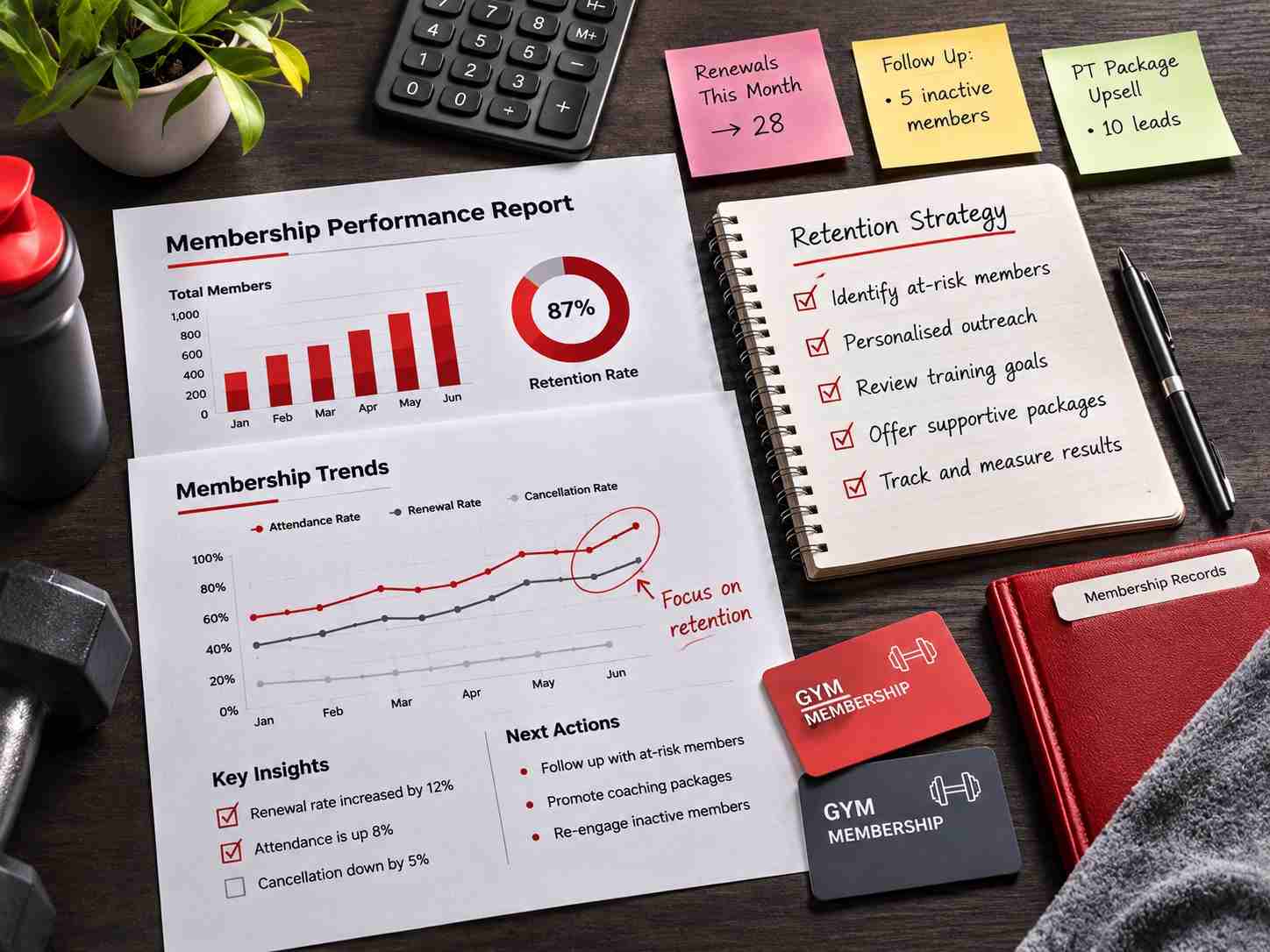
Five warning signs worth monitoring
| Member behaviour | Possible concern | Suggested response |
| Attendance decreases | Changing interest or scheduling difficulties | Arrange a personal check-in |
| Repeated missed sessions | Reduced commitment or availability | Follow up with the coach |
| No progress updates | Programme may need reviewing | Discuss fitness goals |
| Membership approaching expiry | Renewal uncertainty | Send a timely reminder |
| Reduced interaction | Lower engagement | Offer relevant support |
A practical retention management process
Gym owners can use a simple five-step process to make retention activities more organised.
| Step | Activity | What the business should do |
| 1. Record | Collect attendance, booking and membership information | Maintain updated member records |
| 2. Review | Examine changes in activity and engagement | Identify unusual patterns |
| 3. Prioritise | Determine which members may need attention | Assign follow-up responsibility |
| 4. Respond | Contact members and understand their concerns | Offer suitable coaching or scheduling support |
| 5. Evaluate | Review the outcome of the interaction | Improve future retention efforts |
The most important part is the follow-up conversation. Technology can highlight a possible issue, but understanding the member’s actual situation requires human interaction.
How Better Member Retention Creates More Revenue
Member retention and revenue growth are closely connected.
When customers continue using a fitness service, businesses have more opportunities to generate recurring membership income, introduce additional services and build long-term relationships.
1. Increase Membership Lifetime Value
A member who stays with a gym for a longer period may generate more revenue over their relationship with the business.
Consider a fitness centre charging S$100 per month.
| Membership duration | Revenue per member |
| 3 months | S$300 |
| 6 months | S$600 |
| 9 months | S$900 |
| 12 months | S$1,200 |
Illustrative calculation based on a fixed monthly membership fee, excluding additional purchases, operating costs and cancellations.
This example shows why maintaining good member relationships can be valuable over time. Even without increasing membership prices, a business can improve the revenue generated by retaining existing customers for longer.
2. Improve Renewals and Recurring Revenue
Membership renewals are an important part of financial planning for gyms and fitness studios.
When expiry dates are tracked properly, administrators can communicate with members before their current packages end.
Automated reminders, clear membership information and convenient renewal processes can reduce unnecessary administrative delays.
Businesses can also review renewal patterns to understand whether certain membership plans or customer groups require additional attention.
Explore how gym membership management software can help businesses organise membership records, payment tracking and expiry reminders.
3. Introduce Additional Fitness Services
Existing members may be interested in services that complement their current memberships.
These could include:
- Personal training sessions.
- Nutrition consultations.
- Premium coaching packages.
- Specialised fitness programmes.
- Workshops and group challenges.
For example, someone attending regular group classes may eventually want individual coaching to work towards a particular fitness goal.
Introducing relevant services can increase revenue per member while providing additional value. The key is to recommend services according to actual customer interests rather than relying on unnecessary sales messages.
4. Encourage Referrals Through Better Experiences
Members who feel supported and receive consistent service may be more willing to recommend a fitness business.
Quality coaching, convenient bookings, transparent membership information and helpful communication all contribute to the overall experience.
Referral programmes can further encourage satisfied members to introduce friends and family.
5. Improve Revenue Visibility Across Different Services
When business information is scattered across multiple applications, it becomes difficult to understand which services contribute most to revenue.
A connected reporting system can help owners review membership income, training packages, class participation and payment activity together.
This makes it easier to identify opportunities, review pricing decisions and plan future services.

One Operating System for Different Fitness Business Models
Not every fitness business follows the same operating model. A commercial gym, boutique studio and independent personal trainer have different scheduling, membership and coaching requirements.
The technology should accommodate these differences.
| Business model | Important management requirements |
| Commercial gyms | Memberships, attendance, payments and access management |
| Boutique fitness studios | Class reservations, capacity and instructor schedules |
| Personal trainers | Client profiles, workout plans and session credits |
| Yoga studios | Class schedules, workshops and reservations |
| Reformer Pilates studios | Equipment availability and class capacity |
| HIIT and group training | Group bookings, attendance and performance tracking |
For example, a Pilates studio may need to manage limited equipment availability alongside class reservations. An independent personal trainer, on the other hand, may prioritise client progress, individual schedules and session package renewals.
A flexible platform should support these different requirements while keeping important business information organised.
This becomes particularly useful when a fitness business expands its services, hires additional coaches or opens another location.
Choosing the Right AI Gym Management Software in Singapore
Before investing in new technology, gym owners should identify the operational problems they want to solve.
The most suitable software is not necessarily the one with the longest feature list. It is the one that supports the business’s daily requirements and can grow alongside it.
If your business has operational requirements that standard platforms cannot accommodate, consider whether custom gym management software development would be a suitable approach.
What should you evaluate?
| Evaluation area | Questions to consider |
| AI capabilities | Can the system identify useful engagement patterns? |
| Membership management | Can it track renewals and package balances? |
| Automation | Can it handle reminders and routine follow-ups? |
| Client experience | Does it provide convenient mobile access? |
| Coaching | Can trainers manage plans and progress records? |
| Integrations | Can it connect with existing business systems? |
| Scalability | Can it support additional branches and services? |
| Security | Are personal and payment records appropriately protected? |
Consider data protection requirements
Fitness businesses may collect personal profiles, contact details, fitness-related information and payment records.
Singapore businesses should understand their responsibilities under the Personal Data Protection Act (PDPA).
The Personal Data Protection Commission of Singapore provides guidance on important obligations, including consent, purpose limitation, protection, retention and accountability.
Payment processing also deserves attention. Businesses handling payment card information should understand the relevant requirements under the PCI Security Standards Council standards.
Before selecting a provider, ask how information is stored, who can access it, what security measures are implemented and how integrations handle customer data.
How UAutomate AI Helps Fitness Businesses Connect Operations and Growth
Fitness businesses need more than separate applications for bookings, payments, coaching and member communication. They need a connected digital environment that supports the complete member journey.
UAutomate AI offers technology solutions for fitness businesses, including branded mobile applications and connected management capabilities designed to support everyday operations.
Its fitness solution brings together several important areas.
1. Connected Client Onboarding and Profiling
Businesses can organise digital client profiles containing fitness goals, preferences and relevant information.
Having these details available in one place helps trainers understand client requirements and organise more suitable fitness experiences.
It also makes it easier to maintain updated records as members progress through their programmes.
2. Personalised Fitness and Nutrition Management
UAutomate AI highlights several fitness-related capabilities, including:
- Workout plans and daily schedules.
- Meal planning and nutrition tracking.
- AI-assisted meal guidance.
- Exercise guidance.
- Client progress monitoring.
These capabilities can help businesses organise coaching activities and give members a more structured digital experience.
Trainers can use relevant client information to review progress and make appropriate adjustments to fitness programmes.
3. Membership Management and Retention Support
Managing membership information accurately is essential for daily gym operations.
UAutomate AI’s fitness solution includes capabilities such as:
- Digital membership cards.
- Barcode-based access.
- Attendance records.
- Membership deduction history.
- Renewal management.
AI-assisted profile analysis and improvement tracking can also support businesses in reviewing client engagement and identifying areas where additional attention may be useful.
4. Better Coach-Client Communication
Maintaining regular communication between trainers and members can become difficult as a fitness business expands.
Connected coaching and communication capabilities help organise interactions between clients and their trainers.
Depending on the configured solution, this can include in-app communication, booking requests, rescheduling and session reminders.
Having these activities connected makes it easier for businesses to maintain a consistent coaching experience.
5. Branded iOS and Android Fitness Applications
One important offering is the ability to launch fitness applications under the business’s own brand.
Instead of relying entirely on generic third-party applications, gyms and studios can provide members with a dedicated digital experience.
The branded application can bring together relevant features such as:
- Member profiles and onboarding.
- Workout and meal plans.
- Class and session bookings.
- Membership information.
- Progress tracking.
- Coach-client communication.
This gives fitness businesses an opportunity to strengthen their digital identity while providing clients with convenient access to important services.
6. Integrations Across the Fitness Ecosystem
Fitness businesses often depend on several external systems to manage different activities.
UAutomate AI highlights integration capabilities across categories such as:
| Integration category | Examples |
| Health data | Apple Health, Google Fit and wearables |
| Communication | WhatsApp API, SMS and email |
| Finance | Xero and QuickBooks |
| Payments | Payment gateway integrations |
| Hardware | Smart gym equipment and access systems |
The availability and scope of individual integrations should be confirmed according to the business’s specific implementation requirements.
The overall objective is to connect client experiences, coaching workflows and business operations within a more organised environment.
Explore UAutomate AI’s fitness applications to understand how its solutions can support your fitness business.
Frequently Asked Questions
1. What is fitness business management software?
It is a digital platform that helps gyms, fitness studios and personal trainers manage memberships, bookings, attendance, payments, client profiles and coaching activities. Advanced platforms may also include AI-assisted analytics and workflow automation.
2. How does AI gym management software improve member retention?
It can analyse available attendance, booking and engagement information to identify changes in member behaviour. Businesses can use these insights to initiate timely follow-ups, provide coaching support and improve the overall member experience.
3. Can AI help gym owners increase membership revenue?
AI can support business decisions by highlighting membership trends, renewal opportunities and service engagement. However, actual revenue growth depends on pricing, customer experience, retention strategies and business execution.
4. What features should fitness business management software include?
Important capabilities include membership management, class scheduling, attendance tracking, payment management, client profiles, coach scheduling, progress monitoring, reporting and communication automation.
5. Is AI gym management software suitable for small fitness studios?
Yes. Small studios can use connected systems to reduce manual administration, manage bookings and maintain client records. The selected platform should match their current requirements, available resources and budget.
6. How can gyms automate membership renewals?
Gyms can use centralised membership records, expiry tracking and automated reminders to communicate with members before renewal dates. Payment integrations can further support recurring billing when appropriately configured.
7. Can personal trainers use AI-powered fitness management software?
Yes. Personal trainers can use these platforms to organise client profiles, workout plans, session schedules, nutrition records, progress tracking and communication. This can make it easier to manage multiple clients.
Build a Smarter Fitness Business with UAutomate AI
Managing a successful fitness business requires more than attracting new members. It involves maintaining consistent engagement, organising daily operations, supporting personalised coaching and providing a digital experience that encourages members to stay connected.
From identifying changes in attendance to managing membership renewals, AI-supported systems can help fitness operators make better use of their business information.
With fitness business management software, gyms and fitness studios can bring their client experience, coaching workflows and membership operations closer together.
UAutomate AI helps fitness businesses explore branded mobile applications, AI-powered capabilities and connected software solutions designed around their operational requirements.
Ready to improve member engagement and build a more organised fitness business?
Contact UAutomate AI to discuss your requirements and explore a connected fitness operating system for your gym or studio.